Haifeng Wang , Wencan Zhang , Yiming Ren , Jincheng Lu , Shen Liu , Liang Liu , Peng Zhang , Zhijian Wei , Dachuan Wang , Liang Chen
{"title":"Ultrasound-driven piezoelectric hydrogel enhances Schwann/neural stem cells Co-transplantation for spinal cord injury repair","authors":"Haifeng Wang , Wencan Zhang , Yiming Ren , Jincheng Lu , Shen Liu , Liang Liu , Peng Zhang , Zhijian Wei , Dachuan Wang , Liang Chen","doi":"10.1016/j.matdes.2025.113842","DOIUrl":null,"url":null,"abstract":"<div><div>Spinal cord injury (SCI) remains a formidable clinical challenge due to the central nervous system’s limited regenerative capacity and the hostile microenvironment characterized by impaired axonal regeneration. Emerging therapeutic strategies employing co-transplantation of neural stem cells (NSCs) and Schwann cells (SCs) have shown promise through dual mechanisms of cellular replacement and neurotrophic factor delivery. However, suboptimal cell survival, incomplete neuronal differentiation, and the lack of endogenous electrophysiological cues persistently undermine therapeutic outcomes. To address these limitations, we developed an innovative piezoelectric hydrogel-based platform integrating ultrasound-driven bioelectrical stimulation with three-dimensional cellular co-delivery. This system leverages the unique properties of piezoelectric hydrogels to generate localized electrical fields under non-invasive ultrasound actuation, while simultaneously serving as a biomimetic scaffold for NSCs/SCs co-culture. In vitro analyses revealed that the piezoelectric stimulation significantly enhanced neuronal differentiation efficiency and promoted robust remyelination. In murine models of complete spinal cord transection, the synergistic system demonstrated multifaceted therapeutic effects: 1) enhanced NSCs-derived neuron survival, 2) increased synaptic density, and 3) accelerated motor function recovery. These findings establish a paradigm-shifting approach that orchestrates biophysical (electrical) and biochemical (cellular) regulatory cues to reconstruct spinal cord circuitry, offering new insights into developing multimodal neuroregenerative therapies for SCI.</div></div>","PeriodicalId":383,"journal":{"name":"Materials & Design","volume":"253 ","pages":"Article 113842"},"PeriodicalIF":7.9000,"publicationDate":"2025-05-01","publicationTypes":"Journal Article","fieldsOfStudy":null,"isOpenAccess":false,"openAccessPdf":"","citationCount":"0","resultStr":null,"platform":"Semanticscholar","paperid":null,"PeriodicalName":"Materials & Design","FirstCategoryId":"88","ListUrlMain":"https://www.sciencedirect.com/science/article/pii/S026412752500262X","RegionNum":2,"RegionCategory":"材料科学","ArticlePicture":[],"TitleCN":null,"AbstractTextCN":null,"PMCID":null,"EPubDate":"2025/3/16 0:00:00","PubModel":"Epub","JCR":"Q1","JCRName":"MATERIALS SCIENCE, MULTIDISCIPLINARY","Score":null,"Total":0}
引用次数: 0
Abstract
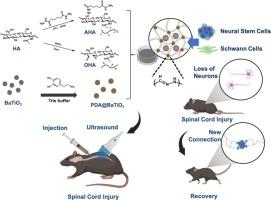
Spinal cord injury (SCI) remains a formidable clinical challenge due to the central nervous system’s limited regenerative capacity and the hostile microenvironment characterized by impaired axonal regeneration. Emerging therapeutic strategies employing co-transplantation of neural stem cells (NSCs) and Schwann cells (SCs) have shown promise through dual mechanisms of cellular replacement and neurotrophic factor delivery. However, suboptimal cell survival, incomplete neuronal differentiation, and the lack of endogenous electrophysiological cues persistently undermine therapeutic outcomes. To address these limitations, we developed an innovative piezoelectric hydrogel-based platform integrating ultrasound-driven bioelectrical stimulation with three-dimensional cellular co-delivery. This system leverages the unique properties of piezoelectric hydrogels to generate localized electrical fields under non-invasive ultrasound actuation, while simultaneously serving as a biomimetic scaffold for NSCs/SCs co-culture. In vitro analyses revealed that the piezoelectric stimulation significantly enhanced neuronal differentiation efficiency and promoted robust remyelination. In murine models of complete spinal cord transection, the synergistic system demonstrated multifaceted therapeutic effects: 1) enhanced NSCs-derived neuron survival, 2) increased synaptic density, and 3) accelerated motor function recovery. These findings establish a paradigm-shifting approach that orchestrates biophysical (electrical) and biochemical (cellular) regulatory cues to reconstruct spinal cord circuitry, offering new insights into developing multimodal neuroregenerative therapies for SCI.
期刊介绍:
Materials and Design is a multi-disciplinary journal that publishes original research reports, review articles, and express communications. The journal focuses on studying the structure and properties of inorganic and organic materials, advancements in synthesis, processing, characterization, and testing, the design of materials and engineering systems, and their applications in technology. It aims to bring together various aspects of materials science, engineering, physics, and chemistry.
The journal explores themes ranging from materials to design and aims to reveal the connections between natural and artificial materials, as well as experiment and modeling. Manuscripts submitted to Materials and Design should contain elements of discovery and surprise, as they often contribute new insights into the architecture and function of matter.



 京公网安备 11010802042870号
京ICP备2023020795号-1
京公网安备 11010802042870号
京ICP备2023020795号-1

 分享
分享
 求助内容:
求助内容: 应助结果提醒方式:
 扫码关注我们
