Prithwish Tarafder , Jinghao Xu , Anton Wiberg , Johan Moverare
{"title":"Assessing the effect of scan strategies on the structure-property relationship in electron beam powder bed fusion processed 316L stainless steel","authors":"Prithwish Tarafder , Jinghao Xu , Anton Wiberg , Johan Moverare","doi":"10.1016/j.matdes.2025.113837","DOIUrl":null,"url":null,"abstract":"<div><div>Different electron beam path patterns realized in eight varying scanning strategies were adopted in an electron beam powder bed fusion machine to understand the effect of scan patterns on the microstructure and mechanical properties of 316L austenitic stainless steel. Results showed that variation in localized microstructure is principally determined by the beam path length and the extent of melting-remelting cycles. Sporadic dislocation sub-structures were observed in scan strategies where thermal conditions were more turbulent than the reference raster scan, eventually leading to a different mechanical response despite their lower measured densities. Average yield strength and ultimate tensile strength surpassed the conventionally produced and subsequently annealed 316L; and were very close to the standards set forward for nuclear applications. This therefore opens up the possibility of using different scan strategies in an electron beam powder bed fusion system that can exploit the scan path design freedom and achieve localized microstructural and property differences. A proof-of-concept scaled-down version of an industrial component was fabricated with varying scan patterns at different areas and mechanically tested to showcase the feasibility of the presented approach.</div></div>","PeriodicalId":383,"journal":{"name":"Materials & Design","volume":"253 ","pages":"Article 113837"},"PeriodicalIF":7.9000,"publicationDate":"2025-05-01","publicationTypes":"Journal Article","fieldsOfStudy":null,"isOpenAccess":false,"openAccessPdf":"","citationCount":"0","resultStr":null,"platform":"Semanticscholar","paperid":null,"PeriodicalName":"Materials & Design","FirstCategoryId":"88","ListUrlMain":"https://www.sciencedirect.com/science/article/pii/S0264127525002576","RegionNum":2,"RegionCategory":"材料科学","ArticlePicture":[],"TitleCN":null,"AbstractTextCN":null,"PMCID":null,"EPubDate":"2025/3/15 0:00:00","PubModel":"Epub","JCR":"Q1","JCRName":"MATERIALS SCIENCE, MULTIDISCIPLINARY","Score":null,"Total":0}
引用次数: 0
Abstract
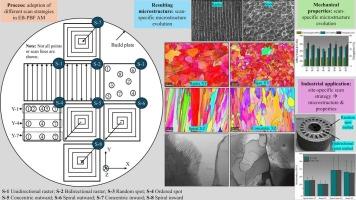
Different electron beam path patterns realized in eight varying scanning strategies were adopted in an electron beam powder bed fusion machine to understand the effect of scan patterns on the microstructure and mechanical properties of 316L austenitic stainless steel. Results showed that variation in localized microstructure is principally determined by the beam path length and the extent of melting-remelting cycles. Sporadic dislocation sub-structures were observed in scan strategies where thermal conditions were more turbulent than the reference raster scan, eventually leading to a different mechanical response despite their lower measured densities. Average yield strength and ultimate tensile strength surpassed the conventionally produced and subsequently annealed 316L; and were very close to the standards set forward for nuclear applications. This therefore opens up the possibility of using different scan strategies in an electron beam powder bed fusion system that can exploit the scan path design freedom and achieve localized microstructural and property differences. A proof-of-concept scaled-down version of an industrial component was fabricated with varying scan patterns at different areas and mechanically tested to showcase the feasibility of the presented approach.
期刊介绍:
Materials and Design is a multi-disciplinary journal that publishes original research reports, review articles, and express communications. The journal focuses on studying the structure and properties of inorganic and organic materials, advancements in synthesis, processing, characterization, and testing, the design of materials and engineering systems, and their applications in technology. It aims to bring together various aspects of materials science, engineering, physics, and chemistry.
The journal explores themes ranging from materials to design and aims to reveal the connections between natural and artificial materials, as well as experiment and modeling. Manuscripts submitted to Materials and Design should contain elements of discovery and surprise, as they often contribute new insights into the architecture and function of matter.



 京公网安备 11010802042870号
京ICP备2023020795号-1
京公网安备 11010802042870号
京ICP备2023020795号-1

 分享
分享
 求助内容:
求助内容: 应助结果提醒方式:
 扫码关注我们
