Yihu Zang , Jilin Xie , Yuhua Chen , Min Zheng , Xiaofang Liu , Jiajia Shen , J.P. Oliveira
{"title":"Resistance spot welded NiTi shape memory alloy to Ti6Al4V: Correlation between joint microstructure, cracking and mechanical properties","authors":"Yihu Zang , Jilin Xie , Yuhua Chen , Min Zheng , Xiaofang Liu , Jiajia Shen , J.P. Oliveira","doi":"10.1016/j.matdes.2025.113859","DOIUrl":null,"url":null,"abstract":"<div><div>Despite the popularity of joining NiTi and Ti6Al4V in aerospace and biomedical applications, effective solutions for their dissimilar joining are limited due to brittle intermetallic compounds. In this work, we successfully joined NiTi/Ti6Al4V using resistance spot welding. Results indicate that the number of cracks is the primary factor determining the lap-shear load. The extensive accumulation of brittle Ti<sub>2</sub>Ni at the bottom of the weld pool leads to stress concentration and is the main cause of crack initiation. X-ray diffraction and phase diagrams revealed the solidification sequence of liquid metal in the joint, including <span><math><mrow><mi>L</mi><mo>→</mo><mi>N</mi><mi>i</mi><mi>T</mi><mi>i</mi></mrow></math></span>, <span><math><mrow><mi>L</mi><mo>+</mo><mi>N</mi><mi>i</mi><mi>T</mi><mi>i</mi><mo>→</mo><msub><mrow><mi>Ti</mi></mrow><mn>2</mn></msub><mi>N</mi><mi>i</mi></mrow></math></span>, <span><math><mrow><mi>L</mi><mo>→</mo><mi>β</mi><mi>T</mi><mi>i</mi><mo>+</mo><msub><mrow><mi>Ti</mi></mrow><mn>2</mn></msub><mi>N</mi><mi>i</mi></mrow></math></span>. Electron backscatter diffraction analysis showed that weld nugget grains exhibited random orientation, with stress concentration mainly within the Ti<sub>2</sub>Ni phase on the Ti6Al4V side and at the boundary between the NiTi and Ti<sub>2</sub>Ni phases, contributing to high susceptibility to deformation and cracking in these regions. Nanoindentation analysis further demonstrated that the welding process diminished the superelastic performance of NiTi, attributable to Ti<sub>2</sub>Ni phase, grain coarsening and the orientation deviation of B2 NiTi.</div></div>","PeriodicalId":383,"journal":{"name":"Materials & Design","volume":"253 ","pages":"Article 113859"},"PeriodicalIF":7.9000,"publicationDate":"2025-05-01","publicationTypes":"Journal Article","fieldsOfStudy":null,"isOpenAccess":false,"openAccessPdf":"","citationCount":"0","resultStr":null,"platform":"Semanticscholar","paperid":null,"PeriodicalName":"Materials & Design","FirstCategoryId":"88","ListUrlMain":"https://www.sciencedirect.com/science/article/pii/S0264127525002795","RegionNum":2,"RegionCategory":"材料科学","ArticlePicture":[],"TitleCN":null,"AbstractTextCN":null,"PMCID":null,"EPubDate":"2025/3/21 0:00:00","PubModel":"Epub","JCR":"Q1","JCRName":"MATERIALS SCIENCE, MULTIDISCIPLINARY","Score":null,"Total":0}
引用次数: 0
Abstract
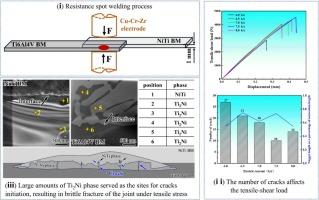
Despite the popularity of joining NiTi and Ti6Al4V in aerospace and biomedical applications, effective solutions for their dissimilar joining are limited due to brittle intermetallic compounds. In this work, we successfully joined NiTi/Ti6Al4V using resistance spot welding. Results indicate that the number of cracks is the primary factor determining the lap-shear load. The extensive accumulation of brittle Ti2Ni at the bottom of the weld pool leads to stress concentration and is the main cause of crack initiation. X-ray diffraction and phase diagrams revealed the solidification sequence of liquid metal in the joint, including , , . Electron backscatter diffraction analysis showed that weld nugget grains exhibited random orientation, with stress concentration mainly within the Ti2Ni phase on the Ti6Al4V side and at the boundary between the NiTi and Ti2Ni phases, contributing to high susceptibility to deformation and cracking in these regions. Nanoindentation analysis further demonstrated that the welding process diminished the superelastic performance of NiTi, attributable to Ti2Ni phase, grain coarsening and the orientation deviation of B2 NiTi.
期刊介绍:
Materials and Design is a multi-disciplinary journal that publishes original research reports, review articles, and express communications. The journal focuses on studying the structure and properties of inorganic and organic materials, advancements in synthesis, processing, characterization, and testing, the design of materials and engineering systems, and their applications in technology. It aims to bring together various aspects of materials science, engineering, physics, and chemistry.
The journal explores themes ranging from materials to design and aims to reveal the connections between natural and artificial materials, as well as experiment and modeling. Manuscripts submitted to Materials and Design should contain elements of discovery and surprise, as they often contribute new insights into the architecture and function of matter.




 京公网安备 11010802042870号
京ICP备2023020795号-1
京公网安备 11010802042870号
京ICP备2023020795号-1

 分享
分享
 求助内容:
求助内容: 应助结果提醒方式:
 扫码关注我们
