Qiaochu Zhou, Yiyang Wang, Zhe Zhang, Chi Zhang, Fang Li, Qiming Li
{"title":"Preparation and optimization of highly active Co3O4 catalyst for hydrogen generation from NaBH4 hydrolysis","authors":"Qiaochu Zhou, Yiyang Wang, Zhe Zhang, Chi Zhang, Fang Li, Qiming Li","doi":"10.1016/j.renene.2025.122943","DOIUrl":null,"url":null,"abstract":"<div><div>The oxidation state and phase structure of oxide catalysts play a crucial role in NaBH<sub>4</sub> hydrolysis. In this study, diverse Co<sub>3</sub>O<sub>4</sub> catalysts were synthesized via the EDTA-citric acid complexing method and employed for hydrogen production from NaBH<sub>4</sub> hydrolysis. The impacts of different calcination temperatures on crystalline structure, microstructure, and catalytic performance of Co<sub>3</sub>O<sub>4</sub> catalysts were examined systematically. It was observed that the calcination temperature cannot affect the crystal structure of Co<sub>3</sub>O<sub>4</sub> catalysts, but it significantly influences their crystallinity, induction period and catalytic performance. The bulk crystallization of Co<sub>3</sub>O<sub>4</sub> remained unaltered after reduction by NaBH<sub>4</sub>, while its surface layer would transform into an amorphous phase, forming a core-shell structure. Moreover, the ratio of Co<sup>2+</sup>/Co<sup>3+</sup> on the surface of the Co<sub>3</sub>O<sub>4</sub> catalyst is substantially enhanced and more oxygen defects can be obtained through an <em>in-situ</em> reduction. The experimental results demonstrated that all Co<sub>3</sub>O<sub>4</sub> catalysts exhibit an induction period before attaining a higher hydrogen generation rate. And the intrinsic catalytic activity of Co<sub>3</sub>O<sub>4</sub> catalysts initially increases and then declines with the ascending calcination temperature, whereas their cyclic stability monotonically increases with calcination temperature. The Co<sub>3</sub>O<sub>4</sub> catalyst achieves its highest catalytic activity at 1000 °C and the maximum cyclic stability at 1100 °C.</div></div>","PeriodicalId":419,"journal":{"name":"Renewable Energy","volume":"246 ","pages":"Article 122943"},"PeriodicalIF":9.1000,"publicationDate":"2025-03-20","publicationTypes":"Journal Article","fieldsOfStudy":null,"isOpenAccess":false,"openAccessPdf":"","citationCount":"0","resultStr":null,"platform":"Semanticscholar","paperid":null,"PeriodicalName":"Renewable Energy","FirstCategoryId":"5","ListUrlMain":"https://www.sciencedirect.com/science/article/pii/S0960148125006056","RegionNum":1,"RegionCategory":"工程技术","ArticlePicture":[],"TitleCN":null,"AbstractTextCN":null,"PMCID":null,"EPubDate":"","PubModel":"","JCR":"Q1","JCRName":"ENERGY & FUELS","Score":null,"Total":0}
引用次数: 0
Abstract
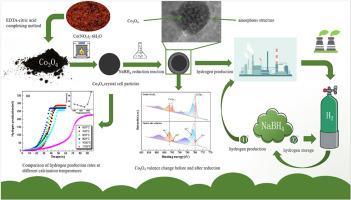
The oxidation state and phase structure of oxide catalysts play a crucial role in NaBH4 hydrolysis. In this study, diverse Co3O4 catalysts were synthesized via the EDTA-citric acid complexing method and employed for hydrogen production from NaBH4 hydrolysis. The impacts of different calcination temperatures on crystalline structure, microstructure, and catalytic performance of Co3O4 catalysts were examined systematically. It was observed that the calcination temperature cannot affect the crystal structure of Co3O4 catalysts, but it significantly influences their crystallinity, induction period and catalytic performance. The bulk crystallization of Co3O4 remained unaltered after reduction by NaBH4, while its surface layer would transform into an amorphous phase, forming a core-shell structure. Moreover, the ratio of Co2+/Co3+ on the surface of the Co3O4 catalyst is substantially enhanced and more oxygen defects can be obtained through an in-situ reduction. The experimental results demonstrated that all Co3O4 catalysts exhibit an induction period before attaining a higher hydrogen generation rate. And the intrinsic catalytic activity of Co3O4 catalysts initially increases and then declines with the ascending calcination temperature, whereas their cyclic stability monotonically increases with calcination temperature. The Co3O4 catalyst achieves its highest catalytic activity at 1000 °C and the maximum cyclic stability at 1100 °C.
期刊介绍:
Renewable Energy journal is dedicated to advancing knowledge and disseminating insights on various topics and technologies within renewable energy systems and components. Our mission is to support researchers, engineers, economists, manufacturers, NGOs, associations, and societies in staying updated on new developments in their respective fields and applying alternative energy solutions to current practices.
As an international, multidisciplinary journal in renewable energy engineering and research, we strive to be a premier peer-reviewed platform and a trusted source of original research and reviews in the field of renewable energy. Join us in our endeavor to drive innovation and progress in sustainable energy solutions.



 京公网安备 11010802042870号
京ICP备2023020795号-1
京公网安备 11010802042870号
京ICP备2023020795号-1

 分享
分享
 求助内容:
求助内容: 应助结果提醒方式:
 扫码关注我们
