Paulo Pereira , Miguel Inacio , Damia Barcelo , Wenwu Zhao
{"title":"Ecosystem services mapping and modelling. Where is the validation?","authors":"Paulo Pereira , Miguel Inacio , Damia Barcelo , Wenwu Zhao","doi":"10.1016/j.geosus.2025.100286","DOIUrl":null,"url":null,"abstract":"<div><div>Ecosystem services (ES) mapping and models have advanced in recent years. Improvements were made, and the assessments have transitioned from qualitative to quantitative. Although this is an important advancement, the ES mapping and modelling validation step has been overlooked, and this raises an important question in the credibility of the outcomes. This has been an important and unsolved issue in the ES research community that needs to be tackled. This highlight paper discusses the importance of validating single ES mapping and models. Conducting this using field or proximal/remote sensing raw data and not data from other models or stakeholder evaluation is important. A validation step should be mandatory in ES frameworks since it can assess the models’ veracity, contribute to identifying the model’s weaknesses/strengths and ultimately represent a scientific advance in the field. This is easier to apply to the biophysical mapping and models of regulating and provisioning ES than to cultural ES, as the latter rely more on perception and cultural contexts. Also, ES supply models are easier to validate than demand and flow models. Robust and well-grounded models are essential for ensuring the reliability of individual ES maps and models and should be integrated into decision-making processes. Although several challenges arise related to the costs of data collection, in several cases prohibitive, and the time and the expertise needed to conduct this sampling and analysis, this is likely an imperative step that needs to be considered in the future. This will be beneficial in establishing ES research and improving decision-making and wellbeing.</div></div>","PeriodicalId":52374,"journal":{"name":"Geography and Sustainability","volume":"6 3","pages":"Article 100286"},"PeriodicalIF":8.0000,"publicationDate":"2025-06-01","publicationTypes":"Journal Article","fieldsOfStudy":null,"isOpenAccess":false,"openAccessPdf":"","citationCount":"0","resultStr":null,"platform":"Semanticscholar","paperid":null,"PeriodicalName":"Geography and Sustainability","FirstCategoryId":"93","ListUrlMain":"https://www.sciencedirect.com/science/article/pii/S2666683925000252","RegionNum":1,"RegionCategory":"环境科学与生态学","ArticlePicture":[],"TitleCN":null,"AbstractTextCN":null,"PMCID":null,"EPubDate":"2025/3/13 0:00:00","PubModel":"Epub","JCR":"Q1","JCRName":"GEOGRAPHY, PHYSICAL","Score":null,"Total":0}
引用次数: 0
Abstract
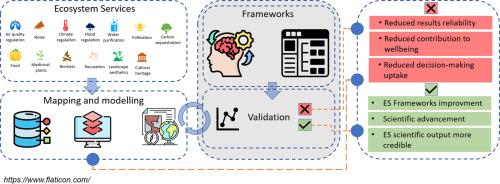
Ecosystem services (ES) mapping and models have advanced in recent years. Improvements were made, and the assessments have transitioned from qualitative to quantitative. Although this is an important advancement, the ES mapping and modelling validation step has been overlooked, and this raises an important question in the credibility of the outcomes. This has been an important and unsolved issue in the ES research community that needs to be tackled. This highlight paper discusses the importance of validating single ES mapping and models. Conducting this using field or proximal/remote sensing raw data and not data from other models or stakeholder evaluation is important. A validation step should be mandatory in ES frameworks since it can assess the models’ veracity, contribute to identifying the model’s weaknesses/strengths and ultimately represent a scientific advance in the field. This is easier to apply to the biophysical mapping and models of regulating and provisioning ES than to cultural ES, as the latter rely more on perception and cultural contexts. Also, ES supply models are easier to validate than demand and flow models. Robust and well-grounded models are essential for ensuring the reliability of individual ES maps and models and should be integrated into decision-making processes. Although several challenges arise related to the costs of data collection, in several cases prohibitive, and the time and the expertise needed to conduct this sampling and analysis, this is likely an imperative step that needs to be considered in the future. This will be beneficial in establishing ES research and improving decision-making and wellbeing.
期刊介绍:
Geography and Sustainability serves as a central hub for interdisciplinary research and education aimed at promoting sustainable development from an integrated geography perspective. By bridging natural and human sciences, the journal fosters broader analysis and innovative thinking on global and regional sustainability issues.
Geography and Sustainability welcomes original, high-quality research articles, review articles, short communications, technical comments, perspective articles and editorials on the following themes:
Geographical Processes: Interactions with and between water, soil, atmosphere and the biosphere and their spatio-temporal variations;
Human-Environmental Systems: Interactions between humans and the environment, resilience of socio-ecological systems and vulnerability;
Ecosystem Services and Human Wellbeing: Ecosystem structure, processes, services and their linkages with human wellbeing;
Sustainable Development: Theory, practice and critical challenges in sustainable development.



 京公网安备 11010802042870号
京ICP备2023020795号-1
京公网安备 11010802042870号
京ICP备2023020795号-1

 分享
分享
 求助内容:
求助内容: 应助结果提醒方式:
 扫码关注我们
