{"title":"Advanced biomarkers: Beyond amyloid and tau: Emerging non-traditional biomarkers for alzheimer`s diagnosis and progression","authors":"Meher Rijwana Afrin , Pankaj Ghritakousik Upadhyaya , Abdul Hashim , Kunal Bhattacharya , Nongmaithem Randhoni Chanu , Dibyajyoti Das , Pukar Khanal , Satyendra Deka","doi":"10.1016/j.arr.2025.102736","DOIUrl":null,"url":null,"abstract":"<div><div>Alzheimer’s disease (AD) is the most common neurodegenerative disorder that leads to progressive cognitive decline and imposes a significant socio-economic burden. Traditional diagnostic methods, primarily based on amyloid-beta (Aβ) and tau biomarkers, often identify the disease at late stages, highlighting the need for more sensitive and accessible early detection tools. This review explores emerging non-traditional biomarkers, including salivary, lipid, urinary, synaptic, blood-based, microRNA (miRNA), cerebrospinal fluid (CSF), fecal, and inflammatory markers, which provide deeper insights into AD pathophysiology. These biomarkers reflect key pathological processes such as neuroinflammation, mitochondrial dysfunction, oxidative stress, synaptic damage, lipid dysregulation, and genetic factors. Non-invasive biomarkers, such as those found in saliva and urine, present promising avenues for large-scale screening, while advanced blood-based markers like neurofilament light chain (NfL) and glial fibrillary acidic protein (GFAP) offer precise monitoring of neurodegeneration and inflammation. Additionally, miRNAs and lipid biomarkers shed light on molecular alterations in neuronal health and signaling. Integrating these biomarkers with imaging techniques, proteomics, and genetic profiling enhances diagnostic accuracy and enables personalized treatment approaches. This shift toward multi-dimensional biomarker assessment not only improves early detection but also aids in tailoring therapeutic strategies to individual disease profiles. By reviewing recent advancements, this article highlights the transformative potential of emerging biomarkers in overcoming the limitations of conventional diagnostics. Standardization and validation across diverse populations will be crucial in expanding their clinical applicability, ultimately improving disease management, reducing societal burden, and enhancing the quality of life for individuals affected by AD.</div></div>","PeriodicalId":55545,"journal":{"name":"Ageing Research Reviews","volume":"108 ","pages":"Article 102736"},"PeriodicalIF":12.4000,"publicationDate":"2025-03-22","publicationTypes":"Journal Article","fieldsOfStudy":null,"isOpenAccess":false,"openAccessPdf":"","citationCount":"0","resultStr":null,"platform":"Semanticscholar","paperid":null,"PeriodicalName":"Ageing Research Reviews","FirstCategoryId":"3","ListUrlMain":"https://www.sciencedirect.com/science/article/pii/S1568163725000820","RegionNum":1,"RegionCategory":"医学","ArticlePicture":[],"TitleCN":null,"AbstractTextCN":null,"PMCID":null,"EPubDate":"","PubModel":"","JCR":"Q1","JCRName":"CELL BIOLOGY","Score":null,"Total":0}
引用次数: 0
Abstract
Alzheimer’s disease (AD) is the most common neurodegenerative disorder that leads to progressive cognitive decline and imposes a significant socio-economic burden. Traditional diagnostic methods, primarily based on amyloid-beta (Aβ) and tau biomarkers, often identify the disease at late stages, highlighting the need for more sensitive and accessible early detection tools. This review explores emerging non-traditional biomarkers, including salivary, lipid, urinary, synaptic, blood-based, microRNA (miRNA), cerebrospinal fluid (CSF), fecal, and inflammatory markers, which provide deeper insights into AD pathophysiology. These biomarkers reflect key pathological processes such as neuroinflammation, mitochondrial dysfunction, oxidative stress, synaptic damage, lipid dysregulation, and genetic factors. Non-invasive biomarkers, such as those found in saliva and urine, present promising avenues for large-scale screening, while advanced blood-based markers like neurofilament light chain (NfL) and glial fibrillary acidic protein (GFAP) offer precise monitoring of neurodegeneration and inflammation. Additionally, miRNAs and lipid biomarkers shed light on molecular alterations in neuronal health and signaling. Integrating these biomarkers with imaging techniques, proteomics, and genetic profiling enhances diagnostic accuracy and enables personalized treatment approaches. This shift toward multi-dimensional biomarker assessment not only improves early detection but also aids in tailoring therapeutic strategies to individual disease profiles. By reviewing recent advancements, this article highlights the transformative potential of emerging biomarkers in overcoming the limitations of conventional diagnostics. Standardization and validation across diverse populations will be crucial in expanding their clinical applicability, ultimately improving disease management, reducing societal burden, and enhancing the quality of life for individuals affected by AD.
期刊介绍:
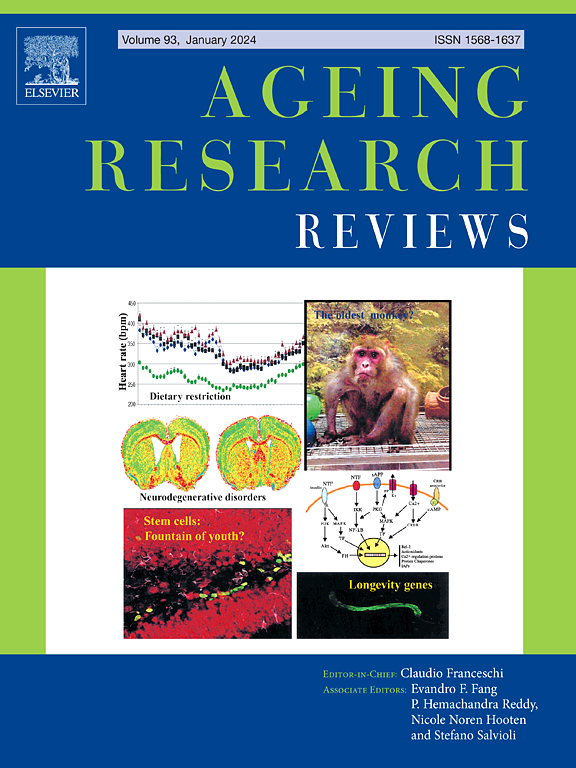
With the rise in average human life expectancy, the impact of ageing and age-related diseases on our society has become increasingly significant. Ageing research is now a focal point for numerous laboratories, encompassing leaders in genetics, molecular and cellular biology, biochemistry, and behavior. Ageing Research Reviews (ARR) serves as a cornerstone in this field, addressing emerging trends.
ARR aims to fill a substantial gap by providing critical reviews and viewpoints on evolving discoveries concerning the mechanisms of ageing and age-related diseases. The rapid progress in understanding the mechanisms controlling cellular proliferation, differentiation, and survival is unveiling new insights into the regulation of ageing. From telomerase to stem cells, and from energy to oxyradical metabolism, we are witnessing an exciting era in the multidisciplinary field of ageing research.
The journal explores the cellular and molecular foundations of interventions that extend lifespan, such as caloric restriction. It identifies the underpinnings of manipulations that extend lifespan, shedding light on novel approaches for preventing age-related diseases. ARR publishes articles on focused topics selected from the expansive field of ageing research, with a particular emphasis on the cellular and molecular mechanisms of the aging process. This includes age-related diseases like cancer, cardiovascular disease, diabetes, and neurodegenerative disorders. The journal also covers applications of basic ageing research to lifespan extension and disease prevention, offering a comprehensive platform for advancing our understanding of this critical field.



 京公网安备 11010802042870号
京ICP备2023020795号-1
京公网安备 11010802042870号
京ICP备2023020795号-1

 分享
分享
 求助内容:
求助内容: 应助结果提醒方式:
 扫码关注我们
