Sergio Davinelli , Alessandro Medoro , Frank B. Hu , Giovanni Scapagnini
{"title":"Dietary polyphenols as geroprotective compounds: From Blue Zones to hallmarks of ageing","authors":"Sergio Davinelli , Alessandro Medoro , Frank B. Hu , Giovanni Scapagnini","doi":"10.1016/j.arr.2025.102733","DOIUrl":null,"url":null,"abstract":"<div><div>Following the demographic shift towards an ageing population over the past century, particularly in developed countries, the concept of healthspan has gained increasing acceptance as a key framework for understanding the drivers of healthy ageing. Accordingly, long-lived individuals, such as nonagenarians and centenarians, who remain free from chronic diseases, provide a valuable model to investigate the complex interplay of biological, genetic, and environmental factors that contribute to exceptional longevity. Although there are other longevity hotspots worldwide, five regions, known as Blue Zones, are widely recognized for their exceptionally long-lived populations. Among the various determinants of healthy ageing, the eating patterns of long-lived individuals in Blue Zones include a variety of polyphenol-rich foods, which may contribute to their healthy phenotype. A significant body of evidence suggests that polyphenols, a large family of compounds ubiquitously found in plant-based foods, may exhibit geroprotective activity by influencing underlying biological mechanisms of ageing and promoting optimal longevity. While identifying several knowledge gaps that future investigations should address, the goal of this review is to provide an overview of how specific polyphenols found in foods commonly consumed by long-lived individuals residing in the Blue Zones may mitigate the risk of age-related diseases. Additionally, we discuss how these compounds, by acting on evolutionarily conserved mechanisms associated with ageing, have the potential to modulate the intricate network of the hallmarks of ageing.</div></div>","PeriodicalId":55545,"journal":{"name":"Ageing Research Reviews","volume":"108 ","pages":"Article 102733"},"PeriodicalIF":12.4000,"publicationDate":"2025-03-20","publicationTypes":"Journal Article","fieldsOfStudy":null,"isOpenAccess":false,"openAccessPdf":"","citationCount":"0","resultStr":null,"platform":"Semanticscholar","paperid":null,"PeriodicalName":"Ageing Research Reviews","FirstCategoryId":"3","ListUrlMain":"https://www.sciencedirect.com/science/article/pii/S1568163725000790","RegionNum":1,"RegionCategory":"医学","ArticlePicture":[],"TitleCN":null,"AbstractTextCN":null,"PMCID":null,"EPubDate":"","PubModel":"","JCR":"Q1","JCRName":"CELL BIOLOGY","Score":null,"Total":0}
引用次数: 0
Abstract
Following the demographic shift towards an ageing population over the past century, particularly in developed countries, the concept of healthspan has gained increasing acceptance as a key framework for understanding the drivers of healthy ageing. Accordingly, long-lived individuals, such as nonagenarians and centenarians, who remain free from chronic diseases, provide a valuable model to investigate the complex interplay of biological, genetic, and environmental factors that contribute to exceptional longevity. Although there are other longevity hotspots worldwide, five regions, known as Blue Zones, are widely recognized for their exceptionally long-lived populations. Among the various determinants of healthy ageing, the eating patterns of long-lived individuals in Blue Zones include a variety of polyphenol-rich foods, which may contribute to their healthy phenotype. A significant body of evidence suggests that polyphenols, a large family of compounds ubiquitously found in plant-based foods, may exhibit geroprotective activity by influencing underlying biological mechanisms of ageing and promoting optimal longevity. While identifying several knowledge gaps that future investigations should address, the goal of this review is to provide an overview of how specific polyphenols found in foods commonly consumed by long-lived individuals residing in the Blue Zones may mitigate the risk of age-related diseases. Additionally, we discuss how these compounds, by acting on evolutionarily conserved mechanisms associated with ageing, have the potential to modulate the intricate network of the hallmarks of ageing.
期刊介绍:
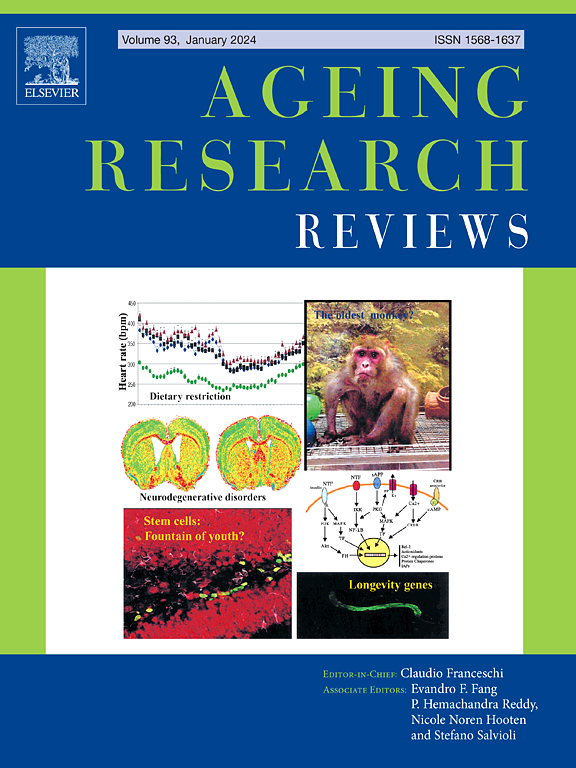
With the rise in average human life expectancy, the impact of ageing and age-related diseases on our society has become increasingly significant. Ageing research is now a focal point for numerous laboratories, encompassing leaders in genetics, molecular and cellular biology, biochemistry, and behavior. Ageing Research Reviews (ARR) serves as a cornerstone in this field, addressing emerging trends.
ARR aims to fill a substantial gap by providing critical reviews and viewpoints on evolving discoveries concerning the mechanisms of ageing and age-related diseases. The rapid progress in understanding the mechanisms controlling cellular proliferation, differentiation, and survival is unveiling new insights into the regulation of ageing. From telomerase to stem cells, and from energy to oxyradical metabolism, we are witnessing an exciting era in the multidisciplinary field of ageing research.
The journal explores the cellular and molecular foundations of interventions that extend lifespan, such as caloric restriction. It identifies the underpinnings of manipulations that extend lifespan, shedding light on novel approaches for preventing age-related diseases. ARR publishes articles on focused topics selected from the expansive field of ageing research, with a particular emphasis on the cellular and molecular mechanisms of the aging process. This includes age-related diseases like cancer, cardiovascular disease, diabetes, and neurodegenerative disorders. The journal also covers applications of basic ageing research to lifespan extension and disease prevention, offering a comprehensive platform for advancing our understanding of this critical field.



 京公网安备 11010802042870号
京ICP备2023020795号-1
京公网安备 11010802042870号
京ICP备2023020795号-1

 分享
分享
 求助内容:
求助内容: 应助结果提醒方式:
 扫码关注我们
