Lizbeth Tipán-Salazar, Natalia Naval, Jose M. Yusta
{"title":"An optimal dispatch model of renewable generation and pumped hydro energy storage for green hydrogen production","authors":"Lizbeth Tipán-Salazar, Natalia Naval, Jose M. Yusta","doi":"10.1016/j.renene.2025.122939","DOIUrl":null,"url":null,"abstract":"<div><div>The aim of the work is to propose an optimal dispatch model for a pumped hydro energy storage (PHES) system integrated with a photovoltaic plant, wind farm, and grid connection to meet weekly green hydrogen production demand through electrolysis while maximizing operating profit. A mixed-integer nonlinear programming (MINLP) model is formulated to optimize the technical and economic management of the proposed system. The model is applied to a project under development in Spain. The optimization model is solved using GAMS (General Algebraic Modeling System) software and the SCIP solver with a spatial branch-and-cut algorithm. The results from electricity market price scenarios for 2023 and 2030 show that the combined optimal operating model, RE-PHES-ELY, managed energy efficiently. Energy was imported at prices of up to 116 €/MWh when renewable energy was insufficient. Furthermore, exporting at prices of up to 151 €/MWh, maximizing profits during periods of high renewable generation. Pumping reached up to 454 MWh at 67 €/MWh, taking advantage of surplus renewable energy and low prices. Turbining reached up to 385 MWh at 173 €/MWh during periods of renewable shortages. Electrolyzers adjusted their demand to optimize production and profitability. In the 2030 scenario, the increased spread enhances the use of PHES by 117 %, thereby strengthening the economic viability of storage solutions.</div></div>","PeriodicalId":419,"journal":{"name":"Renewable Energy","volume":"246 ","pages":"Article 122939"},"PeriodicalIF":9.1000,"publicationDate":"2025-06-15","publicationTypes":"Journal Article","fieldsOfStudy":null,"isOpenAccess":false,"openAccessPdf":"","citationCount":"0","resultStr":null,"platform":"Semanticscholar","paperid":null,"PeriodicalName":"Renewable Energy","FirstCategoryId":"5","ListUrlMain":"https://www.sciencedirect.com/science/article/pii/S0960148125006019","RegionNum":1,"RegionCategory":"工程技术","ArticlePicture":[],"TitleCN":null,"AbstractTextCN":null,"PMCID":null,"EPubDate":"2025/3/20 0:00:00","PubModel":"Epub","JCR":"Q1","JCRName":"ENERGY & FUELS","Score":null,"Total":0}
引用次数: 0
Abstract
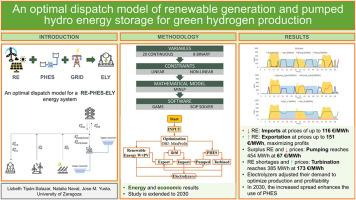
The aim of the work is to propose an optimal dispatch model for a pumped hydro energy storage (PHES) system integrated with a photovoltaic plant, wind farm, and grid connection to meet weekly green hydrogen production demand through electrolysis while maximizing operating profit. A mixed-integer nonlinear programming (MINLP) model is formulated to optimize the technical and economic management of the proposed system. The model is applied to a project under development in Spain. The optimization model is solved using GAMS (General Algebraic Modeling System) software and the SCIP solver with a spatial branch-and-cut algorithm. The results from electricity market price scenarios for 2023 and 2030 show that the combined optimal operating model, RE-PHES-ELY, managed energy efficiently. Energy was imported at prices of up to 116 €/MWh when renewable energy was insufficient. Furthermore, exporting at prices of up to 151 €/MWh, maximizing profits during periods of high renewable generation. Pumping reached up to 454 MWh at 67 €/MWh, taking advantage of surplus renewable energy and low prices. Turbining reached up to 385 MWh at 173 €/MWh during periods of renewable shortages. Electrolyzers adjusted their demand to optimize production and profitability. In the 2030 scenario, the increased spread enhances the use of PHES by 117 %, thereby strengthening the economic viability of storage solutions.
期刊介绍:
Renewable Energy journal is dedicated to advancing knowledge and disseminating insights on various topics and technologies within renewable energy systems and components. Our mission is to support researchers, engineers, economists, manufacturers, NGOs, associations, and societies in staying updated on new developments in their respective fields and applying alternative energy solutions to current practices.
As an international, multidisciplinary journal in renewable energy engineering and research, we strive to be a premier peer-reviewed platform and a trusted source of original research and reviews in the field of renewable energy. Join us in our endeavor to drive innovation and progress in sustainable energy solutions.



 京公网安备 11010802042870号
京ICP备2023020795号-1
京公网安备 11010802042870号
京ICP备2023020795号-1

 分享
分享
 求助内容:
求助内容: 应助结果提醒方式:
 扫码关注我们
