Zhaoming Liu , Yongzhi Fu , Shulin Gao , Haiyan Yang , Zhengjun Shi , Dawei Wang , Mizi Fan , Taohong Li , Jing Yang
{"title":"Effects of hydrogen bond acceptor with benzyl group in deep eutectic solvents on pretreatment performance of bamboo residue","authors":"Zhaoming Liu , Yongzhi Fu , Shulin Gao , Haiyan Yang , Zhengjun Shi , Dawei Wang , Mizi Fan , Taohong Li , Jing Yang","doi":"10.1016/j.renene.2025.122891","DOIUrl":null,"url":null,"abstract":"<div><div>Nine benzylammonium chloride-based deep eutectic solvents (DESs) were prepared and used to disrupt the natural recalcitrance of bamboo cell walls, to simultaneously produce fermentable sugars and lignin by-products. Under pretreatment conditions of 130 °C and 6 h, nearly 90 % of lignin was removed during the tributyl benzyl ammonium chloride/oxalic acid (TBBAC/OA) pretreatment of <em>Dendrocalamus giganteus Munro</em> bamboo (DG), accompanied by a satisfactory recovery of cellulose (∼84 %). The enzymatic digestibility of TBBAC/OA-DG released 83.72 % of fermentable sugars, which is about twice as high as tetrabutylammonium chloride/oxalic acid pretreated DG (TBAC/OA-DG) without benzyl groups as the hydrogen bond acceptor in the DES system. The structural characteristics of hydrogen bond acceptors (HBA) in DESs remarkably influenced the removal of lignin and xylan, which resulted in a loose structure after DES pretreatment, then increased the enzymatic accessibility of bamboo. Furthermore, the obtained regenerated lignin has a narrow molecular weight distribution and excellent solubility in organic solvents, which demonstrated potential industrial applications. These findings not only explain the relationship between HBA structure and bamboo fractionation, but also provide new insights for the selection and design of DES in biomass pretreatment.</div></div>","PeriodicalId":419,"journal":{"name":"Renewable Energy","volume":"246 ","pages":"Article 122891"},"PeriodicalIF":9.1000,"publicationDate":"2025-06-15","publicationTypes":"Journal Article","fieldsOfStudy":null,"isOpenAccess":false,"openAccessPdf":"","citationCount":"0","resultStr":null,"platform":"Semanticscholar","paperid":null,"PeriodicalName":"Renewable Energy","FirstCategoryId":"5","ListUrlMain":"https://www.sciencedirect.com/science/article/pii/S0960148125005531","RegionNum":1,"RegionCategory":"工程技术","ArticlePicture":[],"TitleCN":null,"AbstractTextCN":null,"PMCID":null,"EPubDate":"2025/3/20 0:00:00","PubModel":"Epub","JCR":"Q1","JCRName":"ENERGY & FUELS","Score":null,"Total":0}
引用次数: 0
Abstract
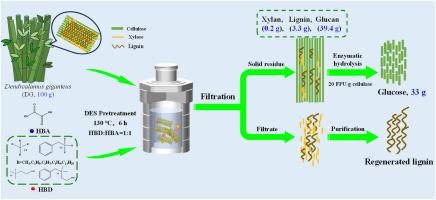
Nine benzylammonium chloride-based deep eutectic solvents (DESs) were prepared and used to disrupt the natural recalcitrance of bamboo cell walls, to simultaneously produce fermentable sugars and lignin by-products. Under pretreatment conditions of 130 °C and 6 h, nearly 90 % of lignin was removed during the tributyl benzyl ammonium chloride/oxalic acid (TBBAC/OA) pretreatment of Dendrocalamus giganteus Munro bamboo (DG), accompanied by a satisfactory recovery of cellulose (∼84 %). The enzymatic digestibility of TBBAC/OA-DG released 83.72 % of fermentable sugars, which is about twice as high as tetrabutylammonium chloride/oxalic acid pretreated DG (TBAC/OA-DG) without benzyl groups as the hydrogen bond acceptor in the DES system. The structural characteristics of hydrogen bond acceptors (HBA) in DESs remarkably influenced the removal of lignin and xylan, which resulted in a loose structure after DES pretreatment, then increased the enzymatic accessibility of bamboo. Furthermore, the obtained regenerated lignin has a narrow molecular weight distribution and excellent solubility in organic solvents, which demonstrated potential industrial applications. These findings not only explain the relationship between HBA structure and bamboo fractionation, but also provide new insights for the selection and design of DES in biomass pretreatment.
期刊介绍:
Renewable Energy journal is dedicated to advancing knowledge and disseminating insights on various topics and technologies within renewable energy systems and components. Our mission is to support researchers, engineers, economists, manufacturers, NGOs, associations, and societies in staying updated on new developments in their respective fields and applying alternative energy solutions to current practices.
As an international, multidisciplinary journal in renewable energy engineering and research, we strive to be a premier peer-reviewed platform and a trusted source of original research and reviews in the field of renewable energy. Join us in our endeavor to drive innovation and progress in sustainable energy solutions.



 京公网安备 11010802042870号
京ICP备2023020795号-1
京公网安备 11010802042870号
京ICP备2023020795号-1

 分享
分享
 求助内容:
求助内容: 应助结果提醒方式:
 扫码关注我们
