Samantha J. (Lindholm) Knight , John D. McCoy , Sanchari Chowdhury , Youngmin Lee
{"title":"Debonding-on-demand reversible adhesives via heat or light with competitive adhesion strength to conventional epoxy adhesives","authors":"Samantha J. (Lindholm) Knight , John D. McCoy , Sanchari Chowdhury , Youngmin Lee","doi":"10.1016/j.polymertesting.2025.108776","DOIUrl":null,"url":null,"abstract":"<div><div>Stimuli responsive debonding-on-demand (DoD) reversible adhesives are of great interest for the circular economy. However, the reversible adhesives developed so far often lack competitive adhesion strength in a bonding state. In this work, reversible epoxy adhesives based on Diels–Alder (DA) chemistry were developed and exhibited a competitive adhesion strength (e.g., 12–16 MPa of a lap shear strength) to commercial non-reversible epoxy adhesives. The reversible epoxy formulation showed superior thermal stability up to 110 °C, and transition to a debonding state in the order of 0.1 MPa at 140 °C, consequently, an on/off-type debonding behavior. The transition to a debonding state was attributed to crosslinking density control (e.g., decrease by 33 %–49 %) through the reversible DA chemistry and the proximity to the glass transition. Next, for debonding by light stimulus, photothermal refractory plasmonic titanium nitride (TiN) nanoparticles were incorporated in the reversible epoxy, which can generate the required heat for debonding upon exposure to visible light. Photothermal debonding allows for precise debonding at target areas and tunable adhesion strength by controlling the exposure area and light intensity. The DA adhesive formulations containing 0.5 wt% TiN nanoparticles presented a debonding state with zero adhesion under light exposure with intensity of 1670 mW/cm<sup>2</sup> (inducing 140 °C). Even after three cycles of reattachment, the DA adhesive formulations retained 96 % of the pristine sample's adhesion strength measured at 110 °C. Therefore, the DA adhesives are attractive candidates as reversible DoD systems applicable in higher temperatures.</div></div>","PeriodicalId":20628,"journal":{"name":"Polymer Testing","volume":"146 ","pages":"Article 108776"},"PeriodicalIF":6.0000,"publicationDate":"2025-05-01","publicationTypes":"Journal Article","fieldsOfStudy":null,"isOpenAccess":false,"openAccessPdf":"","citationCount":"0","resultStr":null,"platform":"Semanticscholar","paperid":null,"PeriodicalName":"Polymer Testing","FirstCategoryId":"88","ListUrlMain":"https://www.sciencedirect.com/science/article/pii/S014294182500090X","RegionNum":2,"RegionCategory":"材料科学","ArticlePicture":[],"TitleCN":null,"AbstractTextCN":null,"PMCID":null,"EPubDate":"2025/3/18 0:00:00","PubModel":"Epub","JCR":"Q1","JCRName":"MATERIALS SCIENCE, CHARACTERIZATION & TESTING","Score":null,"Total":0}
引用次数: 0
Abstract
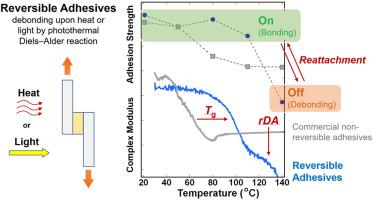
Stimuli responsive debonding-on-demand (DoD) reversible adhesives are of great interest for the circular economy. However, the reversible adhesives developed so far often lack competitive adhesion strength in a bonding state. In this work, reversible epoxy adhesives based on Diels–Alder (DA) chemistry were developed and exhibited a competitive adhesion strength (e.g., 12–16 MPa of a lap shear strength) to commercial non-reversible epoxy adhesives. The reversible epoxy formulation showed superior thermal stability up to 110 °C, and transition to a debonding state in the order of 0.1 MPa at 140 °C, consequently, an on/off-type debonding behavior. The transition to a debonding state was attributed to crosslinking density control (e.g., decrease by 33 %–49 %) through the reversible DA chemistry and the proximity to the glass transition. Next, for debonding by light stimulus, photothermal refractory plasmonic titanium nitride (TiN) nanoparticles were incorporated in the reversible epoxy, which can generate the required heat for debonding upon exposure to visible light. Photothermal debonding allows for precise debonding at target areas and tunable adhesion strength by controlling the exposure area and light intensity. The DA adhesive formulations containing 0.5 wt% TiN nanoparticles presented a debonding state with zero adhesion under light exposure with intensity of 1670 mW/cm2 (inducing 140 °C). Even after three cycles of reattachment, the DA adhesive formulations retained 96 % of the pristine sample's adhesion strength measured at 110 °C. Therefore, the DA adhesives are attractive candidates as reversible DoD systems applicable in higher temperatures.
期刊介绍:
Polymer Testing focuses on the testing, analysis and characterization of polymer materials, including both synthetic and natural or biobased polymers. Novel testing methods and the testing of novel polymeric materials in bulk, solution and dispersion is covered. In addition, we welcome the submission of the testing of polymeric materials for a wide range of applications and industrial products as well as nanoscale characterization.
The scope includes but is not limited to the following main topics:
Novel testing methods and Chemical analysis
• mechanical, thermal, electrical, chemical, imaging, spectroscopy, scattering and rheology
Physical properties and behaviour of novel polymer systems
• nanoscale properties, morphology, transport properties
Degradation and recycling of polymeric materials when combined with novel testing or characterization methods
• degradation, biodegradation, ageing and fire retardancy
Modelling and Simulation work will be only considered when it is linked to new or previously published experimental results.



 京公网安备 11010802042870号
京ICP备2023020795号-1
京公网安备 11010802042870号
京ICP备2023020795号-1

 分享
分享
 求助内容:
求助内容: 应助结果提醒方式:
 扫码关注我们
