{"title":"Measurement of the particle density of small amounts of pharmaceutical powders using high-contrast micro X-ray computed tomography","authors":"Tamaki Miyazaki , Yoshihiro Takeda , Daisuke Ando , Tatsuo Koide , Yoji Sato , Eiichi Yamamoto","doi":"10.1016/j.powtec.2025.120929","DOIUrl":null,"url":null,"abstract":"<div><div>Particle density is a fundamental and important physical property of powders. However, the widely used gas displacement pycnometry (GDP) method typically requires sample volumes in the gram range. In this study, we developed a method for evaluating the density of milligram-scale samples using X-ray computed tomography (XRCT). We used pharmaceutical powders, consisting of organic and light metallic elements, as subjects. The volumes of 24 pharmaceutical powders (2–160 mg) with various particle sizes and shapes were measured using an XRCT device with a resolution of 0.65–2.6 μm (field of view: 1.33–5.32 mm). Copper and molybdenum targets were used as X-ray sources, providing high-contrast imaging for materials with low electron densities. The densities obtained using XRCT correlated well with those obtained using GDP, as indicated by a linear regression line with a slope of 1.0 passing through the origin. The coefficient of variation for six sequential measurements was 0.0070, suggesting high repeatability. Additionally, we investigated optimal experimental conditions, such as spatial resolution, X-ray sources, and measurement time, to enhance the quality of three-dimensional XRCT images. We found that images with a grayscale histogram peak separation of approximately one between the sample and other components (sample tube and air) yielded optimal results. This non-destructive technique has the potential to accurately measure the densities of small sample quantities and can contribute not only to the pharmaceutical field but also to other industries handling organic and light metallic powders.</div></div>","PeriodicalId":407,"journal":{"name":"Powder Technology","volume":"457 ","pages":"Article 120929"},"PeriodicalIF":4.6000,"publicationDate":"2025-03-15","publicationTypes":"Journal Article","fieldsOfStudy":null,"isOpenAccess":false,"openAccessPdf":"","citationCount":"0","resultStr":null,"platform":"Semanticscholar","paperid":null,"PeriodicalName":"Powder Technology","FirstCategoryId":"5","ListUrlMain":"https://www.sciencedirect.com/science/article/pii/S0032591025003249","RegionNum":2,"RegionCategory":"工程技术","ArticlePicture":[],"TitleCN":null,"AbstractTextCN":null,"PMCID":null,"EPubDate":"","PubModel":"","JCR":"Q2","JCRName":"ENGINEERING, CHEMICAL","Score":null,"Total":0}
引用次数: 0
Abstract
Particle density is a fundamental and important physical property of powders. However, the widely used gas displacement pycnometry (GDP) method typically requires sample volumes in the gram range. In this study, we developed a method for evaluating the density of milligram-scale samples using X-ray computed tomography (XRCT). We used pharmaceutical powders, consisting of organic and light metallic elements, as subjects. The volumes of 24 pharmaceutical powders (2–160 mg) with various particle sizes and shapes were measured using an XRCT device with a resolution of 0.65–2.6 μm (field of view: 1.33–5.32 mm). Copper and molybdenum targets were used as X-ray sources, providing high-contrast imaging for materials with low electron densities. The densities obtained using XRCT correlated well with those obtained using GDP, as indicated by a linear regression line with a slope of 1.0 passing through the origin. The coefficient of variation for six sequential measurements was 0.0070, suggesting high repeatability. Additionally, we investigated optimal experimental conditions, such as spatial resolution, X-ray sources, and measurement time, to enhance the quality of three-dimensional XRCT images. We found that images with a grayscale histogram peak separation of approximately one between the sample and other components (sample tube and air) yielded optimal results. This non-destructive technique has the potential to accurately measure the densities of small sample quantities and can contribute not only to the pharmaceutical field but also to other industries handling organic and light metallic powders.
期刊介绍:
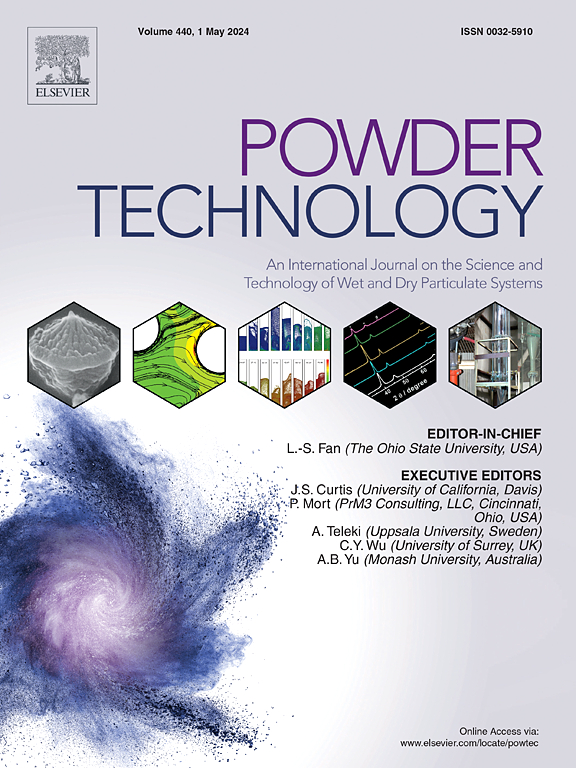
Powder Technology is an International Journal on the Science and Technology of Wet and Dry Particulate Systems. Powder Technology publishes papers on all aspects of the formation of particles and their characterisation and on the study of systems containing particulate solids. No limitation is imposed on the size of the particles, which may range from nanometre scale, as in pigments or aerosols, to that of mined or quarried materials. The following list of topics is not intended to be comprehensive, but rather to indicate typical subjects which fall within the scope of the journal's interests:
Formation and synthesis of particles by precipitation and other methods.
Modification of particles by agglomeration, coating, comminution and attrition.
Characterisation of the size, shape, surface area, pore structure and strength of particles and agglomerates (including the origins and effects of inter particle forces).
Packing, failure, flow and permeability of assemblies of particles.
Particle-particle interactions and suspension rheology.
Handling and processing operations such as slurry flow, fluidization, pneumatic conveying.
Interactions between particles and their environment, including delivery of particulate products to the body.
Applications of particle technology in production of pharmaceuticals, chemicals, foods, pigments, structural, and functional materials and in environmental and energy related matters.
For materials-oriented contributions we are looking for articles revealing the effect of particle/powder characteristics (size, morphology and composition, in that order) on material performance or functionality and, ideally, comparison to any industrial standard.




 京公网安备 11010802042870号
京ICP备2023020795号-1
京公网安备 11010802042870号
京ICP备2023020795号-1

 分享
分享
 求助内容:
求助内容: 应助结果提醒方式:
 扫码关注我们
