Zusakhe Nguqu, Olamide Abiodun Daramola, Francis Birhanu Dejene
{"title":"Effect of different cadmium sources on the optical and structural properties of CdTe quantum dots (QDs) co-stabilized with GSH-TGA","authors":"Zusakhe Nguqu, Olamide Abiodun Daramola, Francis Birhanu Dejene","doi":"10.1016/j.rechem.2025.102214","DOIUrl":null,"url":null,"abstract":"<div><div>CdTe quantum dots (QDs), also known as semiconductor nanoparticles, have unique optical properties demonstrated in many studies. Several studies have reported the variation of different reaction conditions in studying the optical and structural properties of the synthesized QDs. However, the effects of different Cadmium (Cd) precursor on their material properties have not been investigated. Here, we present a comprehensive study on the aqueous synthesis of CdTe QDs using two Cd sources, namely, Cadmium acetate and Cadmium nitrate. Various techniques were used to characterize the as-synthesized QDs, ensuring a thorough understanding of their properties. The photoluminescence studies showed the formation of high emission intensity for both precursors with Cd-acetate, demonstrating the best fluorescence properties at 15 mins, 30 mins, 1 h and 3 h reaction time. A slow growth process was observed for Cd-acetate precursor due to the disappearance of the emission band at 7 h reaction time. The X-ray diffraction (XRD) spectroscopy shows higher crystallinity of the QDs obtained for acetate precursor. The scanning electron microscope (SEM) depicted the formation of fine particles with Cd-nitrate precursor, while nearly spherical shapes were obtained with Cd-acetate precursor. The energy dispersive X-ray spectroscopy (EDX) shows a high amount of Cd and Te ions from both Cd precursor. Fourier transform infrared spectroscopy (FTIR) analysis revealed significant variation in the band intensities and vibration peak of CdTe QDs synthesized with Cd-acetate than Cd-nitrate. Smaller particle size was obtained from the UV–vis excitonic peaks of the QDs with a Cd-acetate precursor compared to Cd-nitrate.</div></div>","PeriodicalId":420,"journal":{"name":"Results in Chemistry","volume":"15 ","pages":"Article 102214"},"PeriodicalIF":4.2000,"publicationDate":"2025-03-21","publicationTypes":"Journal Article","fieldsOfStudy":null,"isOpenAccess":false,"openAccessPdf":"","citationCount":"0","resultStr":null,"platform":"Semanticscholar","paperid":null,"PeriodicalName":"Results in Chemistry","FirstCategoryId":"1085","ListUrlMain":"https://www.sciencedirect.com/science/article/pii/S2211715625001973","RegionNum":0,"RegionCategory":null,"ArticlePicture":[],"TitleCN":null,"AbstractTextCN":null,"PMCID":null,"EPubDate":"","PubModel":"","JCR":"Q2","JCRName":"CHEMISTRY, MULTIDISCIPLINARY","Score":null,"Total":0}
引用次数: 0
Abstract
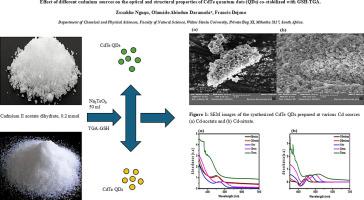
CdTe quantum dots (QDs), also known as semiconductor nanoparticles, have unique optical properties demonstrated in many studies. Several studies have reported the variation of different reaction conditions in studying the optical and structural properties of the synthesized QDs. However, the effects of different Cadmium (Cd) precursor on their material properties have not been investigated. Here, we present a comprehensive study on the aqueous synthesis of CdTe QDs using two Cd sources, namely, Cadmium acetate and Cadmium nitrate. Various techniques were used to characterize the as-synthesized QDs, ensuring a thorough understanding of their properties. The photoluminescence studies showed the formation of high emission intensity for both precursors with Cd-acetate, demonstrating the best fluorescence properties at 15 mins, 30 mins, 1 h and 3 h reaction time. A slow growth process was observed for Cd-acetate precursor due to the disappearance of the emission band at 7 h reaction time. The X-ray diffraction (XRD) spectroscopy shows higher crystallinity of the QDs obtained for acetate precursor. The scanning electron microscope (SEM) depicted the formation of fine particles with Cd-nitrate precursor, while nearly spherical shapes were obtained with Cd-acetate precursor. The energy dispersive X-ray spectroscopy (EDX) shows a high amount of Cd and Te ions from both Cd precursor. Fourier transform infrared spectroscopy (FTIR) analysis revealed significant variation in the band intensities and vibration peak of CdTe QDs synthesized with Cd-acetate than Cd-nitrate. Smaller particle size was obtained from the UV–vis excitonic peaks of the QDs with a Cd-acetate precursor compared to Cd-nitrate.




 京公网安备 11010802042870号
京ICP备2023020795号-1
京公网安备 11010802042870号
京ICP备2023020795号-1

 分享
分享
 求助内容:
求助内容: 应助结果提醒方式:
 扫码关注我们
