{"title":"Deep-learning-assisted near-infrared hyperspectral imaging for microplastic classification","authors":"Melisa Nyakuchena, Cory Juntunen, Yongjin Sung","doi":"10.1016/j.powtec.2025.120933","DOIUrl":null,"url":null,"abstract":"<div><div>Microplastics are small plastics with a size between a few microns and about 5 mm. Due to their small size, microplastics can be ingested by living organisms including humans, which has become a global concern and a heated area of research. To detect and characterize microplastics, various methods have been used, among which Fourier transform infrared (FTIR) spectroscopy and Raman spectroscopy offer nondestructive solutions. In this study, using deep-learning-assisted hyperspectral imaging (HSI) in the near-infrared (NIR) range of 1100–1650 nm, we demonstrate high-throughput, nondestructive classification of microplastics. Because NIR light is barely absorbed by most plastics and highly scattered by small particles, NIR-HSI has mostly been used for microplastics larger than 100 μm. Using deep learning in combination with Fourier transform spectroscopy, here we show NIR-HSI can classify microplastics in the 10–100 μm range with an accuracy over 99 % and at a speed much faster than FTIR or Raman spectroscopy. The demonstrated method offers a new solution for high-throughput detection and classification of microplastics.</div></div>","PeriodicalId":407,"journal":{"name":"Powder Technology","volume":"457 ","pages":"Article 120933"},"PeriodicalIF":4.6000,"publicationDate":"2025-05-15","publicationTypes":"Journal Article","fieldsOfStudy":null,"isOpenAccess":false,"openAccessPdf":"","citationCount":"0","resultStr":null,"platform":"Semanticscholar","paperid":null,"PeriodicalName":"Powder Technology","FirstCategoryId":"5","ListUrlMain":"https://www.sciencedirect.com/science/article/pii/S0032591025003286","RegionNum":2,"RegionCategory":"工程技术","ArticlePicture":[],"TitleCN":null,"AbstractTextCN":null,"PMCID":null,"EPubDate":"2025/3/15 0:00:00","PubModel":"Epub","JCR":"Q2","JCRName":"ENGINEERING, CHEMICAL","Score":null,"Total":0}
引用次数: 0
Abstract
Microplastics are small plastics with a size between a few microns and about 5 mm. Due to their small size, microplastics can be ingested by living organisms including humans, which has become a global concern and a heated area of research. To detect and characterize microplastics, various methods have been used, among which Fourier transform infrared (FTIR) spectroscopy and Raman spectroscopy offer nondestructive solutions. In this study, using deep-learning-assisted hyperspectral imaging (HSI) in the near-infrared (NIR) range of 1100–1650 nm, we demonstrate high-throughput, nondestructive classification of microplastics. Because NIR light is barely absorbed by most plastics and highly scattered by small particles, NIR-HSI has mostly been used for microplastics larger than 100 μm. Using deep learning in combination with Fourier transform spectroscopy, here we show NIR-HSI can classify microplastics in the 10–100 μm range with an accuracy over 99 % and at a speed much faster than FTIR or Raman spectroscopy. The demonstrated method offers a new solution for high-throughput detection and classification of microplastics.
期刊介绍:
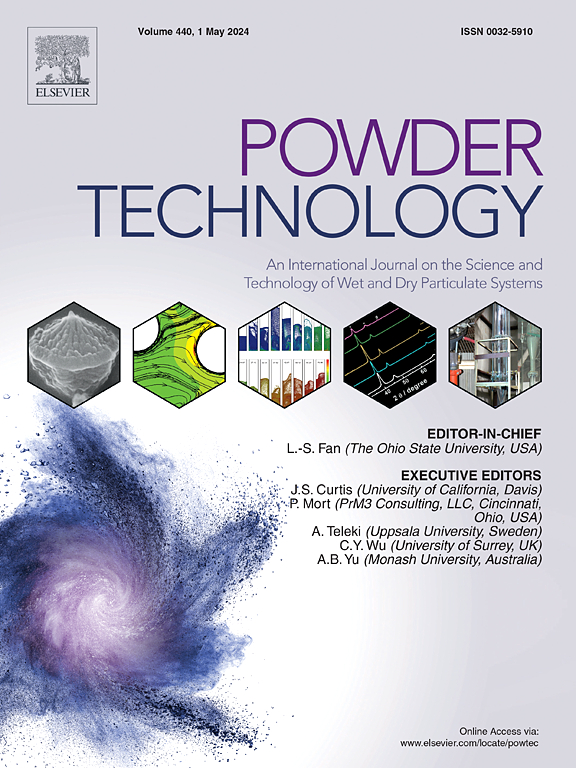
Powder Technology is an International Journal on the Science and Technology of Wet and Dry Particulate Systems. Powder Technology publishes papers on all aspects of the formation of particles and their characterisation and on the study of systems containing particulate solids. No limitation is imposed on the size of the particles, which may range from nanometre scale, as in pigments or aerosols, to that of mined or quarried materials. The following list of topics is not intended to be comprehensive, but rather to indicate typical subjects which fall within the scope of the journal's interests:
Formation and synthesis of particles by precipitation and other methods.
Modification of particles by agglomeration, coating, comminution and attrition.
Characterisation of the size, shape, surface area, pore structure and strength of particles and agglomerates (including the origins and effects of inter particle forces).
Packing, failure, flow and permeability of assemblies of particles.
Particle-particle interactions and suspension rheology.
Handling and processing operations such as slurry flow, fluidization, pneumatic conveying.
Interactions between particles and their environment, including delivery of particulate products to the body.
Applications of particle technology in production of pharmaceuticals, chemicals, foods, pigments, structural, and functional materials and in environmental and energy related matters.
For materials-oriented contributions we are looking for articles revealing the effect of particle/powder characteristics (size, morphology and composition, in that order) on material performance or functionality and, ideally, comparison to any industrial standard.




 京公网安备 11010802042870号
京ICP备2023020795号-1
京公网安备 11010802042870号
京ICP备2023020795号-1

 分享
分享
 求助内容:
求助内容: 应助结果提醒方式:
 扫码关注我们
