{"title":"Nanosilica cross-linked polyurethane hybrid hydrogels to stabilize the silicone rubber based invasive electrode-neural tissue interface","authors":"Haihan Zhou , Kuoying Qiao , Li Rao , Hua-Jin Zhai","doi":"10.1016/j.colsurfb.2025.114643","DOIUrl":null,"url":null,"abstract":"<div><div>An unstable electrode-neural tissue interface induced by tissue inflammatory response hinders the application of invasive brain-computer interfaces (BCIs). In this work, nanosilica cross-linked polyurethane (SiO<sub>2</sub>/PU) hybrid hydrogels were prepared to serve as the coatings and to modify silicone rubber (SR), which is a commonly used encapsulation material of invasive electrodes for neural recording/stimulation. The hydrophilicity, swelling ratio, and bulk ionic conductivity of SiO<sub>2</sub>/PU hybrid hydrogels were tailored by incorporating different amount of SiO<sub>2</sub> serving as the cross-linking agent. Correspondingly, the optimized SiO<sub>2</sub>/PU hybrid hydrogel coatings have less impact on the electrochemical properties of invasive electrodes relative to PU hydrogel. Cell affinity assays with rat pheochromocytoma cells reveal that coatings made of SiO<sub>2</sub>/PU hybrid hydrogels are more effective in enhancing their adhesion and neurite outgrowth than those made of PU hydrogels. The adsorption amount of non-specific proteins on SR is significantly reduced by 81.6 % and 92.6 % upon coating with PU hydrogels and SiO<sub>2</sub>/PU hybrid hydrogels, respectively. Histological assessment indicates that the SR implants with a SiO<sub>2</sub>/PU hybrid hydrogel coating provoke the mildest tissue response. Collectively, the SiO<sub>2</sub>/PU hybrid hydrogel is highly promising for the stabilization of electrode-neural tissue interface, which is crucial for the development of invasive BCIs.</div></div>","PeriodicalId":279,"journal":{"name":"Colloids and Surfaces B: Biointerfaces","volume":"251 ","pages":"Article 114643"},"PeriodicalIF":5.6000,"publicationDate":"2025-07-01","publicationTypes":"Journal Article","fieldsOfStudy":null,"isOpenAccess":false,"openAccessPdf":"","citationCount":"0","resultStr":null,"platform":"Semanticscholar","paperid":null,"PeriodicalName":"Colloids and Surfaces B: Biointerfaces","FirstCategoryId":"1","ListUrlMain":"https://www.sciencedirect.com/science/article/pii/S092777652500150X","RegionNum":2,"RegionCategory":"医学","ArticlePicture":[],"TitleCN":null,"AbstractTextCN":null,"PMCID":null,"EPubDate":"2025/3/19 0:00:00","PubModel":"Epub","JCR":"Q1","JCRName":"BIOPHYSICS","Score":null,"Total":0}
引用次数: 0
Abstract
An unstable electrode-neural tissue interface induced by tissue inflammatory response hinders the application of invasive brain-computer interfaces (BCIs). In this work, nanosilica cross-linked polyurethane (SiO2/PU) hybrid hydrogels were prepared to serve as the coatings and to modify silicone rubber (SR), which is a commonly used encapsulation material of invasive electrodes for neural recording/stimulation. The hydrophilicity, swelling ratio, and bulk ionic conductivity of SiO2/PU hybrid hydrogels were tailored by incorporating different amount of SiO2 serving as the cross-linking agent. Correspondingly, the optimized SiO2/PU hybrid hydrogel coatings have less impact on the electrochemical properties of invasive electrodes relative to PU hydrogel. Cell affinity assays with rat pheochromocytoma cells reveal that coatings made of SiO2/PU hybrid hydrogels are more effective in enhancing their adhesion and neurite outgrowth than those made of PU hydrogels. The adsorption amount of non-specific proteins on SR is significantly reduced by 81.6 % and 92.6 % upon coating with PU hydrogels and SiO2/PU hybrid hydrogels, respectively. Histological assessment indicates that the SR implants with a SiO2/PU hybrid hydrogel coating provoke the mildest tissue response. Collectively, the SiO2/PU hybrid hydrogel is highly promising for the stabilization of electrode-neural tissue interface, which is crucial for the development of invasive BCIs.
期刊介绍:
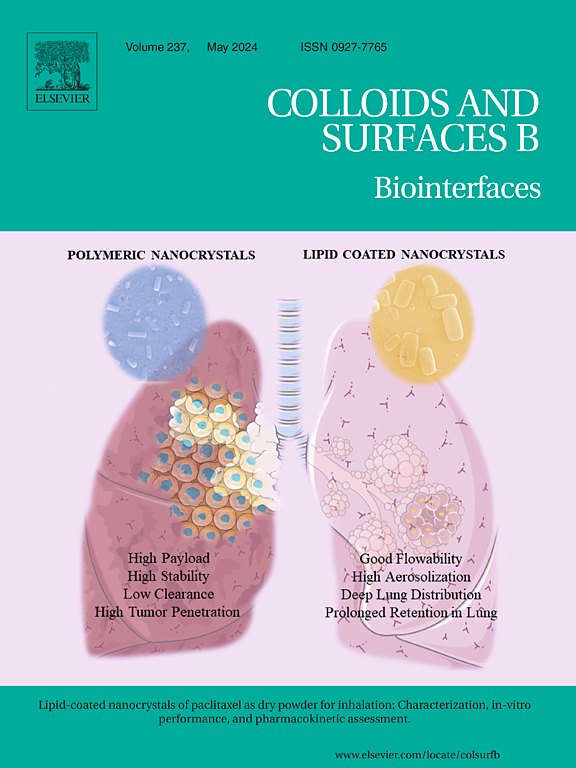
Colloids and Surfaces B: Biointerfaces is an international journal devoted to fundamental and applied research on colloid and interfacial phenomena in relation to systems of biological origin, having particular relevance to the medical, pharmaceutical, biotechnological, food and cosmetic fields.
Submissions that: (1) deal solely with biological phenomena and do not describe the physico-chemical or colloid-chemical background and/or mechanism of the phenomena, and (2) deal solely with colloid/interfacial phenomena and do not have appropriate biological content or relevance, are outside the scope of the journal and will not be considered for publication.
The journal publishes regular research papers, reviews, short communications and invited perspective articles, called BioInterface Perspectives. The BioInterface Perspective provide researchers the opportunity to review their own work, as well as provide insight into the work of others that inspired and influenced the author. Regular articles should have a maximum total length of 6,000 words. In addition, a (combined) maximum of 8 normal-sized figures and/or tables is allowed (so for instance 3 tables and 5 figures). For multiple-panel figures each set of two panels equates to one figure. Short communications should not exceed half of the above. It is required to give on the article cover page a short statistical summary of the article listing the total number of words and tables/figures.



 京公网安备 11010802042870号
京ICP备2023020795号-1
京公网安备 11010802042870号
京ICP备2023020795号-1

 分享
分享
 求助内容:
求助内容: 应助结果提醒方式:
 扫码关注我们
