Alfonso Carlos Barragán-Rosillo, Ricardo A. Chávez Montes, Luis Herrera-Estrella
{"title":"The role of DNA content in shaping chromatin architecture and gene expression","authors":"Alfonso Carlos Barragán-Rosillo, Ricardo A. Chávez Montes, Luis Herrera-Estrella","doi":"10.1111/tpj.70116","DOIUrl":null,"url":null,"abstract":"<p>Whole-genome duplication is an evolutionary force that drives speciation in all living kingdoms and is notably prevalent in plants. The evolutionary history of plants involved at least two genomic duplications that significantly expanded the plant morphology and physiology spectrum. Many important crops are polyploids, showing valuable features relative to morphological and stress response traits. After genome duplication, diploidization processes facilitate genomic adjustments to restore disomic inheritance. However, little is known about the chromatin changes triggered by nuclear DNA content alterations. Here, we report that synthetically induced genome duplication leads to chromatinization and significant changes in gene expression, resulting in a transcriptional landscape resembling a natural tetraploid. Interestingly, synthetic diploidization elicits only minor alterations in transcriptional activity and chromatin accessibility compared to the more pronounced effects of tetraploidization. We identified epigenetic factors, including specific histone variants, that showed increased expression following genome duplication and decreased expression after genome reduction. These changes may play a key role in the epigenetic mechanisms underlying the phenotypic complexity after tetraploidization in plants. Our findings shed light on the mechanisms that modulate chromatin accessibility remodeling and gene transcription regulation underlying plant genome adaptation in response to changes in genome size.</p>","PeriodicalId":233,"journal":{"name":"The Plant Journal","volume":"121 6","pages":""},"PeriodicalIF":5.7000,"publicationDate":"2025-03-24","publicationTypes":"Journal Article","fieldsOfStudy":null,"isOpenAccess":false,"openAccessPdf":"https://onlinelibrary.wiley.com/doi/epdf/10.1111/tpj.70116","citationCount":"0","resultStr":null,"platform":"Semanticscholar","paperid":null,"PeriodicalName":"The Plant Journal","FirstCategoryId":"2","ListUrlMain":"https://onlinelibrary.wiley.com/doi/10.1111/tpj.70116","RegionNum":1,"RegionCategory":"生物学","ArticlePicture":[],"TitleCN":null,"AbstractTextCN":null,"PMCID":null,"EPubDate":"","PubModel":"","JCR":"Q1","JCRName":"PLANT SCIENCES","Score":null,"Total":0}
引用次数: 0
Abstract
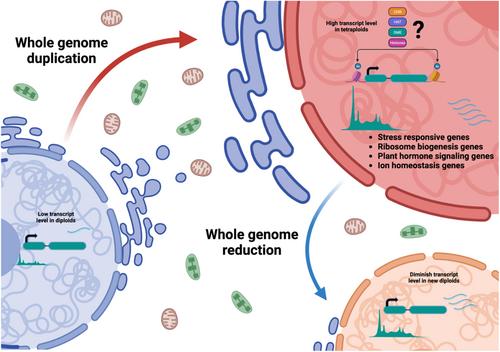
Whole-genome duplication is an evolutionary force that drives speciation in all living kingdoms and is notably prevalent in plants. The evolutionary history of plants involved at least two genomic duplications that significantly expanded the plant morphology and physiology spectrum. Many important crops are polyploids, showing valuable features relative to morphological and stress response traits. After genome duplication, diploidization processes facilitate genomic adjustments to restore disomic inheritance. However, little is known about the chromatin changes triggered by nuclear DNA content alterations. Here, we report that synthetically induced genome duplication leads to chromatinization and significant changes in gene expression, resulting in a transcriptional landscape resembling a natural tetraploid. Interestingly, synthetic diploidization elicits only minor alterations in transcriptional activity and chromatin accessibility compared to the more pronounced effects of tetraploidization. We identified epigenetic factors, including specific histone variants, that showed increased expression following genome duplication and decreased expression after genome reduction. These changes may play a key role in the epigenetic mechanisms underlying the phenotypic complexity after tetraploidization in plants. Our findings shed light on the mechanisms that modulate chromatin accessibility remodeling and gene transcription regulation underlying plant genome adaptation in response to changes in genome size.
期刊介绍:
Publishing the best original research papers in all key areas of modern plant biology from the world"s leading laboratories, The Plant Journal provides a dynamic forum for this ever growing international research community.
Plant science research is now at the forefront of research in the biological sciences, with breakthroughs in our understanding of fundamental processes in plants matching those in other organisms. The impact of molecular genetics and the availability of model and crop species can be seen in all aspects of plant biology. For publication in The Plant Journal the research must provide a highly significant new contribution to our understanding of plants and be of general interest to the plant science community.



 京公网安备 11010802042870号
京ICP备2023020795号-1
京公网安备 11010802042870号
京ICP备2023020795号-1

 分享
分享
 求助内容:
求助内容: 应助结果提醒方式:
 扫码关注我们
