{"title":"Sodium-Rich Fluorine-Doped Na<sub>3.475</sub>Fe<sub>2.4</sub>(PO<sub>4</sub>)<sub>1.4</sub>(P<sub>2</sub>O<sub>7</sub>)F<sub>0.075</sub> Cathode for High-Rate Performance in Sodium-Ion Batteries.","authors":"Haiyang Ding, Yao Jiang, Xinlu Li, Jiafeng He","doi":"10.1021/acsami.5c01638","DOIUrl":null,"url":null,"abstract":"<p><p>Pure-phase iron-based phosphate Na<sub>3.4</sub>Fe<sub>2.4</sub>(PO<sub>4</sub>)<sub>1.4</sub>P<sub>2</sub>O<sub>7</sub> (NFPP) is anticipated to emerge as a competitive candidate material for sodium-ion batteries (SIBs). Nevertheless, the low electronic conductivity and sluggish sodium ion diffusion kinetics during sodium storage present significant challenges to its electrochemical performance. Consequently, a sodium-rich fluorine-doping strategy has been proposed, and we elucidate the mechanism through which F doping influences the crystal structure and electronic conductivity of NFPP. Both experimental and theoretical calculations demonstrate that F doping expands the diffusion channels for Na<sup>+</sup>, reduces the band gap and Na<sup>+</sup> migration energy barrier, and enhances the intrinsic electronic conductivity of NFPP. Owing to the enhanced charge transport capability, the electrochemical performance of Na<sub>3.475</sub>Fe<sub>2.4</sub>(PO<sub>4</sub>)<sub>1.4</sub>(P<sub>2</sub>O<sub>7</sub>)F<sub>0.075</sub> (NFPPF-0.075) significantly surpasses that of the undoped sample. NFPPF-0.075 demonstrates a discharge specific capacity of 113.7 mAh g<sup>-1</sup> at 0.1 C; even at a current density of 30 C, the discharge specific capacity is sustained at 84.1 mAh g<sup>-1</sup>. NFPPF-0.075 also exhibits remarkable cycle stability, achieving a capacity retention of 88.7% over 2000 cycles at 10 C. Furthermore, the NFPPF-0.075||HC full cell demonstrates remarkable rate performance and cycle performance. Therefore, Na<sub>3.475</sub>Fe<sub>2.4</sub>(PO<sub>4</sub>)<sub>1.4</sub>(P<sub>2</sub>O<sub>7</sub>)F<sub>0.075</sub> has the potential to serve as a highly promising cathode material for large-scale applications in SIBs.</p>","PeriodicalId":5,"journal":{"name":"ACS Applied Materials & Interfaces","volume":" ","pages":"19772-19782"},"PeriodicalIF":8.2000,"publicationDate":"2025-04-02","publicationTypes":"Journal Article","fieldsOfStudy":null,"isOpenAccess":false,"openAccessPdf":"","citationCount":"0","resultStr":null,"platform":"Semanticscholar","paperid":null,"PeriodicalName":"ACS Applied Materials & Interfaces","FirstCategoryId":"88","ListUrlMain":"https://doi.org/10.1021/acsami.5c01638","RegionNum":2,"RegionCategory":"材料科学","ArticlePicture":[],"TitleCN":null,"AbstractTextCN":null,"PMCID":null,"EPubDate":"2025/3/24 0:00:00","PubModel":"Epub","JCR":"Q1","JCRName":"MATERIALS SCIENCE, MULTIDISCIPLINARY","Score":null,"Total":0}
引用次数: 0
Abstract
Pure-phase iron-based phosphate Na3.4Fe2.4(PO4)1.4P2O7 (NFPP) is anticipated to emerge as a competitive candidate material for sodium-ion batteries (SIBs). Nevertheless, the low electronic conductivity and sluggish sodium ion diffusion kinetics during sodium storage present significant challenges to its electrochemical performance. Consequently, a sodium-rich fluorine-doping strategy has been proposed, and we elucidate the mechanism through which F doping influences the crystal structure and electronic conductivity of NFPP. Both experimental and theoretical calculations demonstrate that F doping expands the diffusion channels for Na+, reduces the band gap and Na+ migration energy barrier, and enhances the intrinsic electronic conductivity of NFPP. Owing to the enhanced charge transport capability, the electrochemical performance of Na3.475Fe2.4(PO4)1.4(P2O7)F0.075 (NFPPF-0.075) significantly surpasses that of the undoped sample. NFPPF-0.075 demonstrates a discharge specific capacity of 113.7 mAh g-1 at 0.1 C; even at a current density of 30 C, the discharge specific capacity is sustained at 84.1 mAh g-1. NFPPF-0.075 also exhibits remarkable cycle stability, achieving a capacity retention of 88.7% over 2000 cycles at 10 C. Furthermore, the NFPPF-0.075||HC full cell demonstrates remarkable rate performance and cycle performance. Therefore, Na3.475Fe2.4(PO4)1.4(P2O7)F0.075 has the potential to serve as a highly promising cathode material for large-scale applications in SIBs.
纯相铁基磷酸盐Na3.4Fe2.4(PO4)1.4P2O7 (NFPP)有望成为钠离子电池(sib)的候选材料。然而,在钠储存过程中,低的电子导电性和缓慢的钠离子扩散动力学对其电化学性能提出了重大挑战。因此,我们提出了一种富钠氟掺杂策略,并阐明了氟掺杂影响NFPP晶体结构和电子导电性的机理。实验和理论计算均表明,F掺杂扩展了Na+的扩散通道,减小了带隙和Na+迁移能垒,提高了NFPP的本征电子导电性。由于电荷输运能力的增强,Na3.475Fe2.4(PO4)1.4(P2O7)F0.075 (NFPPF-0.075)的电化学性能显著优于未掺杂样品。在0.1℃下,NFPPF-0.075的放电比容量为113.7 mAh g-1;即使在30℃的电流密度下,放电比容量也保持在84.1 mAh g-1。NFPPF-0.075还表现出了出色的循环稳定性,在10℃下,在2000次循环中,容量保持率达到88.7%。此外,NFPPF-0.075||HC全电池也表现出了出色的倍率性能和循环性能。因此,Na3.475Fe2.4(PO4)1.4(P2O7)F0.075极有潜力成为sib中大规模应用的极具前景的正极材料。
期刊介绍:
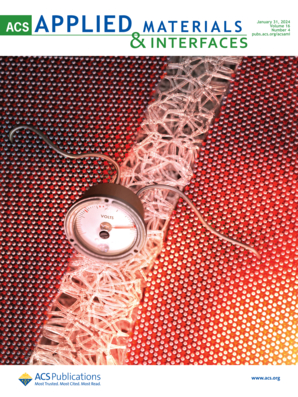
ACS Applied Materials & Interfaces is a leading interdisciplinary journal that brings together chemists, engineers, physicists, and biologists to explore the development and utilization of newly-discovered materials and interfacial processes for specific applications. Our journal has experienced remarkable growth since its establishment in 2009, both in terms of the number of articles published and the impact of the research showcased. We are proud to foster a truly global community, with the majority of published articles originating from outside the United States, reflecting the rapid growth of applied research worldwide.



 京公网安备 11010802042870号
京ICP备2023020795号-1
京公网安备 11010802042870号
京ICP备2023020795号-1

 分享
分享
 求助内容:
求助内容: 应助结果提醒方式:
 扫码关注我们
