Qingying Yu, Huan Li, Mengxue Chen, Yanan Pan, Liuchang Zhou, Lin An, Jinlan Zhao, Shasha Bai, Qi Liang, Rong Zhang and Di Deng
{"title":"GPR120 internalization: a key mechanism for EPA in antidepressant action†","authors":"Qingying Yu, Huan Li, Mengxue Chen, Yanan Pan, Liuchang Zhou, Lin An, Jinlan Zhao, Shasha Bai, Qi Liang, Rong Zhang and Di Deng","doi":"10.1039/D5FO00252D","DOIUrl":null,"url":null,"abstract":"<p >The incidence of depression is on the rise, and currently available antidepressants often exhibit limited efficacy in many patients. Additionally, the underlying mechanisms of depression remain poorly understood. Research has shown that neuroinflammation, driven by M1 microglial phenotypic polarization, contributes to neuronal abnormalities implicated in the development of depression. Eicosapentaenoic acid (EPA) has emerged as a promising therapeutic agent for depression. However, the specific target of EPA's anti-stress effects is yet to be identified. This study aimed to explore the pathogenesis of depression and elucidate the central regulatory mechanisms underlying EPA's antidepressant efficacy. In this study, mice were orally administered EPA for five consecutive weeks. During this period, they were subjected to daily chronic unpredictable mild stress (CUMS) and treated with lipopolysaccharide (LPS, 0.5 mg kg<small><sup>−1</sup></small>, intraperitoneally) every other week. The results demonstrated that EPA significantly alleviated neuronal degeneration in the medial prefrontal cortex. Furthermore, EPA improved synaptic plasticity impairments induced by CUMS combined with LPSs, as indicated by the increased protein levels of Nlgn1, PSD95, GAP43, and Syn. EPA also reduced neuroinflammation by inhibiting M1 microglial polarization and NLRP3 inflammasome activation. Notably, EPA exerted antidepressant-like effects by modulating GPR120. These findings suggest that EPA intake can mitigate abnormal mood and behavior induced by elevated immune-inflammatory signals. These findings suggest that EPA intake can attenuate abnormal moods and behaviors induced by elevated immune-inflammatory signals. Therefore, EPA may be a promising strategy for the clinical treatment of inflammatory depression.</p>","PeriodicalId":77,"journal":{"name":"Food & Function","volume":" 7","pages":" 2893-2908"},"PeriodicalIF":5.4000,"publicationDate":"2025-03-24","publicationTypes":"Journal Article","fieldsOfStudy":null,"isOpenAccess":false,"openAccessPdf":"","citationCount":"0","resultStr":null,"platform":"Semanticscholar","paperid":null,"PeriodicalName":"Food & Function","FirstCategoryId":"97","ListUrlMain":"https://pubs.rsc.org/en/content/articlelanding/2025/fo/d5fo00252d","RegionNum":1,"RegionCategory":"农林科学","ArticlePicture":[],"TitleCN":null,"AbstractTextCN":null,"PMCID":null,"EPubDate":"","PubModel":"","JCR":"Q1","JCRName":"BIOCHEMISTRY & MOLECULAR BIOLOGY","Score":null,"Total":0}
引用次数: 0
Abstract
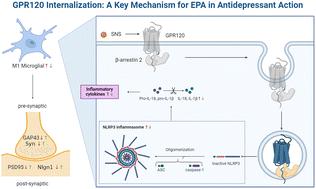
The incidence of depression is on the rise, and currently available antidepressants often exhibit limited efficacy in many patients. Additionally, the underlying mechanisms of depression remain poorly understood. Research has shown that neuroinflammation, driven by M1 microglial phenotypic polarization, contributes to neuronal abnormalities implicated in the development of depression. Eicosapentaenoic acid (EPA) has emerged as a promising therapeutic agent for depression. However, the specific target of EPA's anti-stress effects is yet to be identified. This study aimed to explore the pathogenesis of depression and elucidate the central regulatory mechanisms underlying EPA's antidepressant efficacy. In this study, mice were orally administered EPA for five consecutive weeks. During this period, they were subjected to daily chronic unpredictable mild stress (CUMS) and treated with lipopolysaccharide (LPS, 0.5 mg kg−1, intraperitoneally) every other week. The results demonstrated that EPA significantly alleviated neuronal degeneration in the medial prefrontal cortex. Furthermore, EPA improved synaptic plasticity impairments induced by CUMS combined with LPSs, as indicated by the increased protein levels of Nlgn1, PSD95, GAP43, and Syn. EPA also reduced neuroinflammation by inhibiting M1 microglial polarization and NLRP3 inflammasome activation. Notably, EPA exerted antidepressant-like effects by modulating GPR120. These findings suggest that EPA intake can mitigate abnormal mood and behavior induced by elevated immune-inflammatory signals. These findings suggest that EPA intake can attenuate abnormal moods and behaviors induced by elevated immune-inflammatory signals. Therefore, EPA may be a promising strategy for the clinical treatment of inflammatory depression.
期刊介绍:
Food & Function provides a unique venue for physicists, chemists, biochemists, nutritionists and other food scientists to publish work at the interface of the chemistry, physics and biology of food. The journal focuses on food and the functions of food in relation to health.



 京公网安备 11010802042870号
京ICP备2023020795号-1
京公网安备 11010802042870号
京ICP备2023020795号-1

 分享
分享
 求助内容:
求助内容: 应助结果提醒方式:
 扫码关注我们
