Qiue Zhang, Tong Su, Yajing Pan, Xiaomeng Wang, Chengfei Zhang, Huizhao Qin, Mingxiu Li, Qingsong Li, Xiaochen Li, Jiangfan Guo, Lili Wu, Lingling Qin and Tonghua Liu
{"title":"Malus hupehensis leaves: a functional beverage for alleviating hepatic inflammation and modulating gut microbiota in diabetic mice†","authors":"Qiue Zhang, Tong Su, Yajing Pan, Xiaomeng Wang, Chengfei Zhang, Huizhao Qin, Mingxiu Li, Qingsong Li, Xiaochen Li, Jiangfan Guo, Lili Wu, Lingling Qin and Tonghua Liu","doi":"10.1039/D4FO05325G","DOIUrl":null,"url":null,"abstract":"<p >\r\n <em>Malus hupehensis</em> leaves (MHL), consumed as a daily beverage in Chinese folk tradition and recently recognized as a new food material, are abundant in polyphenols and bioactive compounds that demonstrate hypoglycemic, lipid-lowering, and anti-inflammatory effects. However, the antidiabetic mechanisms have not been fully elucidated. This study aimed to investigate the protective mechanisms of <em>Malus hupehensis</em> leaves’ extract (MHLE) against type 2 diabetes mellitus (T2DM). The results showed that MHLE effectively ameliorated glucose and lipid metabolic abnormalities in db/db mice, and attenuated hepatic macrophage activation. Transcriptomic analysis of the liver revealed that MHLE primarily affects genes involved in inflammatory responses and inhibited the TLR4/MAPK pathway to reduce hepatic inflammation. Metagenomic sequencing identified changes in gut microbiota composition and showed that MHLE restored the abundance of <em>Lachnospiraceae bacterium</em>, <em>Oscillospiraceae bacterium</em>, and <em>Clostridia bacterium</em> while reducing the abundance of <em>Escherichia coli</em>, thereby ameliorating gut dysbiosis. The integrated regulation of metabolism, immune response, and the microbial environment by MHLE significantly alleviated symptoms of T2DM. This study offers strong scientific evidence for the potential use of MHL as a functional food.</p>","PeriodicalId":77,"journal":{"name":"Food & Function","volume":" 8","pages":" 2972-2990"},"PeriodicalIF":5.4000,"publicationDate":"2025-03-24","publicationTypes":"Journal Article","fieldsOfStudy":null,"isOpenAccess":false,"openAccessPdf":"https://pubs.rsc.org/en/content/articlepdf/2025/fo/d4fo05325g?page=search","citationCount":"0","resultStr":null,"platform":"Semanticscholar","paperid":null,"PeriodicalName":"Food & Function","FirstCategoryId":"97","ListUrlMain":"https://pubs.rsc.org/en/content/articlelanding/2025/fo/d4fo05325g","RegionNum":1,"RegionCategory":"农林科学","ArticlePicture":[],"TitleCN":null,"AbstractTextCN":null,"PMCID":null,"EPubDate":"","PubModel":"","JCR":"Q1","JCRName":"BIOCHEMISTRY & MOLECULAR BIOLOGY","Score":null,"Total":0}
引用次数: 0
Abstract
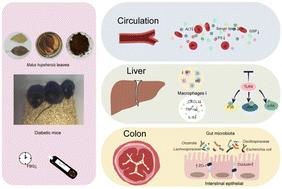
Malus hupehensis leaves (MHL), consumed as a daily beverage in Chinese folk tradition and recently recognized as a new food material, are abundant in polyphenols and bioactive compounds that demonstrate hypoglycemic, lipid-lowering, and anti-inflammatory effects. However, the antidiabetic mechanisms have not been fully elucidated. This study aimed to investigate the protective mechanisms of Malus hupehensis leaves’ extract (MHLE) against type 2 diabetes mellitus (T2DM). The results showed that MHLE effectively ameliorated glucose and lipid metabolic abnormalities in db/db mice, and attenuated hepatic macrophage activation. Transcriptomic analysis of the liver revealed that MHLE primarily affects genes involved in inflammatory responses and inhibited the TLR4/MAPK pathway to reduce hepatic inflammation. Metagenomic sequencing identified changes in gut microbiota composition and showed that MHLE restored the abundance of Lachnospiraceae bacterium, Oscillospiraceae bacterium, and Clostridia bacterium while reducing the abundance of Escherichia coli, thereby ameliorating gut dysbiosis. The integrated regulation of metabolism, immune response, and the microbial environment by MHLE significantly alleviated symptoms of T2DM. This study offers strong scientific evidence for the potential use of MHL as a functional food.
期刊介绍:
Food & Function provides a unique venue for physicists, chemists, biochemists, nutritionists and other food scientists to publish work at the interface of the chemistry, physics and biology of food. The journal focuses on food and the functions of food in relation to health.



 京公网安备 11010802042870号
京ICP备2023020795号-1
京公网安备 11010802042870号
京ICP备2023020795号-1

 分享
分享
 求助内容:
求助内容: 应助结果提醒方式:
 扫码关注我们
