Mudan Zhang, Yan Yu, Baofei Sun, Chaolun Xiao, Jingxi Yang, Zijiang Yu, Dan Yang
{"title":"Investigating Clinical-Relevant Learning in the Anatomy Curriculum: Perspectives and Effectiveness for Undergraduate Medical Students.","authors":"Mudan Zhang, Yan Yu, Baofei Sun, Chaolun Xiao, Jingxi Yang, Zijiang Yu, Dan Yang","doi":"10.1177/23821205251328952","DOIUrl":null,"url":null,"abstract":"<p><strong>Background: </strong>Traditional anatomical education often lacks clinical application. This study aimed to investigate the feasibility of clinical-relevant education in the anatomy curriculum.</p><p><strong>Methods: </strong>A total of 109 4th-year and 5th-year undergraduate medical students, including 8 international students, completed the questionnaire. The questionnaire comprised 20 questions divided into 5 sections, resulting in 109 responses collected for all questions. Students enrolled in the 5-year program at Guizhou Medical University in 2019 (<i>n</i> = 27) and 2020 (<i>n</i> = 30) were included in the clinical-relevant education evaluation in the anatomy curriculum.</p><p><strong>Results: </strong>The questionnaire return rate was 100%. Approximately 40.4% of undergraduate medical students expressed neutrality or dissatisfaction with the traditional anatomy teaching methods. Most students felt that the methodology overly emphasized theory while neglecting clinical experience. Over half had not taken advantage of clinical opportunities offered by the university, and only 58.7% felt adequately prepared with anatomical knowledge for clinical work. Forty-four percent had not systematically reviewed the dissection laboratory after starting clinical practice. However, the majority strongly supported the need for clinical experiential education, with abdominal surgical observation being the most preferred type. In the \"Human Anatomy\" course, average daily scores for students enrolled in 2019 and 2020 were 89.6 ± 1.4 and 90.9 ± 2.3 (<i>P </i>< .05), respectively. For \"Regional Anatomy\" averages were 88.8 ± 3.6 and 91.5 ± 0.7 (<i>P </i>< .001). The final scores for \"Human Anatomy\" were 67.7 ± 10.6 and 81.0 ± 7.6 (<i>P </i>< .0001), while \"Regional Anatomy\" scores were 92.4 ± 3.9 and 96.3 ± 3.0 (<i>P </i>< .0001).</p><p><strong>Conclusions: </strong>This study highlights students' dissatisfaction with their anatomical knowledge and the traditional anatomical education. Our reform demonstrates the positive impact of the clinical-relevant learning anatomy curriculum we are currently implementing.</p>","PeriodicalId":45121,"journal":{"name":"Journal of Medical Education and Curricular Development","volume":"12 ","pages":"23821205251328952"},"PeriodicalIF":1.6000,"publicationDate":"2025-03-20","publicationTypes":"Journal Article","fieldsOfStudy":null,"isOpenAccess":false,"openAccessPdf":"https://www.ncbi.nlm.nih.gov/pmc/articles/PMC11926839/pdf/","citationCount":"0","resultStr":null,"platform":"Semanticscholar","paperid":null,"PeriodicalName":"Journal of Medical Education and Curricular Development","FirstCategoryId":"1085","ListUrlMain":"https://doi.org/10.1177/23821205251328952","RegionNum":0,"RegionCategory":null,"ArticlePicture":[],"TitleCN":null,"AbstractTextCN":null,"PMCID":null,"EPubDate":"2025/1/1 0:00:00","PubModel":"eCollection","JCR":"Q2","JCRName":"EDUCATION, SCIENTIFIC DISCIPLINES","Score":null,"Total":0}
引用次数: 0
Abstract
Background: Traditional anatomical education often lacks clinical application. This study aimed to investigate the feasibility of clinical-relevant education in the anatomy curriculum.
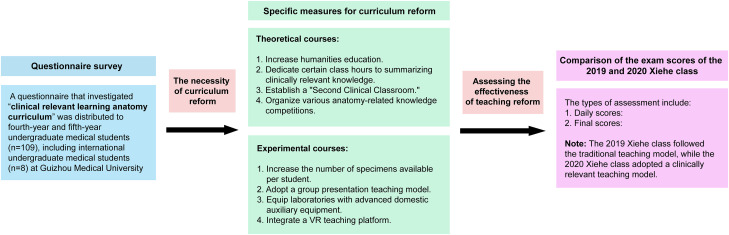
Methods: A total of 109 4th-year and 5th-year undergraduate medical students, including 8 international students, completed the questionnaire. The questionnaire comprised 20 questions divided into 5 sections, resulting in 109 responses collected for all questions. Students enrolled in the 5-year program at Guizhou Medical University in 2019 (n = 27) and 2020 (n = 30) were included in the clinical-relevant education evaluation in the anatomy curriculum.
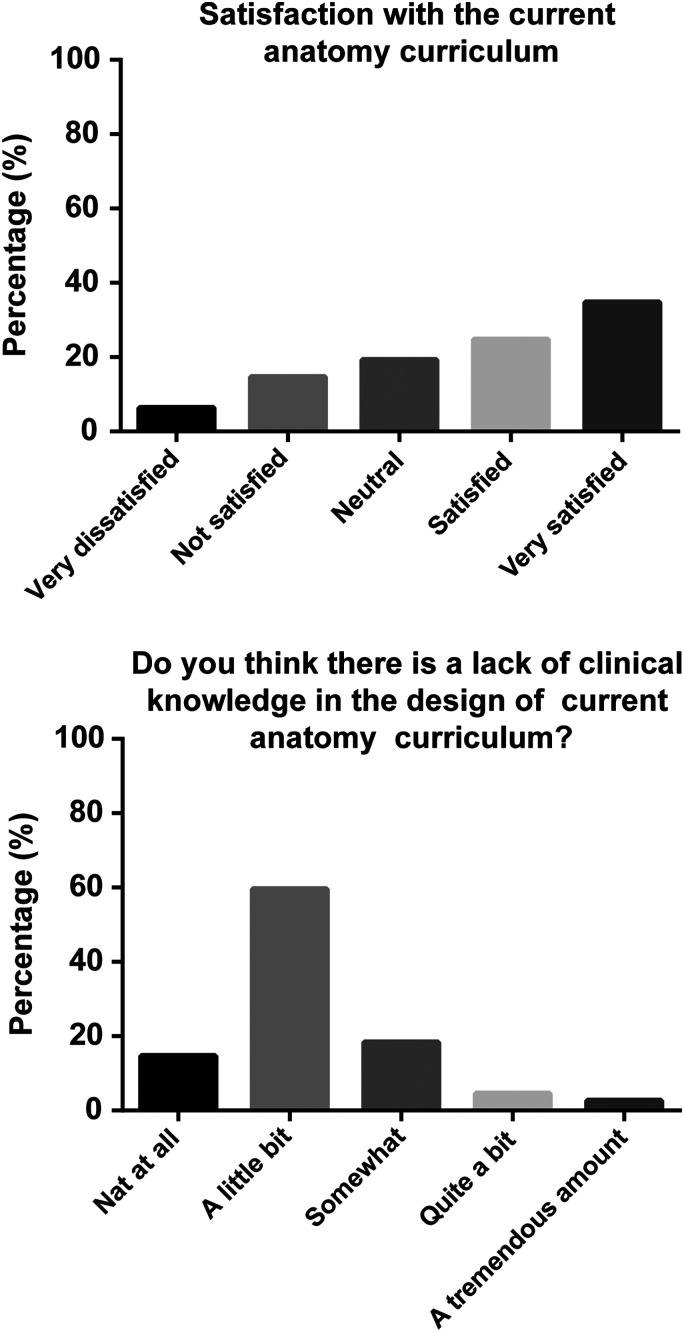
Results: The questionnaire return rate was 100%. Approximately 40.4% of undergraduate medical students expressed neutrality or dissatisfaction with the traditional anatomy teaching methods. Most students felt that the methodology overly emphasized theory while neglecting clinical experience. Over half had not taken advantage of clinical opportunities offered by the university, and only 58.7% felt adequately prepared with anatomical knowledge for clinical work. Forty-four percent had not systematically reviewed the dissection laboratory after starting clinical practice. However, the majority strongly supported the need for clinical experiential education, with abdominal surgical observation being the most preferred type. In the "Human Anatomy" course, average daily scores for students enrolled in 2019 and 2020 were 89.6 ± 1.4 and 90.9 ± 2.3 (P < .05), respectively. For "Regional Anatomy" averages were 88.8 ± 3.6 and 91.5 ± 0.7 (P < .001). The final scores for "Human Anatomy" were 67.7 ± 10.6 and 81.0 ± 7.6 (P < .0001), while "Regional Anatomy" scores were 92.4 ± 3.9 and 96.3 ± 3.0 (P < .0001).
Conclusions: This study highlights students' dissatisfaction with their anatomical knowledge and the traditional anatomical education. Our reform demonstrates the positive impact of the clinical-relevant learning anatomy curriculum we are currently implementing.
背景:传统的解剖学教育往往缺乏临床应用。本研究旨在探讨解剖学课程中临床相关教育的可行性。方法:对109名医学本科四、五年级学生进行问卷调查,其中包括8名留学生。问卷共有20个问题,分为5个部分,所有问题共收集到109个回答。将2019年(27名)和2020年(30名)贵州医科大学五年制学生纳入解剖学课程临床相关教育评价。结果:问卷回收率为100%。约40.4%的本科医学生对传统的解剖学教学方法表示中立或不满意。大多数学生认为该方法过于强调理论而忽视临床经验。超过一半的人没有利用大学提供的临床机会,只有58.7%的人认为有足够的解剖学知识为临床工作做好准备。44%的人在开始临床实践后没有系统地审查解剖实验室。然而,大多数人强烈支持临床经验教育的必要性,腹部手术观察是最受欢迎的类型。在“人体解剖学”课程中,2019级和2020级学生的平均日成绩分别为89.6±1.4和90.9±2.3 (P P P P P)。结论:本研究突出了学生对解剖学知识和传统解剖学教育的不满。我们的改革证明了我们目前正在实施的临床相关学习解剖学课程的积极影响。




 京公网安备 11010802042870号
京ICP备2023020795号-1
京公网安备 11010802042870号
京ICP备2023020795号-1

 分享
分享
 求助内容:
求助内容: 应助结果提醒方式:
 扫码关注我们
