Victor Rodriguez-Lopez, Benjamin M Chin, Johannes Burge
{"title":"Decreases in overall light level increase the severity of the reverse Pulfrich effect.","authors":"Victor Rodriguez-Lopez, Benjamin M Chin, Johannes Burge","doi":"10.1167/jov.25.3.7","DOIUrl":null,"url":null,"abstract":"<p><p>The Pulfrich effect is an illusion characterized by the misperception of the depth and 3D direction of moving objects. Interocular luminance differences cause the classic Pulfrich effect; the darker image is processed more slowly. Interocular blur differences cause the reverse Pulfrich effect; the blurrier image is processed more quickly. A common correction for presbyopia-monovision-intentionally induces the optical conditions that cause the reverse Pulfrich effect. The effect sizes, and the fact that tens of millions of people wear these corrections every day, raise concerns about public safety. However, although the impact of overall light level (e.g., nighttime vs. daytime) on the classic Pulfrich effect has been well characterized, its impact on the reverse Pulfrich effect is unknown. Here, using a custom binocular 4f tunable lens optical system that allows the decoupling of retinal illuminance and retinal blur, we report how the classic and reverse Pulfrich effects scale with overall light level. Both effects increase logarithmically with decreases in light level. These results motivate a characterization of how light level interacts with other optical factors (e.g., higher-order aberrations) that are likely to impact the reverse Pulfrich effect and, hence, the perceptual consequences of monovision corrections.</p>","PeriodicalId":49955,"journal":{"name":"Journal of Vision","volume":"25 3","pages":"7"},"PeriodicalIF":2.3000,"publicationDate":"2025-03-03","publicationTypes":"Journal Article","fieldsOfStudy":null,"isOpenAccess":false,"openAccessPdf":"https://www.ncbi.nlm.nih.gov/pmc/articles/PMC11951055/pdf/","citationCount":"0","resultStr":null,"platform":"Semanticscholar","paperid":null,"PeriodicalName":"Journal of Vision","FirstCategoryId":"3","ListUrlMain":"https://doi.org/10.1167/jov.25.3.7","RegionNum":4,"RegionCategory":"心理学","ArticlePicture":[],"TitleCN":null,"AbstractTextCN":null,"PMCID":null,"EPubDate":"","PubModel":"","JCR":"Q2","JCRName":"OPHTHALMOLOGY","Score":null,"Total":0}
引用次数: 0
Abstract
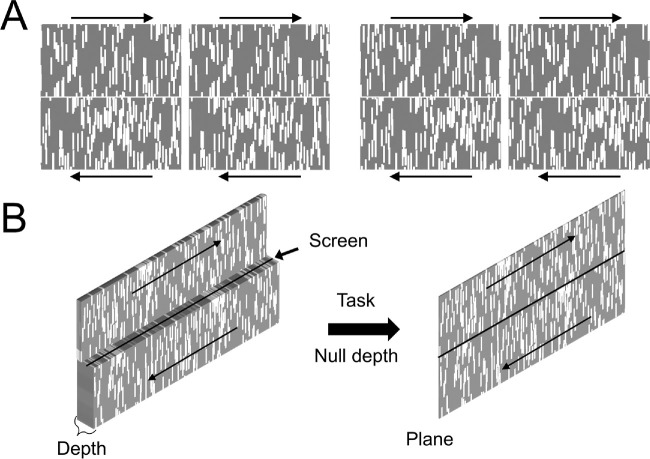
The Pulfrich effect is an illusion characterized by the misperception of the depth and 3D direction of moving objects. Interocular luminance differences cause the classic Pulfrich effect; the darker image is processed more slowly. Interocular blur differences cause the reverse Pulfrich effect; the blurrier image is processed more quickly. A common correction for presbyopia-monovision-intentionally induces the optical conditions that cause the reverse Pulfrich effect. The effect sizes, and the fact that tens of millions of people wear these corrections every day, raise concerns about public safety. However, although the impact of overall light level (e.g., nighttime vs. daytime) on the classic Pulfrich effect has been well characterized, its impact on the reverse Pulfrich effect is unknown. Here, using a custom binocular 4f tunable lens optical system that allows the decoupling of retinal illuminance and retinal blur, we report how the classic and reverse Pulfrich effects scale with overall light level. Both effects increase logarithmically with decreases in light level. These results motivate a characterization of how light level interacts with other optical factors (e.g., higher-order aberrations) that are likely to impact the reverse Pulfrich effect and, hence, the perceptual consequences of monovision corrections.
期刊介绍:
Exploring all aspects of biological visual function, including spatial vision, perception,
low vision, color vision and more, spanning the fields of neuroscience, psychology and psychophysics.






 京公网安备 11010802042870号
京ICP备2023020795号-1
京公网安备 11010802042870号
京ICP备2023020795号-1

 分享
分享
 求助内容:
求助内容: 应助结果提醒方式:
 扫码关注我们
