Asma Jebari, Taro Takahashi, Michael R F Lee, Adrian L Collins, Kevin Coleman, Alison Carswell, Carmen Segura, Laura Cardenas, Graham A McAuliffe
{"title":"Carbon footprints of greenhouse gas mitigation measures for a grass-based beef cattle finishing system in the UK.","authors":"Asma Jebari, Taro Takahashi, Michael R F Lee, Adrian L Collins, Kevin Coleman, Alison Carswell, Carmen Segura, Laura Cardenas, Graham A McAuliffe","doi":"10.1007/s11367-025-02428-9","DOIUrl":null,"url":null,"abstract":"<p><strong>Purpose: </strong>Agri-food systems across the globe are faced with the challenge of reducing their supply-chain emissions of greenhouse gases (GHGs) such as nitrous oxide (N<sub>2</sub>O), carbon dioxide (CO<sub>2</sub>), and methane (CH<sub>4</sub>). For instance, 10% of the UK's GHG emissions are generated by agriculture, and ~ 56% of these are generated by livestock production. Numerous mitigation measures are being proposed to reduce GHG emissions from ruminants (representing 70 to 80% of total livestock emissions), particularly from beef cattle (presenting 30-40% of total livestock emissions).</p><p><strong>Methods: </strong>To explore such potential, first, a business-as-usual (BAU) partial cradle-to-finishing farmgate scale modelling framework was developed. The BAU systems (i.e. steady-state productivity based on primary data from the North Wyke Farm Platform) were built using ensemble modelling wherein the RothC process-based soil organic carbon (SOC) model was integrated into the life cycle assessment (LCA) framework to conduct a trade-off analysis related to mitigation measures applicable to the study system. Potential mitigation measures were applied to the BAU scenario. The interventions assessed included: (i) extensification; (ii) adopting anaerobic digestion technology; and (iii) the use of the nitrification inhibitor DCD and substitution of fertiliser nitrogen with symbiotically fixed nitrogen from legumes.</p><p><strong>Results: </strong>The partial carbon footprint for 1 kg of beef liveweight gain leaving the farmgate <i>could</i> be reduced by 7.5%, 12%, or 26% by adopting nitrification inhibitors, white clover introduction (pending establishment success), and anaerobic digestion for manure management, respectively.</p><p><strong>Conclusions: </strong>The findings highlight the importance of including emissions beyond the farmgate level to analyse the carbon footprint of different management scenarios in order to assess the sustainability of agri-food production systems.</p><p><strong>Supplementary information: </strong>The online version contains supplementary material available at 10.1007/s11367-025-02428-9.</p>","PeriodicalId":54952,"journal":{"name":"International Journal of Life Cycle Assessment","volume":"30 4","pages":"654-667"},"PeriodicalIF":5.4000,"publicationDate":"2025-01-01","publicationTypes":"Journal Article","fieldsOfStudy":null,"isOpenAccess":false,"openAccessPdf":"https://www.ncbi.nlm.nih.gov/pmc/articles/PMC11923010/pdf/","citationCount":"0","resultStr":null,"platform":"Semanticscholar","paperid":null,"PeriodicalName":"International Journal of Life Cycle Assessment","FirstCategoryId":"93","ListUrlMain":"https://doi.org/10.1007/s11367-025-02428-9","RegionNum":3,"RegionCategory":"环境科学与生态学","ArticlePicture":[],"TitleCN":null,"AbstractTextCN":null,"PMCID":null,"EPubDate":"2025/1/14 0:00:00","PubModel":"Epub","JCR":"Q2","JCRName":"ENGINEERING, ENVIRONMENTAL","Score":null,"Total":0}
引用次数: 0
Abstract
Purpose: Agri-food systems across the globe are faced with the challenge of reducing their supply-chain emissions of greenhouse gases (GHGs) such as nitrous oxide (N2O), carbon dioxide (CO2), and methane (CH4). For instance, 10% of the UK's GHG emissions are generated by agriculture, and ~ 56% of these are generated by livestock production. Numerous mitigation measures are being proposed to reduce GHG emissions from ruminants (representing 70 to 80% of total livestock emissions), particularly from beef cattle (presenting 30-40% of total livestock emissions).
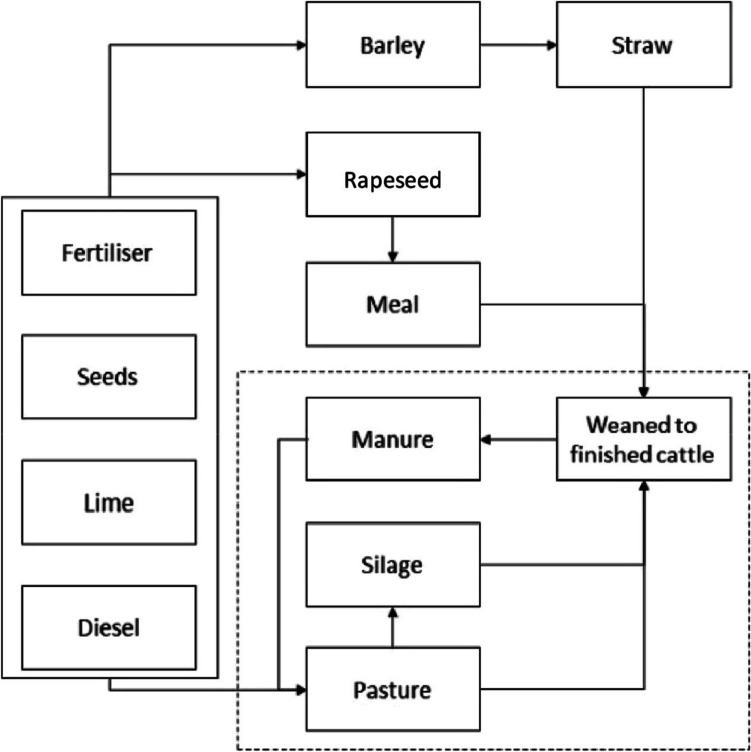
Methods: To explore such potential, first, a business-as-usual (BAU) partial cradle-to-finishing farmgate scale modelling framework was developed. The BAU systems (i.e. steady-state productivity based on primary data from the North Wyke Farm Platform) were built using ensemble modelling wherein the RothC process-based soil organic carbon (SOC) model was integrated into the life cycle assessment (LCA) framework to conduct a trade-off analysis related to mitigation measures applicable to the study system. Potential mitigation measures were applied to the BAU scenario. The interventions assessed included: (i) extensification; (ii) adopting anaerobic digestion technology; and (iii) the use of the nitrification inhibitor DCD and substitution of fertiliser nitrogen with symbiotically fixed nitrogen from legumes.
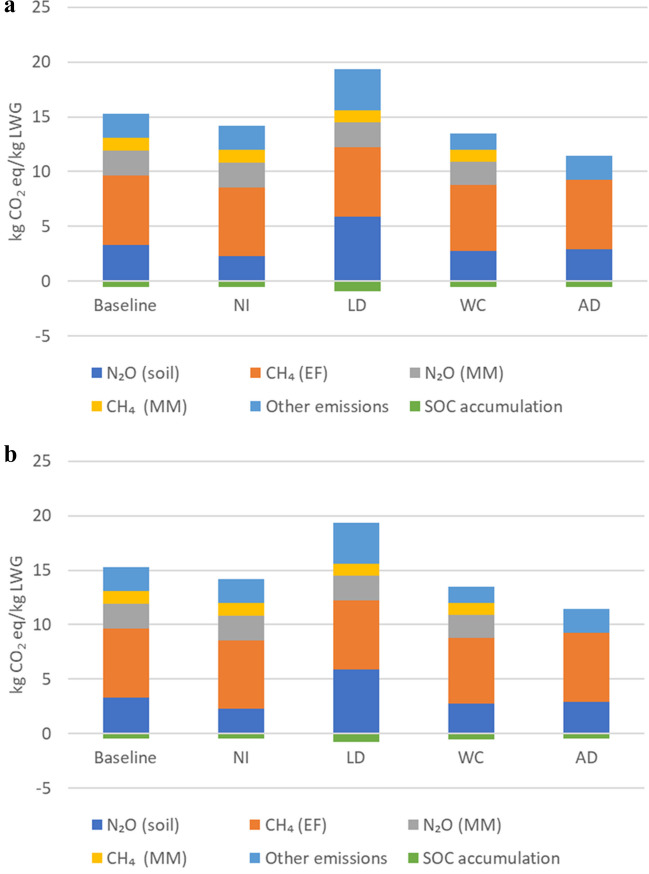
Results: The partial carbon footprint for 1 kg of beef liveweight gain leaving the farmgate could be reduced by 7.5%, 12%, or 26% by adopting nitrification inhibitors, white clover introduction (pending establishment success), and anaerobic digestion for manure management, respectively.
Conclusions: The findings highlight the importance of including emissions beyond the farmgate level to analyse the carbon footprint of different management scenarios in order to assess the sustainability of agri-food production systems.
Supplementary information: The online version contains supplementary material available at 10.1007/s11367-025-02428-9.
期刊介绍:
The International Journal of Life Cycle Assessment (Int J Life Cycle Assess) is the first journal devoted entirely to Life Cycle Assessment and closely related methods. LCA has become a recognized instrument to assess the ecological burdens and impacts throughout the consecutive and interlinked stages of a product system, from raw material acquisition or generation from natural resources, through production and use to final disposal. The Int J Life Cycle Assess is a forum for scientists developing LCA and LCM (Life Cycle Management); LCA and LCM practitioners; managers concerned with environmental aspects of products; governmental environmental agencies responsible for product quality; scientific and industrial societies involved in LCA development, and ecological institutions and bodies.



 京公网安备 11010802042870号
京ICP备2023020795号-1
京公网安备 11010802042870号
京ICP备2023020795号-1

 分享
分享
 求助内容:
求助内容: 应助结果提醒方式:
 扫码关注我们
