Senhe Huang, Pu Yan, Zhiya Han, Hongyu Wu, Youcheng Wang, Jichao Zhang, Lei Yuan, Shuai Fu, Guanzhao Wen, Jinhui Zhu, Mischa Bonn, Hai I. Wang, Kecheng Cao, Xiaodong Zhuang
{"title":"2D Rhodium-Isocyanide Frameworks","authors":"Senhe Huang, Pu Yan, Zhiya Han, Hongyu Wu, Youcheng Wang, Jichao Zhang, Lei Yuan, Shuai Fu, Guanzhao Wen, Jinhui Zhu, Mischa Bonn, Hai I. Wang, Kecheng Cao, Xiaodong Zhuang","doi":"10.1002/adma.202502192","DOIUrl":null,"url":null,"abstract":"<p>2D metal-organic frameworks (2D MOFs) are emerging organic van der Waals materials with great potential in various applications owing to their structural diversity, and tunable optoelectronic properties. So far, most reported 2D MOFs rely on metal-heteroatom coordination (e.g., metal–nitrogen, metal–oxygen, and metal–sulfur); synthesis of metal-carbon coordination based 2D MOFs remains a formidable challenge. This study reports the rhodium–carbon (Rh–C) coordination-based 2D MOFs, using isocyanide as the ligand and Rh(I) as metal node. The synthesized MOFs show excellent crystallinity with quasi-square lattice networks. These MOFs show ultra-narrow bandgaps (0.1–0.28 eV) resulting from the interaction between Rh(I) and isocyano groups. Terahertz spectroscopy demonstrates exceptional short-range charge mobilities up to 560 ± 46 cm<sup>2</sup> V<sup>−1</sup> s<sup>−1</sup> in the as-synthesized MOFs. Moreover, these MOFs are used as electrocatalysts for nitrogen reduction reaction and show an excellent NH<sub>3</sub> yield rate of 56.0 ± 1.5 µg h<sup>−1</sup> mg<sub>cat</sub><sup>−1</sup> and a record Faradaic efficiency of 87.1 ± 1.8%. In situ experiments reveal dual pathways involving Rh(I) during the catalytic process. This work represents a pioneering step toward 2D MOFs based on metal–carbon coordination and paves the way for novel reticular materials with ultra-high carrier mobility and for versatile optoelectronic devices.</p>","PeriodicalId":114,"journal":{"name":"Advanced Materials","volume":"37 19","pages":""},"PeriodicalIF":26.8000,"publicationDate":"2025-03-25","publicationTypes":"Journal Article","fieldsOfStudy":null,"isOpenAccess":false,"openAccessPdf":"","citationCount":"0","resultStr":null,"platform":"Semanticscholar","paperid":null,"PeriodicalName":"Advanced Materials","FirstCategoryId":"88","ListUrlMain":"https://advanced.onlinelibrary.wiley.com/doi/10.1002/adma.202502192","RegionNum":1,"RegionCategory":"材料科学","ArticlePicture":[],"TitleCN":null,"AbstractTextCN":null,"PMCID":null,"EPubDate":"","PubModel":"","JCR":"Q1","JCRName":"CHEMISTRY, MULTIDISCIPLINARY","Score":null,"Total":0}
引用次数: 0
Abstract
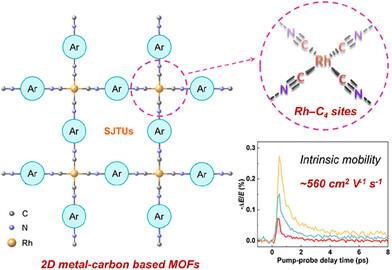
2D metal-organic frameworks (2D MOFs) are emerging organic van der Waals materials with great potential in various applications owing to their structural diversity, and tunable optoelectronic properties. So far, most reported 2D MOFs rely on metal-heteroatom coordination (e.g., metal–nitrogen, metal–oxygen, and metal–sulfur); synthesis of metal-carbon coordination based 2D MOFs remains a formidable challenge. This study reports the rhodium–carbon (Rh–C) coordination-based 2D MOFs, using isocyanide as the ligand and Rh(I) as metal node. The synthesized MOFs show excellent crystallinity with quasi-square lattice networks. These MOFs show ultra-narrow bandgaps (0.1–0.28 eV) resulting from the interaction between Rh(I) and isocyano groups. Terahertz spectroscopy demonstrates exceptional short-range charge mobilities up to 560 ± 46 cm2 V−1 s−1 in the as-synthesized MOFs. Moreover, these MOFs are used as electrocatalysts for nitrogen reduction reaction and show an excellent NH3 yield rate of 56.0 ± 1.5 µg h−1 mgcat−1 and a record Faradaic efficiency of 87.1 ± 1.8%. In situ experiments reveal dual pathways involving Rh(I) during the catalytic process. This work represents a pioneering step toward 2D MOFs based on metal–carbon coordination and paves the way for novel reticular materials with ultra-high carrier mobility and for versatile optoelectronic devices.
期刊介绍:
Advanced Materials, one of the world's most prestigious journals and the foundation of the Advanced portfolio, is the home of choice for best-in-class materials science for more than 30 years. Following this fast-growing and interdisciplinary field, we are considering and publishing the most important discoveries on any and all materials from materials scientists, chemists, physicists, engineers as well as health and life scientists and bringing you the latest results and trends in modern materials-related research every week.





 京公网安备 11010802042870号
京ICP备2023020795号-1
京公网安备 11010802042870号
京ICP备2023020795号-1

 分享
分享
 求助内容:
求助内容: 应助结果提醒方式:
 扫码关注我们
