Der Vang, Jonathan Pahren, Emily Duderstadt, Frances Joan Alvarez, Manisha Sheokand, Justin A. Caserta, Tom Cambron, Pietro Strobbia
{"title":"Surface-Enhanced Raman Spectroscopy and Multivariate Analysis for Elucidating Mechanisms of Action in Antibacterial Agents","authors":"Der Vang, Jonathan Pahren, Emily Duderstadt, Frances Joan Alvarez, Manisha Sheokand, Justin A. Caserta, Tom Cambron, Pietro Strobbia","doi":"10.1021/acssensors.4c03304","DOIUrl":null,"url":null,"abstract":"Antibiotic and antibacterial-resistant bacteria continue to pose a global-health threat. Understanding the mechanism of action (MoA) of antibacterial agents is crucial for developing precise and novel treatment methods. Traditionally, the MoA of a novel treatment is studied with genome sequencing and mass spectrometry, which are both labor-intensive and costly. In contrast, surface-enhanced Raman spectroscopy (SERS) provides a rapid, sensitive, and noninvasive alternative for analyzing bacterial molecular responses to antibacterial agents. In this study, we employed SERS to analyze the effects of various antibacterial agents on <i>Escherichia coli</i>. We treated <i>E. coli</i> cultures with agents that have different known MoAs, including oxidative stress, metabolic disruption, and membrane lysis. Through partial least-squares (PLS) analysis, we correlated changes in the SERS spectra with bacterial viability, achieving high predictive accuracy (<i>R</i><sup>2</sup> > 0.98). From the PLS models, we were able to extract variable importance projection scores, which were used to identify the MoA in subsets of the data. Our results revealed distinct spectral signatures associated with each MoA, demonstrating the potential of SERS to differentiate between different antibacterial treatments. This study highlights the feasibility of using SERS combined with multivariate analysis to rapidly characterize the molecular effects of antibacterial agents even with smaller data sets. By providing a real-time method for monitoring bacterial responses, this SERS approach could accelerate the discovery of novel antibacterial therapies while reducing dependency on more time-consuming and expensive analytical techniques.","PeriodicalId":24,"journal":{"name":"ACS Sensors","volume":"13 1","pages":""},"PeriodicalIF":9.1000,"publicationDate":"2025-03-24","publicationTypes":"Journal Article","fieldsOfStudy":null,"isOpenAccess":false,"openAccessPdf":"","citationCount":"0","resultStr":null,"platform":"Semanticscholar","paperid":null,"PeriodicalName":"ACS Sensors","FirstCategoryId":"92","ListUrlMain":"https://doi.org/10.1021/acssensors.4c03304","RegionNum":1,"RegionCategory":"化学","ArticlePicture":[],"TitleCN":null,"AbstractTextCN":null,"PMCID":null,"EPubDate":"","PubModel":"","JCR":"Q1","JCRName":"CHEMISTRY, ANALYTICAL","Score":null,"Total":0}
引用次数: 0
Abstract
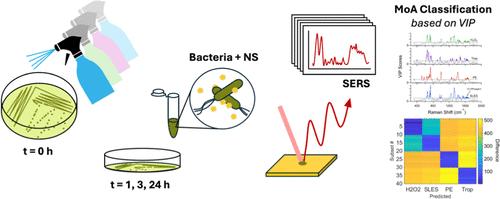
Antibiotic and antibacterial-resistant bacteria continue to pose a global-health threat. Understanding the mechanism of action (MoA) of antibacterial agents is crucial for developing precise and novel treatment methods. Traditionally, the MoA of a novel treatment is studied with genome sequencing and mass spectrometry, which are both labor-intensive and costly. In contrast, surface-enhanced Raman spectroscopy (SERS) provides a rapid, sensitive, and noninvasive alternative for analyzing bacterial molecular responses to antibacterial agents. In this study, we employed SERS to analyze the effects of various antibacterial agents on Escherichia coli. We treated E. coli cultures with agents that have different known MoAs, including oxidative stress, metabolic disruption, and membrane lysis. Through partial least-squares (PLS) analysis, we correlated changes in the SERS spectra with bacterial viability, achieving high predictive accuracy (R2 > 0.98). From the PLS models, we were able to extract variable importance projection scores, which were used to identify the MoA in subsets of the data. Our results revealed distinct spectral signatures associated with each MoA, demonstrating the potential of SERS to differentiate between different antibacterial treatments. This study highlights the feasibility of using SERS combined with multivariate analysis to rapidly characterize the molecular effects of antibacterial agents even with smaller data sets. By providing a real-time method for monitoring bacterial responses, this SERS approach could accelerate the discovery of novel antibacterial therapies while reducing dependency on more time-consuming and expensive analytical techniques.
期刊介绍:
ACS Sensors is a peer-reviewed research journal that focuses on the dissemination of new and original knowledge in the field of sensor science, particularly those that selectively sense chemical or biological species or processes. The journal covers a broad range of topics, including but not limited to biosensors, chemical sensors, gas sensors, intracellular sensors, single molecule sensors, cell chips, and microfluidic devices. It aims to publish articles that address conceptual advances in sensing technology applicable to various types of analytes or application papers that report on the use of existing sensing concepts in new ways or for new analytes.



 京公网安备 11010802042870号
京ICP备2023020795号-1
京公网安备 11010802042870号
京ICP备2023020795号-1

 分享
分享
 求助内容:
求助内容: 应助结果提醒方式:
 扫码关注我们
