{"title":"Single-Particle Collision Electrochemical Biosensor Developed by a Typical Alkaline Phosphatase-Catalyzed Silver Deposition Reaction","authors":"Fangfang Yang, Jieyu Zhang, Li Wang, Shufeng Liu","doi":"10.1021/acssensors.5c00525","DOIUrl":null,"url":null,"abstract":"Considering the intrinsic importance of alkaline phosphatase (ALP) as a biomarker in disease monitoring and as a mostly widely used biolabel for signal transmission in bioanalysis, the development of a new ALP assay method is highly pursued. Herein, a well-known ALP-catalyzed silver deposition reaction onto gold nanoparticles (Au NPs) was developed into a single-particle-collision-based electrochemical biosensor. ALP-catalyzed dephosphorylation of ascorbic acid 2-phosphate (AA-P) resulted in ascorbic acid (AA), which in turn reduced the silver ion to form a silver nanoshell on the surface of Au NPs (Au@Ag NPs). The generated Au@Ag NPs could stochastically collide with the microelectrode to produce transient current spikes. The collision frequency and charge could concurrently indicate the amount of produced Au@Ag NPs and then the ALP activity. Thus, a new single-particle collision-based electrochemical biosensing platform for ALP was constructed. It operates homogeneously and does not require electrode modification, nanoparticle biofunctionalization, and washing and separation steps. It showed good detection sensitivity toward ALP activity with a quantification limit of 2 mU/mL in 10 μL. The background-free feature endows it with absolute selectivity. It could also be used for inhibitor screening and applied for the ALP assay in the serum. In addition, the proposed collision-based electrochemical strategy was developed for a new enzyme-linked immunosorbent assay. With the human immunoglobulin G (IgG) as a model target, it could effortlessly evaluate 5 ng/mL analytes. It thus opens a new avenue toward the development of single-particle collision-based electrochemical biosensors for a wide range of applications in disease diagnosis and bioanalysis.","PeriodicalId":24,"journal":{"name":"ACS Sensors","volume":"22 1","pages":""},"PeriodicalIF":9.1000,"publicationDate":"2025-03-25","publicationTypes":"Journal Article","fieldsOfStudy":null,"isOpenAccess":false,"openAccessPdf":"","citationCount":"0","resultStr":null,"platform":"Semanticscholar","paperid":null,"PeriodicalName":"ACS Sensors","FirstCategoryId":"92","ListUrlMain":"https://doi.org/10.1021/acssensors.5c00525","RegionNum":1,"RegionCategory":"化学","ArticlePicture":[],"TitleCN":null,"AbstractTextCN":null,"PMCID":null,"EPubDate":"","PubModel":"","JCR":"Q1","JCRName":"CHEMISTRY, ANALYTICAL","Score":null,"Total":0}
引用次数: 0
Abstract
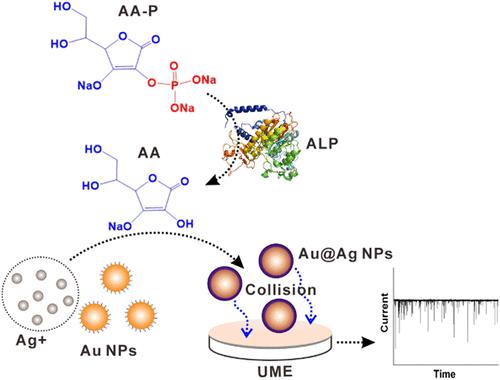
Considering the intrinsic importance of alkaline phosphatase (ALP) as a biomarker in disease monitoring and as a mostly widely used biolabel for signal transmission in bioanalysis, the development of a new ALP assay method is highly pursued. Herein, a well-known ALP-catalyzed silver deposition reaction onto gold nanoparticles (Au NPs) was developed into a single-particle-collision-based electrochemical biosensor. ALP-catalyzed dephosphorylation of ascorbic acid 2-phosphate (AA-P) resulted in ascorbic acid (AA), which in turn reduced the silver ion to form a silver nanoshell on the surface of Au NPs (Au@Ag NPs). The generated Au@Ag NPs could stochastically collide with the microelectrode to produce transient current spikes. The collision frequency and charge could concurrently indicate the amount of produced Au@Ag NPs and then the ALP activity. Thus, a new single-particle collision-based electrochemical biosensing platform for ALP was constructed. It operates homogeneously and does not require electrode modification, nanoparticle biofunctionalization, and washing and separation steps. It showed good detection sensitivity toward ALP activity with a quantification limit of 2 mU/mL in 10 μL. The background-free feature endows it with absolute selectivity. It could also be used for inhibitor screening and applied for the ALP assay in the serum. In addition, the proposed collision-based electrochemical strategy was developed for a new enzyme-linked immunosorbent assay. With the human immunoglobulin G (IgG) as a model target, it could effortlessly evaluate 5 ng/mL analytes. It thus opens a new avenue toward the development of single-particle collision-based electrochemical biosensors for a wide range of applications in disease diagnosis and bioanalysis.
期刊介绍:
ACS Sensors is a peer-reviewed research journal that focuses on the dissemination of new and original knowledge in the field of sensor science, particularly those that selectively sense chemical or biological species or processes. The journal covers a broad range of topics, including but not limited to biosensors, chemical sensors, gas sensors, intracellular sensors, single molecule sensors, cell chips, and microfluidic devices. It aims to publish articles that address conceptual advances in sensing technology applicable to various types of analytes or application papers that report on the use of existing sensing concepts in new ways or for new analytes.



 京公网安备 11010802042870号
京ICP备2023020795号-1
京公网安备 11010802042870号
京ICP备2023020795号-1

 分享
分享
 求助内容:
求助内容: 应助结果提醒方式:
 扫码关注我们
