Eunji Choi, Tae-In Jeong, Thanh Mien Nguyen, Alexander Gliserin, Jimin Lee, Gyeong-Ha Bak, San Kim, Sehyeon Kim, Jin-Woo Oh, Seungchul Kim
{"title":"Identification of Gas Mixture Components with Multichannel Hierarchical Analysis of Time-Resolved Hyperspectral Data","authors":"Eunji Choi, Tae-In Jeong, Thanh Mien Nguyen, Alexander Gliserin, Jimin Lee, Gyeong-Ha Bak, San Kim, Sehyeon Kim, Jin-Woo Oh, Seungchul Kim","doi":"10.1021/acssensors.5c00015","DOIUrl":null,"url":null,"abstract":"Chemical vapor sensors are essential for various fields, including medical diagnostics and environmental monitoring. Notably, the identification of components in unknown gas mixtures has great potential for noninvasive diagnosis of diseases such as lung cancer. However, current gas identification techniques, despite the development of electronic nose-based sensor platforms, still lack sufficient classification accuracy for mixed gases. In our previous study, we introduced multichannel hierarchical analysis using a time-resolved hyperspectral system to address the spectral ambiguity of conventional RGB sensor-based colorimetric e-noses. Here, we demonstrate the identification of mixed gas components through time-resolved line hyperspectral measurements with an eight-colorimetric sensor array that uses genetically engineered M13 bacteriophages as gas-selective colorimetric sensors. The time-dependent spectral variations induced by mixed gas in the different colorimetric sensors are converted into a hyperspectral three-dimensional (3D) data cube. For efficient machine learning classification, the data cube was converted into a multichannel spectrogram by applying a novel data processing method, including dimensionality reduction and a block average filter to reduce high-dimensional complexity and improve the signal-to-noise ratio. A convolution filter was then used for hierarchical analysis of the multichannel spectrogram, effectively capturing the complex gas-induced spectral patterns and temporal dynamics. Our study demonstrates a classification accuracy of 93.9% for pure and mixed gases of acetone, ethanol, and xylene at a low concentration of 2 ppm.","PeriodicalId":24,"journal":{"name":"ACS Sensors","volume":"90 1","pages":""},"PeriodicalIF":9.1000,"publicationDate":"2025-03-24","publicationTypes":"Journal Article","fieldsOfStudy":null,"isOpenAccess":false,"openAccessPdf":"","citationCount":"0","resultStr":null,"platform":"Semanticscholar","paperid":null,"PeriodicalName":"ACS Sensors","FirstCategoryId":"92","ListUrlMain":"https://doi.org/10.1021/acssensors.5c00015","RegionNum":1,"RegionCategory":"化学","ArticlePicture":[],"TitleCN":null,"AbstractTextCN":null,"PMCID":null,"EPubDate":"","PubModel":"","JCR":"Q1","JCRName":"CHEMISTRY, ANALYTICAL","Score":null,"Total":0}
引用次数: 0
Abstract
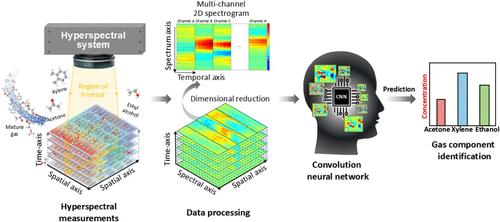
Chemical vapor sensors are essential for various fields, including medical diagnostics and environmental monitoring. Notably, the identification of components in unknown gas mixtures has great potential for noninvasive diagnosis of diseases such as lung cancer. However, current gas identification techniques, despite the development of electronic nose-based sensor platforms, still lack sufficient classification accuracy for mixed gases. In our previous study, we introduced multichannel hierarchical analysis using a time-resolved hyperspectral system to address the spectral ambiguity of conventional RGB sensor-based colorimetric e-noses. Here, we demonstrate the identification of mixed gas components through time-resolved line hyperspectral measurements with an eight-colorimetric sensor array that uses genetically engineered M13 bacteriophages as gas-selective colorimetric sensors. The time-dependent spectral variations induced by mixed gas in the different colorimetric sensors are converted into a hyperspectral three-dimensional (3D) data cube. For efficient machine learning classification, the data cube was converted into a multichannel spectrogram by applying a novel data processing method, including dimensionality reduction and a block average filter to reduce high-dimensional complexity and improve the signal-to-noise ratio. A convolution filter was then used for hierarchical analysis of the multichannel spectrogram, effectively capturing the complex gas-induced spectral patterns and temporal dynamics. Our study demonstrates a classification accuracy of 93.9% for pure and mixed gases of acetone, ethanol, and xylene at a low concentration of 2 ppm.
期刊介绍:
ACS Sensors is a peer-reviewed research journal that focuses on the dissemination of new and original knowledge in the field of sensor science, particularly those that selectively sense chemical or biological species or processes. The journal covers a broad range of topics, including but not limited to biosensors, chemical sensors, gas sensors, intracellular sensors, single molecule sensors, cell chips, and microfluidic devices. It aims to publish articles that address conceptual advances in sensing technology applicable to various types of analytes or application papers that report on the use of existing sensing concepts in new ways or for new analytes.




 京公网安备 11010802042870号
京ICP备2023020795号-1
京公网安备 11010802042870号
京ICP备2023020795号-1

 分享
分享
 求助内容:
求助内容: 应助结果提醒方式:
 扫码关注我们
