Ying Tang , Zhipeng Liu , Juan Jia , Xin Zhong , Hui Zeng , Haijiao Xie , Zebao Rui
{"title":"Plasmon-assisting surface reaction on gas–vapor-solid photothermal catalytic system for efficient ammonia photosynthesis","authors":"Ying Tang , Zhipeng Liu , Juan Jia , Xin Zhong , Hui Zeng , Haijiao Xie , Zebao Rui","doi":"10.1016/j.cej.2025.161980","DOIUrl":null,"url":null,"abstract":"<div><div>Photosynthetic nitrogen reduction reaction (photo-NRR) is an eco-friendly and promising alternative route to energy-intensive Haber-Bosch process, but this emerging technology is limited in practical applications originating from the unsatisfactory N<sub>2</sub>-to-NH<sub>3</sub> conversion efficiencies hindered by inefficient photocatalysts and intrinsic deficiencies in conventional gas–liquid-solid system. Herein, an innovative photothermal catalytic system, composed of porous g-C<sub>3</sub>N<sub>4</sub>/Fe-dispersed MXene aerogel and gas–vapor-solid catalytic environment, is pioneered to revolutionarily conquer the weak photoelectronic/photothermal response, water-induced light attenuation and low aqueous solubility/diffusibility of N<sub>2</sub> in traditional NH<sub>3</sub> photosynthesis. A high NH<sub>3</sub> formation rate from 238.6 to 587.3 μmol g<sup>−1</sup>h<sup>−1</sup> is recorded under light irradiation intensity from 100 to 500 mW cm<sup>−2</sup>, being remarkably higher than reported state-of-the-art photo-NRR systems under similar conditions. The superior performance is related to that solid–liquid spatial separation aids satisfactory light response, and the plasmon resonance accelerates the surface reaction dynamics, resulting in excellent solar-to-matter conversion and reversible active sites utilization.</div></div>","PeriodicalId":270,"journal":{"name":"Chemical Engineering Journal","volume":"511 ","pages":"Article 161980"},"PeriodicalIF":13.2000,"publicationDate":"2025-03-25","publicationTypes":"Journal Article","fieldsOfStudy":null,"isOpenAccess":false,"openAccessPdf":"","citationCount":"0","resultStr":null,"platform":"Semanticscholar","paperid":null,"PeriodicalName":"Chemical Engineering Journal","FirstCategoryId":"5","ListUrlMain":"https://www.sciencedirect.com/science/article/pii/S1385894725028062","RegionNum":1,"RegionCategory":"工程技术","ArticlePicture":[],"TitleCN":null,"AbstractTextCN":null,"PMCID":null,"EPubDate":"","PubModel":"","JCR":"Q1","JCRName":"ENGINEERING, CHEMICAL","Score":null,"Total":0}
引用次数: 0
Abstract
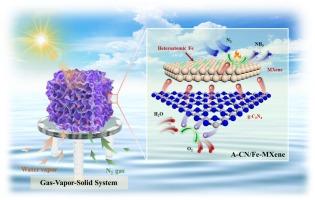
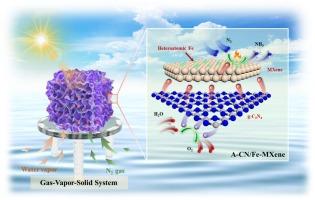
Photosynthetic nitrogen reduction reaction (photo-NRR) is an eco-friendly and promising alternative route to energy-intensive Haber-Bosch process, but this emerging technology is limited in practical applications originating from the unsatisfactory N2-to-NH3 conversion efficiencies hindered by inefficient photocatalysts and intrinsic deficiencies in conventional gas–liquid-solid system. Herein, an innovative photothermal catalytic system, composed of porous g-C3N4/Fe-dispersed MXene aerogel and gas–vapor-solid catalytic environment, is pioneered to revolutionarily conquer the weak photoelectronic/photothermal response, water-induced light attenuation and low aqueous solubility/diffusibility of N2 in traditional NH3 photosynthesis. A high NH3 formation rate from 238.6 to 587.3 μmol g−1h−1 is recorded under light irradiation intensity from 100 to 500 mW cm−2, being remarkably higher than reported state-of-the-art photo-NRR systems under similar conditions. The superior performance is related to that solid–liquid spatial separation aids satisfactory light response, and the plasmon resonance accelerates the surface reaction dynamics, resulting in excellent solar-to-matter conversion and reversible active sites utilization.
期刊介绍:
The Chemical Engineering Journal is an international research journal that invites contributions of original and novel fundamental research. It aims to provide an international platform for presenting original fundamental research, interpretative reviews, and discussions on new developments in chemical engineering. The journal welcomes papers that describe novel theory and its practical application, as well as those that demonstrate the transfer of techniques from other disciplines. It also welcomes reports on carefully conducted experimental work that is soundly interpreted. The main focus of the journal is on original and rigorous research results that have broad significance. The Catalysis section within the Chemical Engineering Journal focuses specifically on Experimental and Theoretical studies in the fields of heterogeneous catalysis, molecular catalysis, and biocatalysis. These studies have industrial impact on various sectors such as chemicals, energy, materials, foods, healthcare, and environmental protection.



 京公网安备 11010802042870号
京ICP备2023020795号-1
京公网安备 11010802042870号
京ICP备2023020795号-1

 分享
分享
 求助内容:
求助内容: 应助结果提醒方式:
 扫码关注我们
