Rutuja U. Amate , Pritam J. Morankar , Aviraj M. Teli , Mrunal K. Bhosale , Namita A. Ahir , Chan-Wook Jeon
{"title":"Interface-centric strategies in Nb2O5/MoS2 heterostructure: Leveraging synergistic potential for dual-function electrochromic energy storage","authors":"Rutuja U. Amate , Pritam J. Morankar , Aviraj M. Teli , Mrunal K. Bhosale , Namita A. Ahir , Chan-Wook Jeon","doi":"10.1016/j.cej.2025.161962","DOIUrl":null,"url":null,"abstract":"<div><div>The advancement of multifunctional materials integrating electrochromic and energy storage functionalities represents a transformative approach to next-generation energy systems. This study reports the Nb<sub>2</sub>O<sub>5</sub>/MoS<sub>2</sub> heterostructure thin films, fabricated via a hydrothermal method, for dual electrochromic energy storage applications. The optimized heterostructure leverages the complementary properties of Nb<sub>2</sub>O<sub>5</sub> and MoS<sub>2</sub>, attaining unrivaled performance in both domains. The electrochemical determinations reveal that the Nb@Mo20 exhibits an areal capacitance of 176.74 mF/cm<sup>2</sup> at 0.8 mA/cm<sup>2</sup>, alongside magnificent cycling stability. Owing to its favorable structural characteristics, the heterostructure unveiled striking optical modulation of 77.11 % at 600 nm, transitioning between 82.25 % (bleached) and 5.14 % (colored) states. It delivered rapid switching times, with a high coloration efficiency of 98.92 cm<sup>2</sup>/C. Long-term cycling stability conveyed minimal performance loss after 20,000 s, ensuring sustained efficiency. Additionally, a hybrid electrochromic supercapacitor is developed, demonstrating a notable optical contrast (73.60 % at 600 nm), acceptable capacitance with good cycling stability. The device maintains a wide voltage range, effectively powering LEDs, showcasing scalability for real-world applications. The design principles outlined in this study offer valuable insights into the development of high-performance electrochromic energy storage materials, highlighting their potential applications in energy efficiency and storage.</div></div>","PeriodicalId":270,"journal":{"name":"Chemical Engineering Journal","volume":"511 ","pages":"Article 161962"},"PeriodicalIF":13.2000,"publicationDate":"2025-03-25","publicationTypes":"Journal Article","fieldsOfStudy":null,"isOpenAccess":false,"openAccessPdf":"","citationCount":"0","resultStr":null,"platform":"Semanticscholar","paperid":null,"PeriodicalName":"Chemical Engineering Journal","FirstCategoryId":"5","ListUrlMain":"https://www.sciencedirect.com/science/article/pii/S1385894725027883","RegionNum":1,"RegionCategory":"工程技术","ArticlePicture":[],"TitleCN":null,"AbstractTextCN":null,"PMCID":null,"EPubDate":"","PubModel":"","JCR":"Q1","JCRName":"ENGINEERING, CHEMICAL","Score":null,"Total":0}
引用次数: 0
Abstract
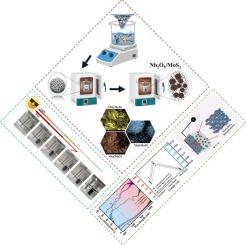
The advancement of multifunctional materials integrating electrochromic and energy storage functionalities represents a transformative approach to next-generation energy systems. This study reports the Nb2O5/MoS2 heterostructure thin films, fabricated via a hydrothermal method, for dual electrochromic energy storage applications. The optimized heterostructure leverages the complementary properties of Nb2O5 and MoS2, attaining unrivaled performance in both domains. The electrochemical determinations reveal that the Nb@Mo20 exhibits an areal capacitance of 176.74 mF/cm2 at 0.8 mA/cm2, alongside magnificent cycling stability. Owing to its favorable structural characteristics, the heterostructure unveiled striking optical modulation of 77.11 % at 600 nm, transitioning between 82.25 % (bleached) and 5.14 % (colored) states. It delivered rapid switching times, with a high coloration efficiency of 98.92 cm2/C. Long-term cycling stability conveyed minimal performance loss after 20,000 s, ensuring sustained efficiency. Additionally, a hybrid electrochromic supercapacitor is developed, demonstrating a notable optical contrast (73.60 % at 600 nm), acceptable capacitance with good cycling stability. The device maintains a wide voltage range, effectively powering LEDs, showcasing scalability for real-world applications. The design principles outlined in this study offer valuable insights into the development of high-performance electrochromic energy storage materials, highlighting their potential applications in energy efficiency and storage.
期刊介绍:
The Chemical Engineering Journal is an international research journal that invites contributions of original and novel fundamental research. It aims to provide an international platform for presenting original fundamental research, interpretative reviews, and discussions on new developments in chemical engineering. The journal welcomes papers that describe novel theory and its practical application, as well as those that demonstrate the transfer of techniques from other disciplines. It also welcomes reports on carefully conducted experimental work that is soundly interpreted. The main focus of the journal is on original and rigorous research results that have broad significance. The Catalysis section within the Chemical Engineering Journal focuses specifically on Experimental and Theoretical studies in the fields of heterogeneous catalysis, molecular catalysis, and biocatalysis. These studies have industrial impact on various sectors such as chemicals, energy, materials, foods, healthcare, and environmental protection.




 京公网安备 11010802042870号
京ICP备2023020795号-1
京公网安备 11010802042870号
京ICP备2023020795号-1

 分享
分享
 求助内容:
求助内容: 应助结果提醒方式:
 扫码关注我们
