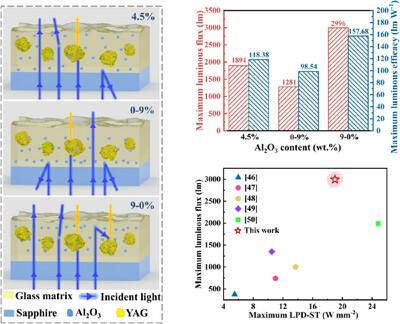
{"title":"Unique Multilayer Gradient Design of Al2O3 Doping Phosphor-In-Glass Film Enabling High-Luminance Laser Lighting","authors":"Zhencheng Li, Jiuzhou Zhao, Yongjie Ding, Hongjin Zhang, Zhenyu Chen, Zhenzi Wu, Yufan Wei, Feng Wu, Changqing Chen, Yang Peng, Jiangnan Dai","doi":"10.1002/lpor.202401991","DOIUrl":null,"url":null,"abstract":"<p>Next-generation high-luminance laser lighting faces a crucial challenge in developing a transmissive color converter with efficient heat dissipation and phosphor conversion. Herein, a unique architecture of Al<sub>2</sub>O<sub>3</sub> particles gradient doping phosphor-in-glass film (PiGF) coated on a transparent sapphire (AGD-PiGF@S) is designed and prepared by a simple multilayer printing and low-temperature sintering strategy. By optimizing the multilayer gradient doping structure, the 9-0%AGD-PiGF@S converter enables a high-luminance white light with a high luminous flux (LF) of 2996 lm under a maximum laser power density saturation threshold (LPD-ST) of 19 W mm<sup>−2</sup>, which is 2.63 times of the traditional PiGF@S converter with a LF of 1139 lm@11 W mm<sup>−2</sup>. The working temperature of this AGD-PiGF@S converter is decreased by 35.8°C@11 W mm<sup>−2</sup> (≈23.82%). Compared with the Al<sub>2</sub>O<sub>3</sub> uniform doping PiGF@S (4.5%AUD-PiGF@S) converter, the maximum LF and luminous efficiency (LE) of AGD-PiGF@S are increased by 58.18% and 33.20%, respectively. The findings will provide a new idea for realizing the preferably color converter in high-luminance laser lighting and display.</p>","PeriodicalId":204,"journal":{"name":"Laser & Photonics Reviews","volume":"19 13","pages":""},"PeriodicalIF":10.0000,"publicationDate":"2025-03-25","publicationTypes":"Journal Article","fieldsOfStudy":null,"isOpenAccess":false,"openAccessPdf":"","citationCount":"0","resultStr":null,"platform":"Semanticscholar","paperid":null,"PeriodicalName":"Laser & Photonics Reviews","FirstCategoryId":"101","ListUrlMain":"https://onlinelibrary.wiley.com/doi/10.1002/lpor.202401991","RegionNum":1,"RegionCategory":"物理与天体物理","ArticlePicture":[],"TitleCN":null,"AbstractTextCN":null,"PMCID":null,"EPubDate":"","PubModel":"","JCR":"Q1","JCRName":"OPTICS","Score":null,"Total":0}
引用次数: 0
Abstract
Next-generation high-luminance laser lighting faces a crucial challenge in developing a transmissive color converter with efficient heat dissipation and phosphor conversion. Herein, a unique architecture of Al2O3 particles gradient doping phosphor-in-glass film (PiGF) coated on a transparent sapphire (AGD-PiGF@S) is designed and prepared by a simple multilayer printing and low-temperature sintering strategy. By optimizing the multilayer gradient doping structure, the 9-0%AGD-PiGF@S converter enables a high-luminance white light with a high luminous flux (LF) of 2996 lm under a maximum laser power density saturation threshold (LPD-ST) of 19 W mm−2, which is 2.63 times of the traditional PiGF@S converter with a LF of 1139 lm@11 W mm−2. The working temperature of this AGD-PiGF@S converter is decreased by 35.8°C@11 W mm−2 (≈23.82%). Compared with the Al2O3 uniform doping PiGF@S (4.5%AUD-PiGF@S) converter, the maximum LF and luminous efficiency (LE) of AGD-PiGF@S are increased by 58.18% and 33.20%, respectively. The findings will provide a new idea for realizing the preferably color converter in high-luminance laser lighting and display.
下一代高亮度激光照明面临的关键挑战是开发具有高效散热和荧光粉转换的透射式颜色转换器。本文通过简单的多层印刷和低温烧结策略,设计并制备了一种独特的Al2O3颗粒梯度掺杂玻璃中磷膜(PiGF)涂层在透明蓝宝石(AGD-PiGF@S)上的结构。通过优化多层梯度掺杂结构,9-0%AGD-PiGF@S变换器可在19 W mm−2的最大激光功率密度饱和阈值(LPD-ST)下产生2996 lm的高亮度白光,是传统PiGF@S变换器(1139 lm@11 W mm−2)的2.63倍。该AGD-PiGF@S转炉的工作温度降低35.8°C@11 W mm−2(≈23.82%)。与Al2O3均匀掺杂PiGF@S (4.5%AUD-PiGF@S)变换器相比,AGD-PiGF@S的最大LF和发光效率(LE)分别提高了58.18%和33.20%。研究结果将为实现高亮度激光照明和显示中较好的颜色转换器提供新的思路。
期刊介绍:
Laser & Photonics Reviews is a reputable journal that publishes high-quality Reviews, original Research Articles, and Perspectives in the field of photonics and optics. It covers both theoretical and experimental aspects, including recent groundbreaking research, specific advancements, and innovative applications.
As evidence of its impact and recognition, Laser & Photonics Reviews boasts a remarkable 2022 Impact Factor of 11.0, according to the Journal Citation Reports from Clarivate Analytics (2023). Moreover, it holds impressive rankings in the InCites Journal Citation Reports: in 2021, it was ranked 6th out of 101 in the field of Optics, 15th out of 161 in Applied Physics, and 12th out of 69 in Condensed Matter Physics.
The journal uses the ISSN numbers 1863-8880 for print and 1863-8899 for online publications.




 京公网安备 11010802042870号
京ICP备2023020795号-1
京公网安备 11010802042870号
京ICP备2023020795号-1

 分享
分享
 求助内容:
求助内容: 应助结果提醒方式:
 扫码关注我们
