{"title":"Synergizing carbon and phosphorus recovery from wastewater: Integrating biofilm-based phosphorus removal in high-rate activated sludge","authors":"Rellegadla Sandeep , Jakob Schelde Madsen , Ugo Marzocchi , Leendert Vergeynst","doi":"10.1016/j.watres.2025.123546","DOIUrl":null,"url":null,"abstract":"<div><div>High-rate activated sludge operated at <2 days biomass age enhances carbon recovery from wastewater, but simultaneous biological recovery of phosphorus remains unachieved. Addressing the reported loss of phosphorus accumulating organisms (PAO) at such short biomass ages, this study investigated the integration of moving bed biofilms into high-rate activated sludge to enhance PAO retention. The results demonstrated sustained biofilm-based PAO activity and complete orthoP removal under short anaerobic-aerobic cycles with a hydraulic retention time of 2.7 h matching high-rate conditions. When combined with high-rate activated sludge in a sequencing batch reactor fed with acetate, complete orthoP removal was sustained. However, using synthetic wastewater promoted the growth of competing heterotrophic bacteria, reducing orthoP removal to 50–65 %. Biofilms served as a continuous source of PAO for the suspended biomass, which contributed to 46–55 % of the overall orthoP removal, even below 2 days biomass age. While acetate-fed microbial communities included known PAOs, using complex feed shifted the community toward less understood putative PAOs. Competition for acetate was likely compensated by a high fermentability of high-rate activated sludge, as PAO activity was maintained while reducing the acetate load in the feed from 20:1 to 5:1 g acetate⋅g P<sup>-1</sup>. P release and uptake rates were accurately described by the biomass-specific acetate loading rate and the depletion of intracellular polyphosphate, respectively, providing predictive relationships for process optimization. Imposing an anaerobic-aerobic regime enhanced the carbon recovery of high-rate activated sludge from about 37 to 60 %. Integrating biofilms enabled efficient phosphorus removal while maintaining carbon recovery rates of 41–53 %, highlighting the synergistic benefits of this approach.</div></div>","PeriodicalId":443,"journal":{"name":"Water Research","volume":"280 ","pages":"Article 123546"},"PeriodicalIF":12.4000,"publicationDate":"2025-03-24","publicationTypes":"Journal Article","fieldsOfStudy":null,"isOpenAccess":false,"openAccessPdf":"","citationCount":"0","resultStr":null,"platform":"Semanticscholar","paperid":null,"PeriodicalName":"Water Research","FirstCategoryId":"93","ListUrlMain":"https://www.sciencedirect.com/science/article/pii/S0043135425004592","RegionNum":1,"RegionCategory":"环境科学与生态学","ArticlePicture":[],"TitleCN":null,"AbstractTextCN":null,"PMCID":null,"EPubDate":"","PubModel":"","JCR":"Q1","JCRName":"ENGINEERING, ENVIRONMENTAL","Score":null,"Total":0}
引用次数: 0
Abstract
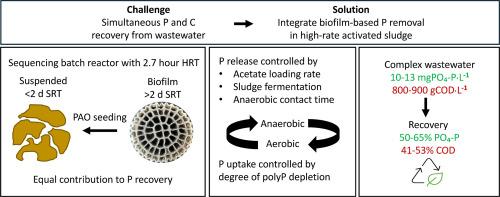
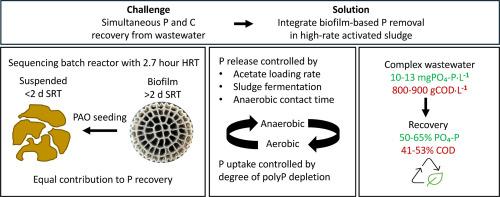
High-rate activated sludge operated at <2 days biomass age enhances carbon recovery from wastewater, but simultaneous biological recovery of phosphorus remains unachieved. Addressing the reported loss of phosphorus accumulating organisms (PAO) at such short biomass ages, this study investigated the integration of moving bed biofilms into high-rate activated sludge to enhance PAO retention. The results demonstrated sustained biofilm-based PAO activity and complete orthoP removal under short anaerobic-aerobic cycles with a hydraulic retention time of 2.7 h matching high-rate conditions. When combined with high-rate activated sludge in a sequencing batch reactor fed with acetate, complete orthoP removal was sustained. However, using synthetic wastewater promoted the growth of competing heterotrophic bacteria, reducing orthoP removal to 50–65 %. Biofilms served as a continuous source of PAO for the suspended biomass, which contributed to 46–55 % of the overall orthoP removal, even below 2 days biomass age. While acetate-fed microbial communities included known PAOs, using complex feed shifted the community toward less understood putative PAOs. Competition for acetate was likely compensated by a high fermentability of high-rate activated sludge, as PAO activity was maintained while reducing the acetate load in the feed from 20:1 to 5:1 g acetate⋅g P-1. P release and uptake rates were accurately described by the biomass-specific acetate loading rate and the depletion of intracellular polyphosphate, respectively, providing predictive relationships for process optimization. Imposing an anaerobic-aerobic regime enhanced the carbon recovery of high-rate activated sludge from about 37 to 60 %. Integrating biofilms enabled efficient phosphorus removal while maintaining carbon recovery rates of 41–53 %, highlighting the synergistic benefits of this approach.
期刊介绍:
Water Research, along with its open access companion journal Water Research X, serves as a platform for publishing original research papers covering various aspects of the science and technology related to the anthropogenic water cycle, water quality, and its management worldwide. The audience targeted by the journal comprises biologists, chemical engineers, chemists, civil engineers, environmental engineers, limnologists, and microbiologists. The scope of the journal include:
•Treatment processes for water and wastewaters (municipal, agricultural, industrial, and on-site treatment), including resource recovery and residuals management;
•Urban hydrology including sewer systems, stormwater management, and green infrastructure;
•Drinking water treatment and distribution;
•Potable and non-potable water reuse;
•Sanitation, public health, and risk assessment;
•Anaerobic digestion, solid and hazardous waste management, including source characterization and the effects and control of leachates and gaseous emissions;
•Contaminants (chemical, microbial, anthropogenic particles such as nanoparticles or microplastics) and related water quality sensing, monitoring, fate, and assessment;
•Anthropogenic impacts on inland, tidal, coastal and urban waters, focusing on surface and ground waters, and point and non-point sources of pollution;
•Environmental restoration, linked to surface water, groundwater and groundwater remediation;
•Analysis of the interfaces between sediments and water, and between water and atmosphere, focusing specifically on anthropogenic impacts;
•Mathematical modelling, systems analysis, machine learning, and beneficial use of big data related to the anthropogenic water cycle;
•Socio-economic, policy, and regulations studies.



 京公网安备 11010802042870号
京ICP备2023020795号-1
京公网安备 11010802042870号
京ICP备2023020795号-1

 分享
分享
 求助内容:
求助内容: 应助结果提醒方式:
 扫码关注我们
