Aiguo Rao, Shiyu Zhang, Mingqing Yang, Lei Wang, Chunhui Niu, Ming Fu
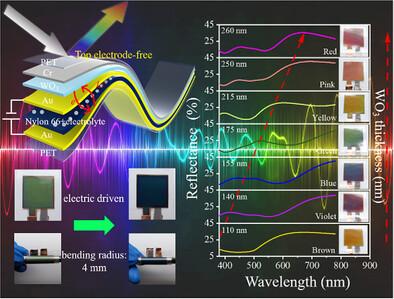
{"title":"Top Electrode-Free Electrochromic Device with Ultra-Flexibility and Wide Color Gamut Based on Porous Resonant Cavity","authors":"Aiguo Rao, Shiyu Zhang, Mingqing Yang, Lei Wang, Chunhui Niu, Ming Fu","doi":"10.1002/smll.202412644","DOIUrl":null,"url":null,"abstract":"<p>Recently, various types of resonant cavities are widely fused with inorganic electrochromic material WO<sub>3</sub> to compensate for its monotonous color modulation range. However, combining stabilized flexibility and vivid color performance in electrochromic devices is limited by the inherent brittleness and constrained transparency of commonly used top transparent electrodes, such as indium tin oxide (ITO). Herein, a novel top electrode-free structure of Cr/WO<sub>3</sub>/Au metal-dielectric-metal (MDM) resonant cavity type flexible multicolor electrochromic device based on inner-layer porous Nylon 66 substrate is reported. By implementing a UV-cured gel electrolyte and PET thermoplastic sealing process, the electrochromic device exhibits ultra-flexibility, retaining 92.9% of its initial performance after 900 bending cycles at a radius of 4 mm, a wide color gamut spanning hues from violet to red, 40.59% maximum reflectance, and fast response times (<i>t<sub>colored</sub></i>/<i>t<sub>bleached</sub></i> = 4.5 s/4.8 s). The porous MDM cavity generates a sharper scattered multi-beam interference resonance and provides a multi-path transport channel for ions, while the bottom porous Au reflection layer serves as the conductive electrode thus replacing the top transparent electrodes in traditional sandwich-like electrochromic device structure. Moreover, a large-area multipixel electrochromic array is further proposed to display different patterns, which demonstrates potential applications in future wearable electronic labels and smart camouflage.</p>","PeriodicalId":228,"journal":{"name":"Small","volume":"21 19","pages":""},"PeriodicalIF":12.1000,"publicationDate":"2025-03-25","publicationTypes":"Journal Article","fieldsOfStudy":null,"isOpenAccess":false,"openAccessPdf":"","citationCount":"0","resultStr":null,"platform":"Semanticscholar","paperid":null,"PeriodicalName":"Small","FirstCategoryId":"88","ListUrlMain":"https://onlinelibrary.wiley.com/doi/10.1002/smll.202412644","RegionNum":2,"RegionCategory":"材料科学","ArticlePicture":[],"TitleCN":null,"AbstractTextCN":null,"PMCID":null,"EPubDate":"","PubModel":"","JCR":"Q1","JCRName":"CHEMISTRY, MULTIDISCIPLINARY","Score":null,"Total":0}
引用次数: 0
Abstract
Recently, various types of resonant cavities are widely fused with inorganic electrochromic material WO3 to compensate for its monotonous color modulation range. However, combining stabilized flexibility and vivid color performance in electrochromic devices is limited by the inherent brittleness and constrained transparency of commonly used top transparent electrodes, such as indium tin oxide (ITO). Herein, a novel top electrode-free structure of Cr/WO3/Au metal-dielectric-metal (MDM) resonant cavity type flexible multicolor electrochromic device based on inner-layer porous Nylon 66 substrate is reported. By implementing a UV-cured gel electrolyte and PET thermoplastic sealing process, the electrochromic device exhibits ultra-flexibility, retaining 92.9% of its initial performance after 900 bending cycles at a radius of 4 mm, a wide color gamut spanning hues from violet to red, 40.59% maximum reflectance, and fast response times (tcolored/tbleached = 4.5 s/4.8 s). The porous MDM cavity generates a sharper scattered multi-beam interference resonance and provides a multi-path transport channel for ions, while the bottom porous Au reflection layer serves as the conductive electrode thus replacing the top transparent electrodes in traditional sandwich-like electrochromic device structure. Moreover, a large-area multipixel electrochromic array is further proposed to display different patterns, which demonstrates potential applications in future wearable electronic labels and smart camouflage.
期刊介绍:
Small serves as an exceptional platform for both experimental and theoretical studies in fundamental and applied interdisciplinary research at the nano- and microscale. The journal offers a compelling mix of peer-reviewed Research Articles, Reviews, Perspectives, and Comments.
With a remarkable 2022 Journal Impact Factor of 13.3 (Journal Citation Reports from Clarivate Analytics, 2023), Small remains among the top multidisciplinary journals, covering a wide range of topics at the interface of materials science, chemistry, physics, engineering, medicine, and biology.
Small's readership includes biochemists, biologists, biomedical scientists, chemists, engineers, information technologists, materials scientists, physicists, and theoreticians alike.




 京公网安备 11010802042870号
京ICP备2023020795号-1
京公网安备 11010802042870号
京ICP备2023020795号-1

 分享
分享
 求助内容:
求助内容: 应助结果提醒方式:
 扫码关注我们
