Nanoscale phosphorus-based agrochemicals enhance tomato and rice growth via positively modulating the growth-associated gene expression and endophytic microbial community†
Mengchen Tian, Zihao Zhao, Qingqing Li, Zeyu Cai, Weili Jia, Xinxin Xu, Anqi Liang, Shuai Wang, Jason C. White, Chuanxin Ma and Baoshan Xing
{"title":"Nanoscale phosphorus-based agrochemicals enhance tomato and rice growth via positively modulating the growth-associated gene expression and endophytic microbial community†","authors":"Mengchen Tian, Zihao Zhao, Qingqing Li, Zeyu Cai, Weili Jia, Xinxin Xu, Anqi Liang, Shuai Wang, Jason C. White, Chuanxin Ma and Baoshan Xing","doi":"10.1039/D5EN00140D","DOIUrl":null,"url":null,"abstract":"<p >Nano-hydroxyapatite (nHA) has attracted increasing attention as a potential novel fertilizer. The present study investigated the effects of root exposure to nHAs (20 nm-nHA, 60 nm-nHA, 1% Cu-nHA, and 10% Cu-nHA) at 50 mg kg<small><sup>−1</sup></small> on the growth and development of tomato (<em>Solanum lycopersicum</em> L.) and rice (<em>Oryza sativa</em> L.) seedlings for 50 days. Compared with the control, different types of 50 mg kg<small><sup>−1</sup></small> nHA increased the biomass of seedlings by 10.7–30.9%; for example, 20 nHA significantly increased the fresh weight of the two plant species by 17.2% and 29.2%, respectively. Additionally, 20 nm-nHA and 1% Cu-nHA altered the diversity of plant endophytic microbial communities and increased the abundance of plant-associated beneficial microorganisms, including <em>Glomeromycotina</em>, <em>Funneliformis</em>, and <em>Blastocladiomycota</em>. Transcriptomic analysis suggests that 20 nm-nHA and 1% Cu-nHA induced transcriptional reprogramming in exposed seedlings. KEGG pathway analysis shows that root exposure to 20 nm-nHA and 1% Cu-nHA promoted plant hormone signal transduction pathways in both tomato and rice roots; and, 1% Cu-nHA promoted photosynthesis and amino acid metabolism. Overall, this work demonstrates that root exposure to 50 mg kg<small><sup>−1</sup></small> 20 nm-nHA significantly improves crop growth, and provides valuable insight into the development of novel nanoscale phosphorus fertilizers as a sustainable path for precision agriculture.</p>","PeriodicalId":73,"journal":{"name":"Environmental Science: Nano","volume":" 5","pages":" 2603-2616"},"PeriodicalIF":5.1000,"publicationDate":"2025-03-25","publicationTypes":"Journal Article","fieldsOfStudy":null,"isOpenAccess":false,"openAccessPdf":"","citationCount":"0","resultStr":null,"platform":"Semanticscholar","paperid":null,"PeriodicalName":"Environmental Science: Nano","FirstCategoryId":"6","ListUrlMain":"https://pubs.rsc.org/en/content/articlelanding/2025/en/d5en00140d","RegionNum":2,"RegionCategory":"环境科学与生态学","ArticlePicture":[],"TitleCN":null,"AbstractTextCN":null,"PMCID":null,"EPubDate":"","PubModel":"","JCR":"Q1","JCRName":"CHEMISTRY, MULTIDISCIPLINARY","Score":null,"Total":0}
引用次数: 0
Abstract
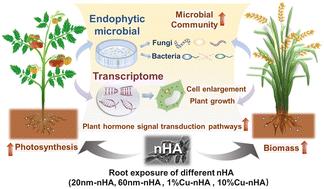
Nano-hydroxyapatite (nHA) has attracted increasing attention as a potential novel fertilizer. The present study investigated the effects of root exposure to nHAs (20 nm-nHA, 60 nm-nHA, 1% Cu-nHA, and 10% Cu-nHA) at 50 mg kg−1 on the growth and development of tomato (Solanum lycopersicum L.) and rice (Oryza sativa L.) seedlings for 50 days. Compared with the control, different types of 50 mg kg−1 nHA increased the biomass of seedlings by 10.7–30.9%; for example, 20 nHA significantly increased the fresh weight of the two plant species by 17.2% and 29.2%, respectively. Additionally, 20 nm-nHA and 1% Cu-nHA altered the diversity of plant endophytic microbial communities and increased the abundance of plant-associated beneficial microorganisms, including Glomeromycotina, Funneliformis, and Blastocladiomycota. Transcriptomic analysis suggests that 20 nm-nHA and 1% Cu-nHA induced transcriptional reprogramming in exposed seedlings. KEGG pathway analysis shows that root exposure to 20 nm-nHA and 1% Cu-nHA promoted plant hormone signal transduction pathways in both tomato and rice roots; and, 1% Cu-nHA promoted photosynthesis and amino acid metabolism. Overall, this work demonstrates that root exposure to 50 mg kg−1 20 nm-nHA significantly improves crop growth, and provides valuable insight into the development of novel nanoscale phosphorus fertilizers as a sustainable path for precision agriculture.
期刊介绍:
Environmental Science: Nano serves as a comprehensive and high-impact peer-reviewed source of information on the design and demonstration of engineered nanomaterials for environment-based applications. It also covers the interactions between engineered, natural, and incidental nanomaterials with biological and environmental systems. This scope includes, but is not limited to, the following topic areas:
Novel nanomaterial-based applications for water, air, soil, food, and energy sustainability
Nanomaterial interactions with biological systems and nanotoxicology
Environmental fate, reactivity, and transformations of nanoscale materials
Nanoscale processes in the environment
Sustainable nanotechnology including rational nanomaterial design, life cycle assessment, risk/benefit analysis



 京公网安备 11010802042870号
京ICP备2023020795号-1
京公网安备 11010802042870号
京ICP备2023020795号-1

 分享
分享
 求助内容:
求助内容: 应助结果提醒方式:
 扫码关注我们
