X.L. Xu , M.Y. Wang , H.T. Jiang , W.W. Liu, G.R. Sun, W. Ma
{"title":"UV enhanced SnO2/TiO2 nanorods-based flexible room temperature sensor by tuning interfacial chemistry and microstructure","authors":"X.L. Xu , M.Y. Wang , H.T. Jiang , W.W. Liu, G.R. Sun, W. Ma","doi":"10.1016/j.snb.2025.137680","DOIUrl":null,"url":null,"abstract":"<div><div>The high working temperature of metal oxide semiconductors hinders its application in flexible sensing devices. In this paper, a UV-activated flexible sensor operating at room temperature (RT, 25℃) is first reported based on SnO<sub>2</sub> nanoparticles embedded in photo-catalytic TiO<sub>2</sub> nanorods matrix. The UV-irradiated SnO<sub>2</sub>/TiO<sub>2</sub> sensor exhibits excellent selectivity (109 ppm, 37 %) to CH<sub>3</sub>COOH and reduced response/recovery time (12 s/41 s). The excellent RT flexible sensing properties are attributed to the synergistic action of UV-365 nm irradiation, the hetero-embedded microstructure and innovative terpineol binder. UV irradiation generates substantial <span><math><msubsup><mrow><mi>e</mi></mrow><mrow><mi>h</mi><mi>υ</mi></mrow><mrow><mo>−</mo></mrow></msubsup></math></span>-<span><math><msubsup><mrow><mi>h</mi></mrow><mrow><mi>h</mi><mi>υ</mi></mrow><mrow><mo>+</mo></mrow></msubsup></math></span> pairs, which serve as active sites to promote the chemisorption and redox reactions. Additional activation energy helps to improve adsorption/desorption kinetics. The heterojunction provides abundant channels, facilitating the separation and transfer of photogenerated carriers. The effect of relative humidity (RH) and temperature variations around RT on the sensor response towards CH<sub>3</sub>COOH are investigated. Under low-RH (35 %-45 %) and high-RH conditions (above 45 %), 1 % RH change has the same effect on the sensor response than 7.2 ppm and 59.4 ppm CH<sub>3</sub>COOH, respectively. 1°C temperature change exhibits the same effect than 17.9 ppm CH<sub>3</sub>COOH. Such a noise effect is by far not suitable for real-world applications. In addition, the response to 109 ppm CO reaches up to 89.5. Therefore, the sensor is seriously disturbed by CO and further research is needed. Above all, UV assistants, hetero-composites combining with innovative microstructure design are expected to be a collaborative enhancement strategy for MOSs-based RT flexible sensors.</div></div>","PeriodicalId":425,"journal":{"name":"Sensors and Actuators B: Chemical","volume":"435 ","pages":"Article 137680"},"PeriodicalIF":3.7000,"publicationDate":"2025-07-15","publicationTypes":"Journal Article","fieldsOfStudy":null,"isOpenAccess":false,"openAccessPdf":"","citationCount":"0","resultStr":null,"platform":"Semanticscholar","paperid":null,"PeriodicalName":"Sensors and Actuators B: Chemical","FirstCategoryId":"92","ListUrlMain":"https://www.sciencedirect.com/science/article/pii/S0925400525004551","RegionNum":1,"RegionCategory":"化学","ArticlePicture":[],"TitleCN":null,"AbstractTextCN":null,"PMCID":null,"EPubDate":"2025/3/24 0:00:00","PubModel":"Epub","JCR":"Q1","JCRName":"CHEMISTRY, ANALYTICAL","Score":null,"Total":0}
引用次数: 0
Abstract
The high working temperature of metal oxide semiconductors hinders its application in flexible sensing devices. In this paper, a UV-activated flexible sensor operating at room temperature (RT, 25℃) is first reported based on SnO2 nanoparticles embedded in photo-catalytic TiO2 nanorods matrix. The UV-irradiated SnO2/TiO2 sensor exhibits excellent selectivity (109 ppm, 37 %) to CH3COOH and reduced response/recovery time (12 s/41 s). The excellent RT flexible sensing properties are attributed to the synergistic action of UV-365 nm irradiation, the hetero-embedded microstructure and innovative terpineol binder. UV irradiation generates substantial - pairs, which serve as active sites to promote the chemisorption and redox reactions. Additional activation energy helps to improve adsorption/desorption kinetics. The heterojunction provides abundant channels, facilitating the separation and transfer of photogenerated carriers. The effect of relative humidity (RH) and temperature variations around RT on the sensor response towards CH3COOH are investigated. Under low-RH (35 %-45 %) and high-RH conditions (above 45 %), 1 % RH change has the same effect on the sensor response than 7.2 ppm and 59.4 ppm CH3COOH, respectively. 1°C temperature change exhibits the same effect than 17.9 ppm CH3COOH. Such a noise effect is by far not suitable for real-world applications. In addition, the response to 109 ppm CO reaches up to 89.5. Therefore, the sensor is seriously disturbed by CO and further research is needed. Above all, UV assistants, hetero-composites combining with innovative microstructure design are expected to be a collaborative enhancement strategy for MOSs-based RT flexible sensors.
期刊介绍:
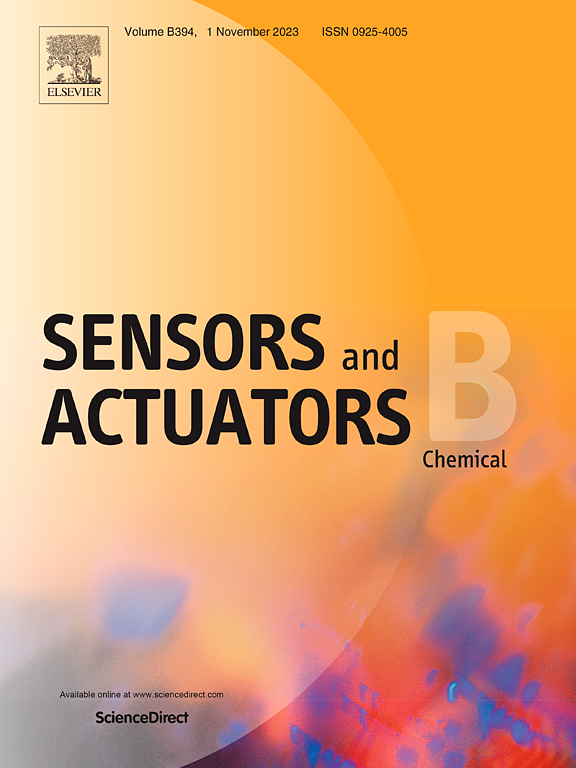
Sensors & Actuators, B: Chemical is an international journal focused on the research and development of chemical transducers. It covers chemical sensors and biosensors, chemical actuators, and analytical microsystems. The journal is interdisciplinary, aiming to publish original works showcasing substantial advancements beyond the current state of the art in these fields, with practical applicability to solving meaningful analytical problems. Review articles are accepted by invitation from an Editor of the journal.





 京公网安备 11010802042870号
京ICP备2023020795号-1
京公网安备 11010802042870号
京ICP备2023020795号-1

 分享
分享
 求助内容:
求助内容: 应助结果提醒方式:
 扫码关注我们
