Renjing Duan, Xiaoshi Lang, Xiang Wang, Lan Li, Tingting Qu, Lin Wang, Jianbin Li, Chuangang Yao, Kedi Cai
{"title":"Perovskite quantum dots Revolutionize Lithium-Sulfur battery Performance: Cathode catalytic Breakthrough with CsPbBr3","authors":"Renjing Duan, Xiaoshi Lang, Xiang Wang, Lan Li, Tingting Qu, Lin Wang, Jianbin Li, Chuangang Yao, Kedi Cai","doi":"10.1016/j.cej.2025.161970","DOIUrl":null,"url":null,"abstract":"Lithium-sulfur batteries (LSBs) are considered one of the most promising energy storage devices, but some challenges such as the low conductivity of the sulfur cathode and the shuttle effect of polysulfides have hindered their commercialization. Here, we have developed a composite catalytic material (PTI-CsPbBr<sub>3</sub>) with CsPbBr<sub>3</sub> halide perovskite quantum dots loading on a polyaniline (PANI) modified with TiO<sub>2</sub> (PTI) substrate as the sulfur host for the LSB. CsPbBr<sub>3</sub> perovskite quantum dots (CsPbBr<sub>3</sub> QDs), as nanoscale perovskite materials, combine the inherent excellent charge transport properties and structural stability of perovskite with the unique size and surface effects of quantum dots. The special octahedral framework structure results in a large number of unsaturated coordination sites on the surface, creating abundant active centers which is beneficial for enhancing the catalytic activity of the material. Moreover, the small size of CsPbBr<sub>3</sub> QDs effectively mitigates the significant polarization issues caused by larger grain sizes in traditional perovskite materials so as to exhibit excellent interactions with lithium polysulfides (LiPSs). Then, they can significantly reduce the activation energy of LiPSs decomposition reactions in order to accelerate the conversion reaction rate of LiPSs. Therefore, the PTI-CsPbBr<sub>3</sub>/S composite cathode at a ratio to 30:1 exhibits excellent LiPSs adsorption and catalytic properties for high-performance lithium-sulfur batteries. Even at a high sulfur loading (6 mg·cm<sup>−2</sup>) and a current density of 0.5C, it still remains stable for 500 cycles with a capacity attenuation rate of only 0.15 % for a single cycle.","PeriodicalId":270,"journal":{"name":"Chemical Engineering Journal","volume":"9 1","pages":""},"PeriodicalIF":13.2000,"publicationDate":"2025-03-25","publicationTypes":"Journal Article","fieldsOfStudy":null,"isOpenAccess":false,"openAccessPdf":"","citationCount":"0","resultStr":null,"platform":"Semanticscholar","paperid":null,"PeriodicalName":"Chemical Engineering Journal","FirstCategoryId":"5","ListUrlMain":"https://doi.org/10.1016/j.cej.2025.161970","RegionNum":1,"RegionCategory":"工程技术","ArticlePicture":[],"TitleCN":null,"AbstractTextCN":null,"PMCID":null,"EPubDate":"","PubModel":"","JCR":"Q1","JCRName":"ENGINEERING, CHEMICAL","Score":null,"Total":0}
引用次数: 0
Abstract
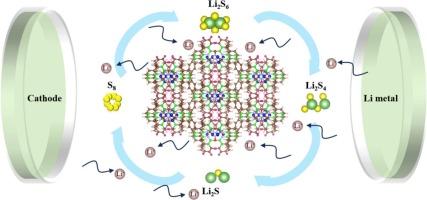
Lithium-sulfur batteries (LSBs) are considered one of the most promising energy storage devices, but some challenges such as the low conductivity of the sulfur cathode and the shuttle effect of polysulfides have hindered their commercialization. Here, we have developed a composite catalytic material (PTI-CsPbBr3) with CsPbBr3 halide perovskite quantum dots loading on a polyaniline (PANI) modified with TiO2 (PTI) substrate as the sulfur host for the LSB. CsPbBr3 perovskite quantum dots (CsPbBr3 QDs), as nanoscale perovskite materials, combine the inherent excellent charge transport properties and structural stability of perovskite with the unique size and surface effects of quantum dots. The special octahedral framework structure results in a large number of unsaturated coordination sites on the surface, creating abundant active centers which is beneficial for enhancing the catalytic activity of the material. Moreover, the small size of CsPbBr3 QDs effectively mitigates the significant polarization issues caused by larger grain sizes in traditional perovskite materials so as to exhibit excellent interactions with lithium polysulfides (LiPSs). Then, they can significantly reduce the activation energy of LiPSs decomposition reactions in order to accelerate the conversion reaction rate of LiPSs. Therefore, the PTI-CsPbBr3/S composite cathode at a ratio to 30:1 exhibits excellent LiPSs adsorption and catalytic properties for high-performance lithium-sulfur batteries. Even at a high sulfur loading (6 mg·cm−2) and a current density of 0.5C, it still remains stable for 500 cycles with a capacity attenuation rate of only 0.15 % for a single cycle.
期刊介绍:
The Chemical Engineering Journal is an international research journal that invites contributions of original and novel fundamental research. It aims to provide an international platform for presenting original fundamental research, interpretative reviews, and discussions on new developments in chemical engineering. The journal welcomes papers that describe novel theory and its practical application, as well as those that demonstrate the transfer of techniques from other disciplines. It also welcomes reports on carefully conducted experimental work that is soundly interpreted. The main focus of the journal is on original and rigorous research results that have broad significance. The Catalysis section within the Chemical Engineering Journal focuses specifically on Experimental and Theoretical studies in the fields of heterogeneous catalysis, molecular catalysis, and biocatalysis. These studies have industrial impact on various sectors such as chemicals, energy, materials, foods, healthcare, and environmental protection.




 京公网安备 11010802042870号
京ICP备2023020795号-1
京公网安备 11010802042870号
京ICP备2023020795号-1

 分享
分享
 求助内容:
求助内容: 应助结果提醒方式:
 扫码关注我们
