The butterfly-effect of flexible linkers in giant-molecule acceptors: optimized crystallization and aggregation for enhancing mechanical durability and approaching 19% efficiency in binary organic solar cells†
Qinrui Ye, Wei Song, Yongqi Bai, Zhenyu Chen, Pengfei Ding, Jinfeng Ge, Yuanyuan Meng, Bin Han, Xin Zhou and Ziyi Ge
{"title":"The butterfly-effect of flexible linkers in giant-molecule acceptors: optimized crystallization and aggregation for enhancing mechanical durability and approaching 19% efficiency in binary organic solar cells†","authors":"Qinrui Ye, Wei Song, Yongqi Bai, Zhenyu Chen, Pengfei Ding, Jinfeng Ge, Yuanyuan Meng, Bin Han, Xin Zhou and Ziyi Ge","doi":"10.1039/D4EE05456C","DOIUrl":null,"url":null,"abstract":"<p >Achieving a balance between power conversion efficiency (PCE) and mechanical robustness in flexible organic solar cells (OSCs) remains a significant challenge for small molecule acceptors (SMAs) and polymer acceptors. Here, we developed a series of flexible linker giant-molecule acceptors (GMAs), DSY-C4 to DSY-C10, by incorporating flexible linkers of varying lengths at side chain sites. The optimized DSY-C10-based device demonstrated both high efficiency (PCE = 18.89%) and exceptional mechanical resilience (crack-onset strain (COS) = 9.95%) in binary OSCs, representing a new benchmark for highly ductile acceptors. The linkage at side chain sites makes the molecules exhibit butterfly-like conformations and the flexible linker reduces spatial site resistance, significantly improving the crystallinity and aggregation of GMAs. As a result, the PM6:DSY-C10-based device exhibits superior short-circuit current density (<em>J</em><small><sub>SC</sub></small> = 27.51 mA cm<small><sup>−2</sup></small>) and fill factor (FF = 0.785) compared with the PM6:DSY-C4-based device (<em>J</em><small><sub>SC</sub></small> = 26.65 mA cm<small><sup>−2</sup></small> and FF = 0.728). Additionally, the longer flexible linker enhanced donor–acceptor interactions, leading to a 65% higher COS for the PM6:DSY-C10 blend film compared to PM6:DSY-C4 (COS = 6.04%), approaching the performance of a polymer acceptor (PT-IY). In addition, the incorporation of DSY-C10 into the PM6:BTP-eC9 binary blend achieved an efficiency of 19.91% (certified 19.39%), underscoring the potential of flexible linker GMAs for high-efficiency flexible OSCs. These results demonstrate that flexible linker GMAs provide an unprecedented balance of PCE and mechanical robustness in binary OSCs, paving the way for durable flexible OSCs.</p>","PeriodicalId":72,"journal":{"name":"Energy & Environmental Science","volume":" 9","pages":" 4373-4383"},"PeriodicalIF":30.8000,"publicationDate":"2025-03-25","publicationTypes":"Journal Article","fieldsOfStudy":null,"isOpenAccess":false,"openAccessPdf":"","citationCount":"0","resultStr":null,"platform":"Semanticscholar","paperid":null,"PeriodicalName":"Energy & Environmental Science","FirstCategoryId":"88","ListUrlMain":"https://pubs.rsc.org/en/content/articlelanding/2025/ee/d4ee05456c","RegionNum":1,"RegionCategory":"材料科学","ArticlePicture":[],"TitleCN":null,"AbstractTextCN":null,"PMCID":null,"EPubDate":"","PubModel":"","JCR":"Q1","JCRName":"CHEMISTRY, MULTIDISCIPLINARY","Score":null,"Total":0}
引用次数: 0
Abstract
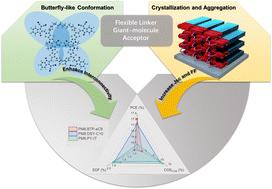
Achieving a balance between power conversion efficiency (PCE) and mechanical robustness in flexible organic solar cells (OSCs) remains a significant challenge for small molecule acceptors (SMAs) and polymer acceptors. Here, we developed a series of flexible linker giant-molecule acceptors (GMAs), DSY-C4 to DSY-C10, by incorporating flexible linkers of varying lengths at side chain sites. The optimized DSY-C10-based device demonstrated both high efficiency (PCE = 18.89%) and exceptional mechanical resilience (crack-onset strain (COS) = 9.95%) in binary OSCs, representing a new benchmark for highly ductile acceptors. The linkage at side chain sites makes the molecules exhibit butterfly-like conformations and the flexible linker reduces spatial site resistance, significantly improving the crystallinity and aggregation of GMAs. As a result, the PM6:DSY-C10-based device exhibits superior short-circuit current density (JSC = 27.51 mA cm−2) and fill factor (FF = 0.785) compared with the PM6:DSY-C4-based device (JSC = 26.65 mA cm−2 and FF = 0.728). Additionally, the longer flexible linker enhanced donor–acceptor interactions, leading to a 65% higher COS for the PM6:DSY-C10 blend film compared to PM6:DSY-C4 (COS = 6.04%), approaching the performance of a polymer acceptor (PT-IY). In addition, the incorporation of DSY-C10 into the PM6:BTP-eC9 binary blend achieved an efficiency of 19.91% (certified 19.39%), underscoring the potential of flexible linker GMAs for high-efficiency flexible OSCs. These results demonstrate that flexible linker GMAs provide an unprecedented balance of PCE and mechanical robustness in binary OSCs, paving the way for durable flexible OSCs.
期刊介绍:
Energy & Environmental Science, a peer-reviewed scientific journal, publishes original research and review articles covering interdisciplinary topics in the (bio)chemical and (bio)physical sciences, as well as chemical engineering disciplines. Published monthly by the Royal Society of Chemistry (RSC), a not-for-profit publisher, Energy & Environmental Science is recognized as a leading journal. It boasts an impressive impact factor of 8.500 as of 2009, ranking 8th among 140 journals in the category "Chemistry, Multidisciplinary," second among 71 journals in "Energy & Fuels," second among 128 journals in "Engineering, Chemical," and first among 181 scientific journals in "Environmental Sciences."
Energy & Environmental Science publishes various types of articles, including Research Papers (original scientific work), Review Articles, Perspectives, and Minireviews (feature review-type articles of broad interest), Communications (original scientific work of an urgent nature), Opinions (personal, often speculative viewpoints or hypotheses on current topics), and Analysis Articles (in-depth examination of energy-related issues).




 京公网安备 11010802042870号
京ICP备2023020795号-1
京公网安备 11010802042870号
京ICP备2023020795号-1

 分享
分享
 求助内容:
求助内容: 应助结果提醒方式:
 扫码关注我们
