Zewei Zhu, Bingcan Ke, Kexuan Sun, Chengkai Jin, Zhenhua Song, Ruixuan Jiang, Jing Li, Song Kong, Chang Liu, Sai Bai, Sisi He, Ziyi Ge, Fuzhi Huang, Yi-Bing Cheng and Tongle Bu
{"title":"High-performance inverted perovskite solar cells and modules via aminothiazole passivation†","authors":"Zewei Zhu, Bingcan Ke, Kexuan Sun, Chengkai Jin, Zhenhua Song, Ruixuan Jiang, Jing Li, Song Kong, Chang Liu, Sai Bai, Sisi He, Ziyi Ge, Fuzhi Huang, Yi-Bing Cheng and Tongle Bu","doi":"10.1039/D5EE01083G","DOIUrl":null,"url":null,"abstract":"<p >The passivation of undesirable defects in the perovskite light-absorption layer is an essential and effective strategy for improving the performance of perovskite solar cells (PSCs). Herein, a novel additive, 5-aminothiazole hydrochloride (5ATCl), possessing both electron-accepting (NH<small><sub>3</sub></small><small><sup>+</sup></small>) and electron-donating (C<img>N) functional groups, is introduced into the perovskite precursor ink, enabling holistic improvements of perovskite thin-film quality and photovoltaic performance. Comprehensive theoretical calculations and experimental characterizations reveal strong hydrogen bonds and intermolecular coordination between 5ATCl with the perovskite components. Consequently, the perovskite films demonstrate increased grain size and improved film quality, along with a released residual stress and a reduced defect density. Furthermore, the 5ATCl contributes to a favorable energy level alignment, thus promoting charge transfer and minimizing open-circuit voltage loss of the resulting devices. Notably, the champion power conversion efficiencies (PCEs) of the rigid and flexible PSCs with the incorporation of 5ATCl reach 26.38% (certified 25.87%) and 24.54%, respectively. The stability of the devices is also enhanced, demonstrating a <em>T</em><small><sub>90</sub></small> lifetime of 850 hours under continuous light illumination at maximum power point tracking. Additionally, centimeter-sized PSCs and 5 cm × 5 cm solar mini-modules also demonstrate impressive PCEs of 24.86% and 21.72% respectively, indicating the great feasibility of our strategy in up-scaling device fabrication.</p>","PeriodicalId":72,"journal":{"name":"Energy & Environmental Science","volume":" 9","pages":" 4120-4129"},"PeriodicalIF":30.8000,"publicationDate":"2025-03-25","publicationTypes":"Journal Article","fieldsOfStudy":null,"isOpenAccess":false,"openAccessPdf":"","citationCount":"0","resultStr":null,"platform":"Semanticscholar","paperid":null,"PeriodicalName":"Energy & Environmental Science","FirstCategoryId":"88","ListUrlMain":"https://pubs.rsc.org/en/content/articlelanding/2025/ee/d5ee01083g","RegionNum":1,"RegionCategory":"材料科学","ArticlePicture":[],"TitleCN":null,"AbstractTextCN":null,"PMCID":null,"EPubDate":"","PubModel":"","JCR":"Q1","JCRName":"CHEMISTRY, MULTIDISCIPLINARY","Score":null,"Total":0}
引用次数: 0
Abstract
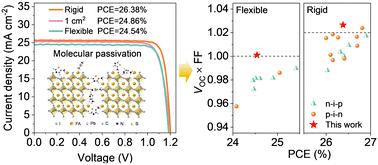
The passivation of undesirable defects in the perovskite light-absorption layer is an essential and effective strategy for improving the performance of perovskite solar cells (PSCs). Herein, a novel additive, 5-aminothiazole hydrochloride (5ATCl), possessing both electron-accepting (NH3+) and electron-donating (CN) functional groups, is introduced into the perovskite precursor ink, enabling holistic improvements of perovskite thin-film quality and photovoltaic performance. Comprehensive theoretical calculations and experimental characterizations reveal strong hydrogen bonds and intermolecular coordination between 5ATCl with the perovskite components. Consequently, the perovskite films demonstrate increased grain size and improved film quality, along with a released residual stress and a reduced defect density. Furthermore, the 5ATCl contributes to a favorable energy level alignment, thus promoting charge transfer and minimizing open-circuit voltage loss of the resulting devices. Notably, the champion power conversion efficiencies (PCEs) of the rigid and flexible PSCs with the incorporation of 5ATCl reach 26.38% (certified 25.87%) and 24.54%, respectively. The stability of the devices is also enhanced, demonstrating a T90 lifetime of 850 hours under continuous light illumination at maximum power point tracking. Additionally, centimeter-sized PSCs and 5 cm × 5 cm solar mini-modules also demonstrate impressive PCEs of 24.86% and 21.72% respectively, indicating the great feasibility of our strategy in up-scaling device fabrication.
期刊介绍:
Energy & Environmental Science, a peer-reviewed scientific journal, publishes original research and review articles covering interdisciplinary topics in the (bio)chemical and (bio)physical sciences, as well as chemical engineering disciplines. Published monthly by the Royal Society of Chemistry (RSC), a not-for-profit publisher, Energy & Environmental Science is recognized as a leading journal. It boasts an impressive impact factor of 8.500 as of 2009, ranking 8th among 140 journals in the category "Chemistry, Multidisciplinary," second among 71 journals in "Energy & Fuels," second among 128 journals in "Engineering, Chemical," and first among 181 scientific journals in "Environmental Sciences."
Energy & Environmental Science publishes various types of articles, including Research Papers (original scientific work), Review Articles, Perspectives, and Minireviews (feature review-type articles of broad interest), Communications (original scientific work of an urgent nature), Opinions (personal, often speculative viewpoints or hypotheses on current topics), and Analysis Articles (in-depth examination of energy-related issues).



 京公网安备 11010802042870号
京ICP备2023020795号-1
京公网安备 11010802042870号
京ICP备2023020795号-1

 分享
分享
 求助内容:
求助内容: 应助结果提醒方式:
 扫码关注我们
