A Nanoplatform of Reversing Tumor Immunosuppressive Microenvironment Based on the NIR-II Gold Hollow Nanorod for the Treatment of Hepatocellular Carcinoma
{"title":"A Nanoplatform of Reversing Tumor Immunosuppressive Microenvironment Based on the NIR-II Gold Hollow Nanorod for the Treatment of Hepatocellular Carcinoma","authors":"Xinyuan Cui, Cheng Cao, Wanting Hao, Xinni Pan, Yu Cao, Yanfei Fu, Huifang Hao, Yingao Jiao, Shujing Lin, Shengsheng Cui, Ruokun Li, Yanlei Liu, Fuhua Yan","doi":"10.1002/smll.202500144","DOIUrl":null,"url":null,"abstract":"<p>Advanced hepatocellular carcinoma (HCC) presents a strongly immunosuppressive tumor microenvironment, which enables tumor cells to evade immune cell attacks and hinder effective drug killing, thereby hindering the achievement of the desired therapeutic effect. In response, a novel nanoplatform- AuHNR@γ-Fe<sub>2</sub>O<sub>3</sub>@Lenvatinib@β-Glucan (AFLG) with surface modified β-1,3-glucan is developed, which exhibits potent immunostimulatory effect and the capability of repolarizing macrophages, to counteract the immunosuppressive conditions present in the tumor microenvironment. Leveraging the hollow structure of gold nanorods, Lenvatinib is efficiently loaded, a first-line targeted drug for HCC, which effectively inhibits tumor angiogenesis. Additionally, through atomic layer deposition, γ-Fe<sub>2</sub>O<sub>3</sub> is generated on the hollow gold nanorod surface, endowing it with chemodynamic therapy and magnetic resonance T<sub>2</sub>-weighted imaging capabilities while excellently maintaining the gold nanorod's superior photothermal therapy and photoacoustic imaging properties under 1064 nm excitation. These AFLG NPs feature dual-modal imaging and quadruple-modal synergistic therapy capabilities, along with their powerful potential in remodeling the immunosuppressive tumor microenvironment, offering an encouraging novel approach for the treatment of hepatocellular carcinoma.</p>","PeriodicalId":228,"journal":{"name":"Small","volume":"21 17","pages":""},"PeriodicalIF":12.1000,"publicationDate":"2025-03-25","publicationTypes":"Journal Article","fieldsOfStudy":null,"isOpenAccess":false,"openAccessPdf":"","citationCount":"0","resultStr":null,"platform":"Semanticscholar","paperid":null,"PeriodicalName":"Small","FirstCategoryId":"88","ListUrlMain":"https://onlinelibrary.wiley.com/doi/10.1002/smll.202500144","RegionNum":2,"RegionCategory":"材料科学","ArticlePicture":[],"TitleCN":null,"AbstractTextCN":null,"PMCID":null,"EPubDate":"","PubModel":"","JCR":"Q1","JCRName":"CHEMISTRY, MULTIDISCIPLINARY","Score":null,"Total":0}
引用次数: 0
Abstract
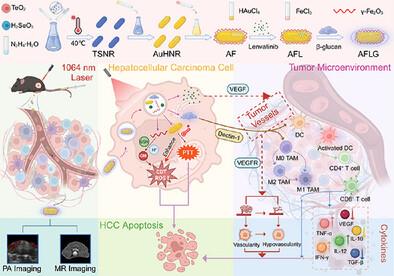
Advanced hepatocellular carcinoma (HCC) presents a strongly immunosuppressive tumor microenvironment, which enables tumor cells to evade immune cell attacks and hinder effective drug killing, thereby hindering the achievement of the desired therapeutic effect. In response, a novel nanoplatform- AuHNR@γ-Fe2O3@Lenvatinib@β-Glucan (AFLG) with surface modified β-1,3-glucan is developed, which exhibits potent immunostimulatory effect and the capability of repolarizing macrophages, to counteract the immunosuppressive conditions present in the tumor microenvironment. Leveraging the hollow structure of gold nanorods, Lenvatinib is efficiently loaded, a first-line targeted drug for HCC, which effectively inhibits tumor angiogenesis. Additionally, through atomic layer deposition, γ-Fe2O3 is generated on the hollow gold nanorod surface, endowing it with chemodynamic therapy and magnetic resonance T2-weighted imaging capabilities while excellently maintaining the gold nanorod's superior photothermal therapy and photoacoustic imaging properties under 1064 nm excitation. These AFLG NPs feature dual-modal imaging and quadruple-modal synergistic therapy capabilities, along with their powerful potential in remodeling the immunosuppressive tumor microenvironment, offering an encouraging novel approach for the treatment of hepatocellular carcinoma.
期刊介绍:
Small serves as an exceptional platform for both experimental and theoretical studies in fundamental and applied interdisciplinary research at the nano- and microscale. The journal offers a compelling mix of peer-reviewed Research Articles, Reviews, Perspectives, and Comments.
With a remarkable 2022 Journal Impact Factor of 13.3 (Journal Citation Reports from Clarivate Analytics, 2023), Small remains among the top multidisciplinary journals, covering a wide range of topics at the interface of materials science, chemistry, physics, engineering, medicine, and biology.
Small's readership includes biochemists, biologists, biomedical scientists, chemists, engineers, information technologists, materials scientists, physicists, and theoreticians alike.




 京公网安备 11010802042870号
京ICP备2023020795号-1
京公网安备 11010802042870号
京ICP备2023020795号-1

 分享
分享
 求助内容:
求助内容: 应助结果提醒方式:
 扫码关注我们
