Ke Shi, Yaze Chen, Haijiao Peng, Yuhao Liu, Chao Lu
{"title":"Intramolecular Charge Transfer-Regulated Isomeric Covalent Organic Frameworks for Multiple Solvent-Response","authors":"Ke Shi, Yaze Chen, Haijiao Peng, Yuhao Liu, Chao Lu","doi":"10.1002/smll.202501139","DOIUrl":null,"url":null,"abstract":"<p>Stimulus-responsive covalent organic frameworks (COFs) own color-switching characteristics when exposed to external stimuli. However, the investigations on the multiple solvent-responsive COFs remain a challenge due to the synthetic difficulties and uncontrollable charge transfer process toward various solvents. In this contribution, two novel isomeric COFs with a regulated intramolecular charge transfer (ICT) process by modulating the distance between the donor/acceptor and the linkage are synthesized. The as-prepared two isomeric COFs exhibited significantly distinct solvatochromic behaviors in water, acid, and halogenated solvents, respectively. These multiple solvent-responsive functions are attributed to the various enhancement degrees of the ICT process by the hydrogen bond interactions, protonation interactions, and halogen/π interactions, respectively. In addition, the two isomeric COFs are employed as stimulation-responsive powder or ink, displaying excellent image and data encryption performances. The work can not only offer a novel viewpoint for the creation of multiple solvent-responsive COFs but also expand the COFs' potential applications in information encryption and anti-counterfeiting.</p>","PeriodicalId":228,"journal":{"name":"Small","volume":"21 19","pages":""},"PeriodicalIF":12.1000,"publicationDate":"2025-03-25","publicationTypes":"Journal Article","fieldsOfStudy":null,"isOpenAccess":false,"openAccessPdf":"","citationCount":"0","resultStr":null,"platform":"Semanticscholar","paperid":null,"PeriodicalName":"Small","FirstCategoryId":"88","ListUrlMain":"https://onlinelibrary.wiley.com/doi/10.1002/smll.202501139","RegionNum":2,"RegionCategory":"材料科学","ArticlePicture":[],"TitleCN":null,"AbstractTextCN":null,"PMCID":null,"EPubDate":"","PubModel":"","JCR":"Q1","JCRName":"CHEMISTRY, MULTIDISCIPLINARY","Score":null,"Total":0}
引用次数: 0
Abstract
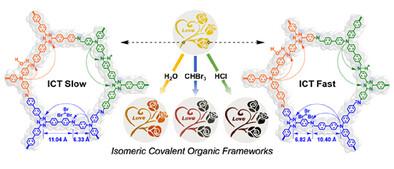
Stimulus-responsive covalent organic frameworks (COFs) own color-switching characteristics when exposed to external stimuli. However, the investigations on the multiple solvent-responsive COFs remain a challenge due to the synthetic difficulties and uncontrollable charge transfer process toward various solvents. In this contribution, two novel isomeric COFs with a regulated intramolecular charge transfer (ICT) process by modulating the distance between the donor/acceptor and the linkage are synthesized. The as-prepared two isomeric COFs exhibited significantly distinct solvatochromic behaviors in water, acid, and halogenated solvents, respectively. These multiple solvent-responsive functions are attributed to the various enhancement degrees of the ICT process by the hydrogen bond interactions, protonation interactions, and halogen/π interactions, respectively. In addition, the two isomeric COFs are employed as stimulation-responsive powder or ink, displaying excellent image and data encryption performances. The work can not only offer a novel viewpoint for the creation of multiple solvent-responsive COFs but also expand the COFs' potential applications in information encryption and anti-counterfeiting.
期刊介绍:
Small serves as an exceptional platform for both experimental and theoretical studies in fundamental and applied interdisciplinary research at the nano- and microscale. The journal offers a compelling mix of peer-reviewed Research Articles, Reviews, Perspectives, and Comments.
With a remarkable 2022 Journal Impact Factor of 13.3 (Journal Citation Reports from Clarivate Analytics, 2023), Small remains among the top multidisciplinary journals, covering a wide range of topics at the interface of materials science, chemistry, physics, engineering, medicine, and biology.
Small's readership includes biochemists, biologists, biomedical scientists, chemists, engineers, information technologists, materials scientists, physicists, and theoreticians alike.



 京公网安备 11010802042870号
京ICP备2023020795号-1
京公网安备 11010802042870号
京ICP备2023020795号-1

 分享
分享
 求助内容:
求助内容: 应助结果提醒方式:
 扫码关注我们
