{"title":"Implications of river reconnection on phosphorus cycling in coastal wetlands","authors":"Lee Potter, Peter Mates, John R. White","doi":"10.1016/j.scitotenv.2025.179205","DOIUrl":null,"url":null,"abstract":"<div><div>Louisiana's coastal wetlands are experiencing some of the world's largest land loss rates. This problem is partly due to levees along the Mississippi River, isolating the river from the coastal basins. This disconnect prevents delivering of sediment and nutrients to the wetland-dominated coastal basins, where sediments would increase marsh accretion. Louisiana's Coastal Master Plan aims to reconnect the river with riparian areas through construction of a diversion. Baseline phosphorus (P) dynamics were determined before river reconnection and compared to an area with an unmanaged connection to the river. In Barataria Basin, the equilibrium P concentration (EPC) was lower in both the marsh (0.039 ± 0.015 mg L<sup>−1</sup>) and open water sediments (0.016 ± 0.008 mg L<sup>−1</sup>) than the concentration of soluble reactive phosphorus (SRP) in the Mississippi River (∼0.075 mg L<sup>−1</sup>). Additionally, total P was significantly higher in marsh soil (677 ± 183 mg P kg<sup>−1</sup>) compared to the open water sediments (503 ± 90 mg P kg<sup>−1</sup>). On average, the organic residual P fraction was the dominant individual P form, comprising 39 % (254 ± 78.2 mg P kg<sup>−1</sup>) of total phosphorus (TP) in marsh soil and 45 % (208 ± 65.9 mg P kg <sup>−1</sup>) of TP in open water sediments. The primary form of total P in the river sediment is the Fe/Al mineral fraction at 43 % (469 mg P kg <sup>−1</sup>). Consequently, river reconnection, the dominant form of soil P will shift to inorganic Fe/Al-bound P. This shift will likely increase the internal loading of P over time due to iron reduction, releasing newly deposited mineral-bound phosphorus into the water column In vegetated wetland areas, this river-sourced P can be taken up by algae and macrophytes, while in open water areas, there could be an increase in algal blooms in these newly river-reconnected coastal basins, changing the P dynamics.</div></div>","PeriodicalId":422,"journal":{"name":"Science of the Total Environment","volume":"974 ","pages":"Article 179205"},"PeriodicalIF":8.0000,"publicationDate":"2025-04-25","publicationTypes":"Journal Article","fieldsOfStudy":null,"isOpenAccess":false,"openAccessPdf":"","citationCount":"0","resultStr":null,"platform":"Semanticscholar","paperid":null,"PeriodicalName":"Science of the Total Environment","FirstCategoryId":"93","ListUrlMain":"https://www.sciencedirect.com/science/article/pii/S004896972500840X","RegionNum":1,"RegionCategory":"环境科学与生态学","ArticlePicture":[],"TitleCN":null,"AbstractTextCN":null,"PMCID":null,"EPubDate":"2025/3/25 0:00:00","PubModel":"Epub","JCR":"Q1","JCRName":"ENVIRONMENTAL SCIENCES","Score":null,"Total":0}
引用次数: 0
Abstract
Louisiana's coastal wetlands are experiencing some of the world's largest land loss rates. This problem is partly due to levees along the Mississippi River, isolating the river from the coastal basins. This disconnect prevents delivering of sediment and nutrients to the wetland-dominated coastal basins, where sediments would increase marsh accretion. Louisiana's Coastal Master Plan aims to reconnect the river with riparian areas through construction of a diversion. Baseline phosphorus (P) dynamics were determined before river reconnection and compared to an area with an unmanaged connection to the river. In Barataria Basin, the equilibrium P concentration (EPC) was lower in both the marsh (0.039 ± 0.015 mg L−1) and open water sediments (0.016 ± 0.008 mg L−1) than the concentration of soluble reactive phosphorus (SRP) in the Mississippi River (∼0.075 mg L−1). Additionally, total P was significantly higher in marsh soil (677 ± 183 mg P kg−1) compared to the open water sediments (503 ± 90 mg P kg−1). On average, the organic residual P fraction was the dominant individual P form, comprising 39 % (254 ± 78.2 mg P kg−1) of total phosphorus (TP) in marsh soil and 45 % (208 ± 65.9 mg P kg −1) of TP in open water sediments. The primary form of total P in the river sediment is the Fe/Al mineral fraction at 43 % (469 mg P kg −1). Consequently, river reconnection, the dominant form of soil P will shift to inorganic Fe/Al-bound P. This shift will likely increase the internal loading of P over time due to iron reduction, releasing newly deposited mineral-bound phosphorus into the water column In vegetated wetland areas, this river-sourced P can be taken up by algae and macrophytes, while in open water areas, there could be an increase in algal blooms in these newly river-reconnected coastal basins, changing the P dynamics.
路易斯安那州的沿海湿地正在经历世界上最大的土地损失率。造成这一问题的部分原因是密西西比河沿岸的堤坝将河流与沿海盆地隔离开来。这种脱节阻碍了沉积物和营养物质向以湿地为主的沿海盆地输送,而沉积物会增加沼泽的增生。路易斯安那州的沿海总体规划旨在通过建设一个改道,将河流与沿岸地区重新连接起来。在河流重新连接之前确定了基线磷(P)动态,并与未管理的河流连接区域进行了比较。在Barataria盆地,沼泽(0.039±0.015 mg L−1)和开阔水域沉积物(0.016±0.008 mg L−1)的平衡磷浓度(EPC)均低于密西西比河(~ 0.075 mg L−1)的可溶性活性磷(SRP)浓度。此外,沼泽土壤的总磷含量(677±183 mg P kg - 1)显著高于开阔水域沉积物(503±90 mg P kg - 1)。平均而言,有机残余磷是主要的磷形态,占沼泽土壤总磷(TP)的39%(254±78.2 mg P kg−1),占开阔水域沉积物总磷的45%(208±65.9 mg P kg−1)。河流沉积物中总磷的主要形式为43% (469 mg P kg−1)的Fe/Al矿物组分。因此,河流重新连接后,土壤磷的主要形式将转变为无机铁/铝结合磷,这种转变可能会随着时间的推移,由于铁的减少而增加磷的内部负荷,将新沉积的矿物结合磷释放到水柱中。在植被湿地地区,这些河流来源的磷可以被藻类和大型植物吸收,而在开阔水域,这些新河流重新连接的沿海盆地中可能会出现藻华的增加,从而改变磷的动态。
期刊介绍:
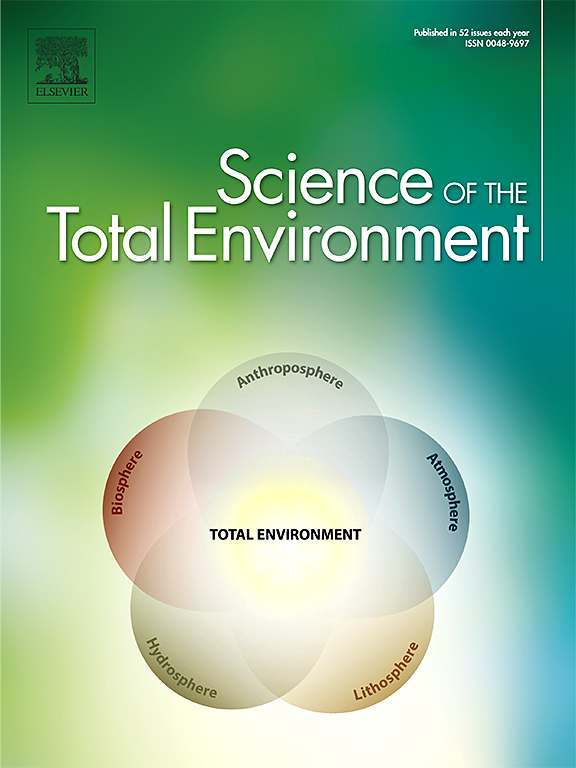
The Science of the Total Environment is an international journal dedicated to scientific research on the environment and its interaction with humanity. It covers a wide range of disciplines and seeks to publish innovative, hypothesis-driven, and impactful research that explores the entire environment, including the atmosphere, lithosphere, hydrosphere, biosphere, and anthroposphere.
The journal's updated Aims & Scope emphasizes the importance of interdisciplinary environmental research with broad impact. Priority is given to studies that advance fundamental understanding and explore the interconnectedness of multiple environmental spheres. Field studies are preferred, while laboratory experiments must demonstrate significant methodological advancements or mechanistic insights with direct relevance to the environment.




 京公网安备 11010802042870号
京ICP备2023020795号-1
京公网安备 11010802042870号
京ICP备2023020795号-1

 分享
分享
 求助内容:
求助内容: 应助结果提醒方式:
 扫码关注我们
