Dan Jiang , Congli Wang , Xuemei Niu , Ye Jiang , Minghui Huang , Chunjie Li
{"title":"Group behaviors and dynamics of plant-parasitic nematodes: Aggregation, clumping and their implications","authors":"Dan Jiang , Congli Wang , Xuemei Niu , Ye Jiang , Minghui Huang , Chunjie Li","doi":"10.1016/j.apsoil.2025.106043","DOIUrl":null,"url":null,"abstract":"<div><div>Plant-parasitic nematodes (PPNs), including root-knot nematodes (RKNs, <em>Meloidogyne</em> spp.) and soybean cyst nematodes (SCN, <em>Heterodera glycines</em>), exhibit distinct group behaviors that influence host location, infection efficiency and survival. <em>Meloidogyne</em> spp. displaying a strong tendency to aggregate around root tips, potentially contributing to their broader host range compared to <em>H. glycines</em>. The review explores the ecological and molecular drivers of nematode aggregation, including species-specific genetic traits, host plant interactions, micro-environmental conditions, and molecular signaling mechanisms. Genetic regulation, effector gene activation, and chemosensory pathways such as GPCR mediated signaling cascades and ascaroside pheromone-mediated communication play critical roles in nematode aggregation and host recognition. Nematode group behaviors also have significant ecological implications, shaping soil structure, nutrient cycling, and microbial community dynamics. Ascaroside pheromones mediate intra-species communication, facilitating aggregation and coordinated host invasion. Understanding these behaviors provides new strategies for nematode management, including disrupting pheromone signaling, targeting chemosensory pathways, and leveraging plant-derived metabolites to repel nematodes. Given the conservation of neurotransmitter systems, insights from plant-parasitic nematodes may also inform strategies for controlling medically significant parasitic nematodes. This review evaluates methodologies for studying nematode aggregation, including molecular and imaging approaches, and highlights their interdisciplinary relevance in sustainable agriculture and biomedical research. Identifying key molecular pathways underlying nematode clustering can drive the development of precision-targeted nematicides, pheromone-based control strategies, and broader applications in parasite-host interaction studies. By integrating molecular, ecological, and evolutionary perspectives, this review advances our understanding of nematode aggregation and its implications for pest management, soil ecology, and medical research.</div></div>","PeriodicalId":8099,"journal":{"name":"Applied Soil Ecology","volume":"209 ","pages":"Article 106043"},"PeriodicalIF":5.0000,"publicationDate":"2025-05-01","publicationTypes":"Journal Article","fieldsOfStudy":null,"isOpenAccess":false,"openAccessPdf":"","citationCount":"0","resultStr":null,"platform":"Semanticscholar","paperid":null,"PeriodicalName":"Applied Soil Ecology","FirstCategoryId":"97","ListUrlMain":"https://www.sciencedirect.com/science/article/pii/S0929139325001817","RegionNum":2,"RegionCategory":"农林科学","ArticlePicture":[],"TitleCN":null,"AbstractTextCN":null,"PMCID":null,"EPubDate":"2025/3/25 0:00:00","PubModel":"Epub","JCR":"Q1","JCRName":"SOIL SCIENCE","Score":null,"Total":0}
引用次数: 0
Abstract
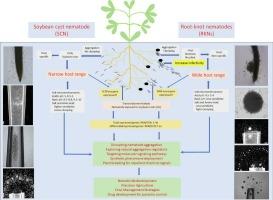
Plant-parasitic nematodes (PPNs), including root-knot nematodes (RKNs, Meloidogyne spp.) and soybean cyst nematodes (SCN, Heterodera glycines), exhibit distinct group behaviors that influence host location, infection efficiency and survival. Meloidogyne spp. displaying a strong tendency to aggregate around root tips, potentially contributing to their broader host range compared to H. glycines. The review explores the ecological and molecular drivers of nematode aggregation, including species-specific genetic traits, host plant interactions, micro-environmental conditions, and molecular signaling mechanisms. Genetic regulation, effector gene activation, and chemosensory pathways such as GPCR mediated signaling cascades and ascaroside pheromone-mediated communication play critical roles in nematode aggregation and host recognition. Nematode group behaviors also have significant ecological implications, shaping soil structure, nutrient cycling, and microbial community dynamics. Ascaroside pheromones mediate intra-species communication, facilitating aggregation and coordinated host invasion. Understanding these behaviors provides new strategies for nematode management, including disrupting pheromone signaling, targeting chemosensory pathways, and leveraging plant-derived metabolites to repel nematodes. Given the conservation of neurotransmitter systems, insights from plant-parasitic nematodes may also inform strategies for controlling medically significant parasitic nematodes. This review evaluates methodologies for studying nematode aggregation, including molecular and imaging approaches, and highlights their interdisciplinary relevance in sustainable agriculture and biomedical research. Identifying key molecular pathways underlying nematode clustering can drive the development of precision-targeted nematicides, pheromone-based control strategies, and broader applications in parasite-host interaction studies. By integrating molecular, ecological, and evolutionary perspectives, this review advances our understanding of nematode aggregation and its implications for pest management, soil ecology, and medical research.
期刊介绍:
Applied Soil Ecology addresses the role of soil organisms and their interactions in relation to: sustainability and productivity, nutrient cycling and other soil processes, the maintenance of soil functions, the impact of human activities on soil ecosystems and bio(techno)logical control of soil-inhabiting pests, diseases and weeds.



 京公网安备 11010802042870号
京ICP备2023020795号-1
京公网安备 11010802042870号
京ICP备2023020795号-1

 分享
分享
 求助内容:
求助内容: 应助结果提醒方式:
 扫码关注我们
