{"title":"Inhibitory mechanisms of quercetin on myoglobin-mediated lipid oxidation: Multi-spectroscopic and molecular docking studies","authors":"Shi-Ya Peng, Naihao Lu, Rong Tian","doi":"10.1016/j.saa.2025.126096","DOIUrl":null,"url":null,"abstract":"<div><div>Myoglobin (Mb) is an efficient inducer for lipid oxidation in muscle foods and protein–polyphenol binding is a well-known phenomenon. The effects of the interaction between quercetin (one of the most common flavonoids in natural plants and human diet) and Mb on lipid oxidation were scarcely elucidated. In this study, the interactions between quercetin and Mb were systematically investigated by multi-spectroscopic techniques (fluorescence, UV–vis absorption, circular dichroism (CD) spectra) and molecular docking, to demonstrate the structural mechanisms whereby bioactive quercetin influenced Mb redox state and stability. Quercetin bound into Mb central pocket to generate Mb-quercetin complex with one binding site, and binding process was spontaneous where hydrophobic interaction played a major role. Heme stability and free hemin (but not inorganic iron) liberated from Mb was vital to Mb oxidation and Mb-mediated lipid oxidation, and quercetin significantly inhibited Mb-mediated lipid oxidation in liposomes or muscles. The inhibitory mechanisms of quercetin were possibly attributable to that the binding of quercetin promoted the compactness of Mb and narrowed the crevice surrounding heme group, which resulted in the reduction of met-Mb to oxy-Mb state and suppression of free hemin loss. In agreement with its weaker properties to bind Mb and scavenge free radicals, rutin (a natural quercetin derivative) did not affect the redox state and stability of Mb, and then, it lesser attenuated Mb-induced lipid oxidation than quercetin. Collectively, our results about the interaction of quercetin with Mb suggest a new mechanism for the antioxidant capability of natural flavonoids and are beneficial to the nutritional application of quercetin in the freshness and good quality of hemeprotein-containing foods.</div></div>","PeriodicalId":433,"journal":{"name":"Spectrochimica Acta Part A: Molecular and Biomolecular Spectroscopy","volume":"337 ","pages":"Article 126096"},"PeriodicalIF":4.6000,"publicationDate":"2025-03-22","publicationTypes":"Journal Article","fieldsOfStudy":null,"isOpenAccess":false,"openAccessPdf":"","citationCount":"0","resultStr":null,"platform":"Semanticscholar","paperid":null,"PeriodicalName":"Spectrochimica Acta Part A: Molecular and Biomolecular Spectroscopy","FirstCategoryId":"92","ListUrlMain":"https://www.sciencedirect.com/science/article/pii/S1386142525004020","RegionNum":2,"RegionCategory":"化学","ArticlePicture":[],"TitleCN":null,"AbstractTextCN":null,"PMCID":null,"EPubDate":"","PubModel":"","JCR":"Q1","JCRName":"SPECTROSCOPY","Score":null,"Total":0}
引用次数: 0
Abstract
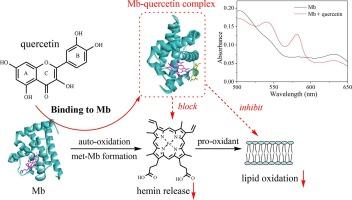
Myoglobin (Mb) is an efficient inducer for lipid oxidation in muscle foods and protein–polyphenol binding is a well-known phenomenon. The effects of the interaction between quercetin (one of the most common flavonoids in natural plants and human diet) and Mb on lipid oxidation were scarcely elucidated. In this study, the interactions between quercetin and Mb were systematically investigated by multi-spectroscopic techniques (fluorescence, UV–vis absorption, circular dichroism (CD) spectra) and molecular docking, to demonstrate the structural mechanisms whereby bioactive quercetin influenced Mb redox state and stability. Quercetin bound into Mb central pocket to generate Mb-quercetin complex with one binding site, and binding process was spontaneous where hydrophobic interaction played a major role. Heme stability and free hemin (but not inorganic iron) liberated from Mb was vital to Mb oxidation and Mb-mediated lipid oxidation, and quercetin significantly inhibited Mb-mediated lipid oxidation in liposomes or muscles. The inhibitory mechanisms of quercetin were possibly attributable to that the binding of quercetin promoted the compactness of Mb and narrowed the crevice surrounding heme group, which resulted in the reduction of met-Mb to oxy-Mb state and suppression of free hemin loss. In agreement with its weaker properties to bind Mb and scavenge free radicals, rutin (a natural quercetin derivative) did not affect the redox state and stability of Mb, and then, it lesser attenuated Mb-induced lipid oxidation than quercetin. Collectively, our results about the interaction of quercetin with Mb suggest a new mechanism for the antioxidant capability of natural flavonoids and are beneficial to the nutritional application of quercetin in the freshness and good quality of hemeprotein-containing foods.
期刊介绍:
Spectrochimica Acta, Part A: Molecular and Biomolecular Spectroscopy (SAA) is an interdisciplinary journal which spans from basic to applied aspects of optical spectroscopy in chemistry, medicine, biology, and materials science.
The journal publishes original scientific papers that feature high-quality spectroscopic data and analysis. From the broad range of optical spectroscopies, the emphasis is on electronic, vibrational or rotational spectra of molecules, rather than on spectroscopy based on magnetic moments.
Criteria for publication in SAA are novelty, uniqueness, and outstanding quality. Routine applications of spectroscopic techniques and computational methods are not appropriate.
Topics of particular interest of Spectrochimica Acta Part A include, but are not limited to:
Spectroscopy and dynamics of bioanalytical, biomedical, environmental, and atmospheric sciences,
Novel experimental techniques or instrumentation for molecular spectroscopy,
Novel theoretical and computational methods,
Novel applications in photochemistry and photobiology,
Novel interpretational approaches as well as advances in data analysis based on electronic or vibrational spectroscopy.



 京公网安备 11010802042870号
京ICP备2023020795号-1
京公网安备 11010802042870号
京ICP备2023020795号-1

 分享
分享
 求助内容:
求助内容: 应助结果提醒方式:
 扫码关注我们
