Wenli Feng , Lu Zhao , Chenxia Hao , Lin Yuan , Lizhen Liu , Xiaoming Yang , Yunfeng Bai , Feng Feng
{"title":"Ultra-stable room temperature phosphorescence CDs-based composite materials for anti-counterfeiting application","authors":"Wenli Feng , Lu Zhao , Chenxia Hao , Lin Yuan , Lizhen Liu , Xiaoming Yang , Yunfeng Bai , Feng Feng","doi":"10.1016/j.saa.2025.126106","DOIUrl":null,"url":null,"abstract":"<div><div>Counterfeit and shoddy products exist widely in our daily life. Effective anti-counterfeiting means have become an issue with increasing concern. Herein, we proposed a new strategy for dispersing N, S-CDs into melamine phosphate (MP) to prepare N, S-CDs@MP composite. The co-doping of carbon dots with heteroatoms (N and S atoms) in conjunction with matrix protection synergistically enhanced the emission of long-lived room temperature phosphorescence (RTP). The obtained N, S-CDs@MP composite exhibited green RTP with phosphorescence quantum yield of 9.27 % and lifetime of 489 ms. More importantly, even in extreme conditions, the RTP of N, S-CDs@MP in the dispersion still persisted. The excellent RTP properties and good stability made N, S-CDs@MP a promising material for advanced anti-counterfeiting applications. This study afforded a new RTP material which could be easily prepared and used for information encryption and graphic anti-counterfeiting.</div></div>","PeriodicalId":433,"journal":{"name":"Spectrochimica Acta Part A: Molecular and Biomolecular Spectroscopy","volume":"337 ","pages":"Article 126106"},"PeriodicalIF":4.6000,"publicationDate":"2025-03-22","publicationTypes":"Journal Article","fieldsOfStudy":null,"isOpenAccess":false,"openAccessPdf":"","citationCount":"0","resultStr":null,"platform":"Semanticscholar","paperid":null,"PeriodicalName":"Spectrochimica Acta Part A: Molecular and Biomolecular Spectroscopy","FirstCategoryId":"92","ListUrlMain":"https://www.sciencedirect.com/science/article/pii/S1386142525004123","RegionNum":2,"RegionCategory":"化学","ArticlePicture":[],"TitleCN":null,"AbstractTextCN":null,"PMCID":null,"EPubDate":"","PubModel":"","JCR":"Q1","JCRName":"SPECTROSCOPY","Score":null,"Total":0}
引用次数: 0
Abstract
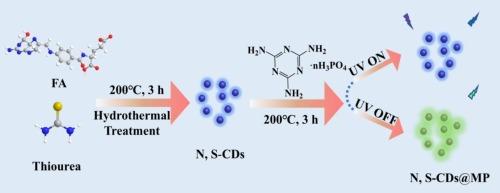
Counterfeit and shoddy products exist widely in our daily life. Effective anti-counterfeiting means have become an issue with increasing concern. Herein, we proposed a new strategy for dispersing N, S-CDs into melamine phosphate (MP) to prepare N, S-CDs@MP composite. The co-doping of carbon dots with heteroatoms (N and S atoms) in conjunction with matrix protection synergistically enhanced the emission of long-lived room temperature phosphorescence (RTP). The obtained N, S-CDs@MP composite exhibited green RTP with phosphorescence quantum yield of 9.27 % and lifetime of 489 ms. More importantly, even in extreme conditions, the RTP of N, S-CDs@MP in the dispersion still persisted. The excellent RTP properties and good stability made N, S-CDs@MP a promising material for advanced anti-counterfeiting applications. This study afforded a new RTP material which could be easily prepared and used for information encryption and graphic anti-counterfeiting.
期刊介绍:
Spectrochimica Acta, Part A: Molecular and Biomolecular Spectroscopy (SAA) is an interdisciplinary journal which spans from basic to applied aspects of optical spectroscopy in chemistry, medicine, biology, and materials science.
The journal publishes original scientific papers that feature high-quality spectroscopic data and analysis. From the broad range of optical spectroscopies, the emphasis is on electronic, vibrational or rotational spectra of molecules, rather than on spectroscopy based on magnetic moments.
Criteria for publication in SAA are novelty, uniqueness, and outstanding quality. Routine applications of spectroscopic techniques and computational methods are not appropriate.
Topics of particular interest of Spectrochimica Acta Part A include, but are not limited to:
Spectroscopy and dynamics of bioanalytical, biomedical, environmental, and atmospheric sciences,
Novel experimental techniques or instrumentation for molecular spectroscopy,
Novel theoretical and computational methods,
Novel applications in photochemistry and photobiology,
Novel interpretational approaches as well as advances in data analysis based on electronic or vibrational spectroscopy.



 京公网安备 11010802042870号
京ICP备2023020795号-1
京公网安备 11010802042870号
京ICP备2023020795号-1

 分享
分享
 求助内容:
求助内容: 应助结果提醒方式:
 扫码关注我们
