{"title":"In-situ cross-linking and shear-driven coating enable defect-free tubular ZIF-8 membranes toward efficient C3H6/C3H8 separation","authors":"Luogang Wu , Jingxian Hua , Yawei Gu, Jian Sun, Qian Wang, Lixiong Zhang, Haiqian Lian, Yichang Pan","doi":"10.1016/j.memsci.2025.124010","DOIUrl":null,"url":null,"abstract":"<div><div>Eliminating potential defects is crucial for making tubular ZIF-8 (T-ZIF-8) membranes widely adopted in chemical process industries. However, the geometric restriction of the inner T-ZIF-8 membrane and the high viscosity of cross-linked PDMS solution pose challenges in uniform polymer deposition and interfacial adhesion that traditional dip-coating methods may not effectively address. Herein, we propose an in-situ cross-linking and rolling coating (ISCL&RC) strategy to overcome these challenges. During the rolling coating process, the PDMS solution gradually solidifies on the surface of the T-ZIF-8 membrane under the shear force induced by gravity, forming a PDMS coating with uniform thickness. The in-situ cross-linking allows the low-viscosity PDMS solution to adequately infiltrate the surface of the T-ZIF-8 membrane, forming a desirable interface. Compared with the pristine T-ZIF-8 membrane, the T-ZIF-8/PDMS membrane demonstrates remarkable improvement in C<sub>3</sub>H<sub>6</sub>/C<sub>3</sub>H<sub>8</sub> separation selectivity (2.6–18.5 times higher than the unmodified membrane), while the C<sub>3</sub>H<sub>6</sub> permeance remains nearly unchanged. Notably, the T-ZIF-8/PDMS membrane sustains coating integrity under high pressure and industrial raw gas for 780 h without exhibiting bubbling or delamination. This work establishes a paradigm for defect engineering in confined tubular membrane systems, effectively bridging the gap between laboratory-scale synthesis and industrial module fabrication.</div></div>","PeriodicalId":368,"journal":{"name":"Journal of Membrane Science","volume":"725 ","pages":"Article 124010"},"PeriodicalIF":9.0000,"publicationDate":"2025-05-01","publicationTypes":"Journal Article","fieldsOfStudy":null,"isOpenAccess":false,"openAccessPdf":"","citationCount":"0","resultStr":null,"platform":"Semanticscholar","paperid":null,"PeriodicalName":"Journal of Membrane Science","FirstCategoryId":"5","ListUrlMain":"https://www.sciencedirect.com/science/article/pii/S0376738825003230","RegionNum":1,"RegionCategory":"工程技术","ArticlePicture":[],"TitleCN":null,"AbstractTextCN":null,"PMCID":null,"EPubDate":"2025/3/20 0:00:00","PubModel":"Epub","JCR":"Q1","JCRName":"ENGINEERING, CHEMICAL","Score":null,"Total":0}
引用次数: 0
Abstract
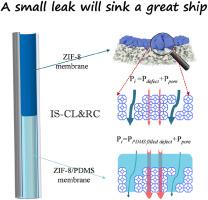
Eliminating potential defects is crucial for making tubular ZIF-8 (T-ZIF-8) membranes widely adopted in chemical process industries. However, the geometric restriction of the inner T-ZIF-8 membrane and the high viscosity of cross-linked PDMS solution pose challenges in uniform polymer deposition and interfacial adhesion that traditional dip-coating methods may not effectively address. Herein, we propose an in-situ cross-linking and rolling coating (ISCL&RC) strategy to overcome these challenges. During the rolling coating process, the PDMS solution gradually solidifies on the surface of the T-ZIF-8 membrane under the shear force induced by gravity, forming a PDMS coating with uniform thickness. The in-situ cross-linking allows the low-viscosity PDMS solution to adequately infiltrate the surface of the T-ZIF-8 membrane, forming a desirable interface. Compared with the pristine T-ZIF-8 membrane, the T-ZIF-8/PDMS membrane demonstrates remarkable improvement in C3H6/C3H8 separation selectivity (2.6–18.5 times higher than the unmodified membrane), while the C3H6 permeance remains nearly unchanged. Notably, the T-ZIF-8/PDMS membrane sustains coating integrity under high pressure and industrial raw gas for 780 h without exhibiting bubbling or delamination. This work establishes a paradigm for defect engineering in confined tubular membrane systems, effectively bridging the gap between laboratory-scale synthesis and industrial module fabrication.
期刊介绍:
The Journal of Membrane Science is a publication that focuses on membrane systems and is aimed at academic and industrial chemists, chemical engineers, materials scientists, and membranologists. It publishes original research and reviews on various aspects of membrane transport, membrane formation/structure, fouling, module/process design, and processes/applications. The journal primarily focuses on the structure, function, and performance of non-biological membranes but also includes papers that relate to biological membranes. The Journal of Membrane Science publishes Full Text Papers, State-of-the-Art Reviews, Letters to the Editor, and Perspectives.



 京公网安备 11010802042870号
京ICP备2023020795号-1
京公网安备 11010802042870号
京ICP备2023020795号-1

 分享
分享
 求助内容:
求助内容: 应助结果提醒方式:
 扫码关注我们
