{"title":"Consensus reaching model with self-confidence-based dynamic weights and personalized adjustment constraints for multi-attribute group decision making","authors":"Xiaoan Tang , Meng Sun , Qiang Zhang , Witold Pedrycz , Yinghua Shen","doi":"10.1016/j.cie.2025.111032","DOIUrl":null,"url":null,"abstract":"<div><div>It is quite a remarkable fact that experts always hope that the final decision outcome can preserve their original assessments in practical multi-attribute group decision making (MAGDM) activities to a high degree, which can be reflected from their self-confidence in their own assessments. Meanwhile, experts may have different attitude towards the assessment modification at the levels of attribute and alternative in consensus reaching process (CRP), which is commonly characterized by their personalized adjustment constraints on the acceptance of the assessment’ modification suggestions recommended by moderators. Motivated by the facts outlined above, this study proposes a consensus reaching method with self-confidence-based dynamic weights and personalized adjustment constraints for the MAGDM problem. First, a self-confidence-based dynamic weight management method is proposed to accelerate the CRP. Next, considering that experts may have different levels of sensitivities/tolerances for their assessment modifications at the various attribute and alternative levels, a dynamic weight and personalized adjustment constraint-driven consensus model is proposed with the objective of minimizing the distance between experts’ initial assessments and the adjusted collective assessment. Meanwhile, an associated maximum consensus model is implemented to examine whether a predetermined consensus threshold can be achieved with the given assessments. Then, a resolution approach with an interactive CRP that can reconcile the goals that experts should be allocated enough attention and their original assessments should be preserved as much as possible is developed. Finally, three illustrative examples and a comparative study are conducted to show the validity and advantages of the proposal. Overall, this study exhibits three facets of originality: the dynamic weight management method is developed, the personalized assessment-modification willingness is formed, and the interactive consensus reaching algorithm is created.</div></div>","PeriodicalId":55220,"journal":{"name":"Computers & Industrial Engineering","volume":"203 ","pages":"Article 111032"},"PeriodicalIF":6.5000,"publicationDate":"2025-03-13","publicationTypes":"Journal Article","fieldsOfStudy":null,"isOpenAccess":false,"openAccessPdf":"","citationCount":"0","resultStr":null,"platform":"Semanticscholar","paperid":null,"PeriodicalName":"Computers & Industrial Engineering","FirstCategoryId":"5","ListUrlMain":"https://www.sciencedirect.com/science/article/pii/S0360835225001780","RegionNum":1,"RegionCategory":"工程技术","ArticlePicture":[],"TitleCN":null,"AbstractTextCN":null,"PMCID":null,"EPubDate":"","PubModel":"","JCR":"Q1","JCRName":"COMPUTER SCIENCE, INTERDISCIPLINARY APPLICATIONS","Score":null,"Total":0}
引用次数: 0
Abstract
It is quite a remarkable fact that experts always hope that the final decision outcome can preserve their original assessments in practical multi-attribute group decision making (MAGDM) activities to a high degree, which can be reflected from their self-confidence in their own assessments. Meanwhile, experts may have different attitude towards the assessment modification at the levels of attribute and alternative in consensus reaching process (CRP), which is commonly characterized by their personalized adjustment constraints on the acceptance of the assessment’ modification suggestions recommended by moderators. Motivated by the facts outlined above, this study proposes a consensus reaching method with self-confidence-based dynamic weights and personalized adjustment constraints for the MAGDM problem. First, a self-confidence-based dynamic weight management method is proposed to accelerate the CRP. Next, considering that experts may have different levels of sensitivities/tolerances for their assessment modifications at the various attribute and alternative levels, a dynamic weight and personalized adjustment constraint-driven consensus model is proposed with the objective of minimizing the distance between experts’ initial assessments and the adjusted collective assessment. Meanwhile, an associated maximum consensus model is implemented to examine whether a predetermined consensus threshold can be achieved with the given assessments. Then, a resolution approach with an interactive CRP that can reconcile the goals that experts should be allocated enough attention and their original assessments should be preserved as much as possible is developed. Finally, three illustrative examples and a comparative study are conducted to show the validity and advantages of the proposal. Overall, this study exhibits three facets of originality: the dynamic weight management method is developed, the personalized assessment-modification willingness is formed, and the interactive consensus reaching algorithm is created.
期刊介绍:
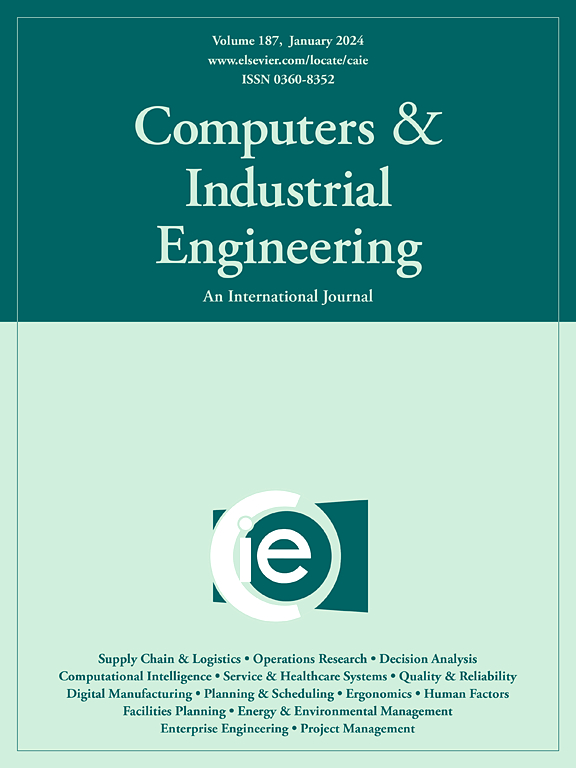
Computers & Industrial Engineering (CAIE) is dedicated to researchers, educators, and practitioners in industrial engineering and related fields. Pioneering the integration of computers in research, education, and practice, industrial engineering has evolved to make computers and electronic communication integral to its domain. CAIE publishes original contributions focusing on the development of novel computerized methodologies to address industrial engineering problems. It also highlights the applications of these methodologies to issues within the broader industrial engineering and associated communities. The journal actively encourages submissions that push the boundaries of fundamental theories and concepts in industrial engineering techniques.



 京公网安备 11010802042870号
京ICP备2023020795号-1
京公网安备 11010802042870号
京ICP备2023020795号-1

 分享
分享
 求助内容:
求助内容: 应助结果提醒方式:
 扫码关注我们
