Zhi Zhang , Anning Zhou , Zhiwei Shi , Huaiqing Zhang , Xinfu He , Yongjuan Wang , Zhuangwei Bai , Dong Xi
{"title":"Explaining relationships between chemical structure and tar-rich coal pyrolysis products yield based on Pearson correlation coefficient","authors":"Zhi Zhang , Anning Zhou , Zhiwei Shi , Huaiqing Zhang , Xinfu He , Yongjuan Wang , Zhuangwei Bai , Dong Xi","doi":"10.1016/j.fuel.2025.135029","DOIUrl":null,"url":null,"abstract":"<div><div>Elucidating the relationship between the structure of tar-rich coal and its pyrolysis products, as well as developing an accurate predictive model for these products, can effectively establish a correspondence between tar-rich coal and high-value utilization pathways. Therefore, this study systematically investigates the structural characteristics of tar-rich coals through proximate analysis, ultimate analysis, and <sup>13</sup>C NMR, and establishes the correlation between coal structure and pyrolysis products using Pearson correlation analysis. Subsequently, ridge regression is applied to construct a predictive model for pyrolysis products using the structural characteristics of tar-rich coals. The results indicate that there is a significant correlation between the pyrolysis yield, product distribution, and the functional groups of tar-rich coal structure. Specifically, tar yield is highly correlated with <em>V</em><sub>daf</sub>, terminal methyl groups, methyl groups on rings, and oxygen-attached aromatic carbon. The formation of tar components, including light oil, phenolic oil, and naphthalene oil, is influenced by aliphatic carbon, methylene, aromatic methyl, and methoxy. Additionally, the correlations between <em>M</em><sub>ad</sub>, <em>O/C</em> ratio, methyl group on rings (Ar-CH<sub>3</sub>), and fixed carbon (<em>FC</em><sub>d</sub>) are closely related to the yields of pyrolysis gas and semi-coke. Based on these correlations, a pyrolysis yield prediction model was constructed, with the R<sup>2</sup> value exceeding 0.87 and the prediction accuracy greater than 88.06%. This study provides valuable theoretical insights into the directional transformation of oils and gases during pyrolysis.</div></div>","PeriodicalId":325,"journal":{"name":"Fuel","volume":"395 ","pages":"Article 135029"},"PeriodicalIF":7.5000,"publicationDate":"2025-09-01","publicationTypes":"Journal Article","fieldsOfStudy":null,"isOpenAccess":false,"openAccessPdf":"","citationCount":"0","resultStr":null,"platform":"Semanticscholar","paperid":null,"PeriodicalName":"Fuel","FirstCategoryId":"5","ListUrlMain":"https://www.sciencedirect.com/science/article/pii/S0016236125007549","RegionNum":1,"RegionCategory":"工程技术","ArticlePicture":[],"TitleCN":null,"AbstractTextCN":null,"PMCID":null,"EPubDate":"2025/3/26 0:00:00","PubModel":"Epub","JCR":"Q2","JCRName":"ENERGY & FUELS","Score":null,"Total":0}
引用次数: 0
Abstract
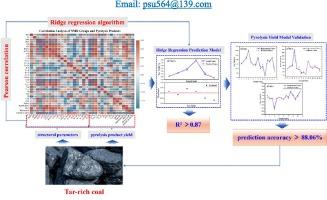
Elucidating the relationship between the structure of tar-rich coal and its pyrolysis products, as well as developing an accurate predictive model for these products, can effectively establish a correspondence between tar-rich coal and high-value utilization pathways. Therefore, this study systematically investigates the structural characteristics of tar-rich coals through proximate analysis, ultimate analysis, and 13C NMR, and establishes the correlation between coal structure and pyrolysis products using Pearson correlation analysis. Subsequently, ridge regression is applied to construct a predictive model for pyrolysis products using the structural characteristics of tar-rich coals. The results indicate that there is a significant correlation between the pyrolysis yield, product distribution, and the functional groups of tar-rich coal structure. Specifically, tar yield is highly correlated with Vdaf, terminal methyl groups, methyl groups on rings, and oxygen-attached aromatic carbon. The formation of tar components, including light oil, phenolic oil, and naphthalene oil, is influenced by aliphatic carbon, methylene, aromatic methyl, and methoxy. Additionally, the correlations between Mad, O/C ratio, methyl group on rings (Ar-CH3), and fixed carbon (FCd) are closely related to the yields of pyrolysis gas and semi-coke. Based on these correlations, a pyrolysis yield prediction model was constructed, with the R2 value exceeding 0.87 and the prediction accuracy greater than 88.06%. This study provides valuable theoretical insights into the directional transformation of oils and gases during pyrolysis.
期刊介绍:
The exploration of energy sources remains a critical matter of study. For the past nine decades, fuel has consistently held the forefront in primary research efforts within the field of energy science. This area of investigation encompasses a wide range of subjects, with a particular emphasis on emerging concerns like environmental factors and pollution.



 京公网安备 11010802042870号
京ICP备2023020795号-1
京公网安备 11010802042870号
京ICP备2023020795号-1

 分享
分享
 求助内容:
求助内容: 应助结果提醒方式:
 扫码关注我们
