S. Hoerl , C. Micheletti , S. Amini , E. Griesshaber , K.-U. Hess , A.G. Checa , M. Peharda , W.W. Schmahl
{"title":"Correlation between nanomechanical properties and microstructural design concepts of bivalve muscle attachment sites","authors":"S. Hoerl , C. Micheletti , S. Amini , E. Griesshaber , K.-U. Hess , A.G. Checa , M. Peharda , W.W. Schmahl","doi":"10.1016/j.matdes.2025.113845","DOIUrl":null,"url":null,"abstract":"<div><div>Bivalves populate various marine environments and follow diverse lifestyles: attaching to substrates, burrowing into sediments or swimming in water. Their shells play a crucial role in the survival of organisms as they shield the soft tissue from external attacks and facilitate their respective lifestyles. Valve movement is controlled by one or two adductor muscles and the hinge. While the function and structure of adductor muscles can vary, the shell-muscle attachment develops the myostracum, a unique microstructural design. Sectioned parallel and perpendicular to the inner shell surface, we investigated myostracal and non-myostracal microstructures, textures and nanomechanical properties for three bivalve species: The burrowing <em>Glycymeris pilosa</em>, the sessile <em>Chama arcana</em> and the swimming <em>Placopecten magellanicus</em>.</div><div>Analyses were conducted using electron backscatter diffraction measurements, laser confocal and backscatter electron imaging, nanoindentation testing and thermogravimetric analysis. We find that the myostracal microstructure is generated mainly through physical determinants, regardless of the bivalve lifestyle and adductor muscle structure. If aragonitic, we show that adjacent shell layers are used as templates for the formation of the myostracal microstructure and highlight how bivalves use the adjacent crystal arrangement to predetermine myostracal microstructure up to inner shell surfaces. Furthermore, this study demonstrates how myostracal layers exceed the hardness of the non-myostracal valves and that of geological aragonite, irrespective of grain size and morphology. Due to the anisotropy of aragonite, we show that aragonite c-axis orientation notably affects the hardness of crystals. The highest hardness is measured when indentation is normal to the shell surface in aragonite c-axes direction.</div></div>","PeriodicalId":383,"journal":{"name":"Materials & Design","volume":"253 ","pages":"Article 113845"},"PeriodicalIF":7.9000,"publicationDate":"2025-05-01","publicationTypes":"Journal Article","fieldsOfStudy":null,"isOpenAccess":false,"openAccessPdf":"","citationCount":"0","resultStr":null,"platform":"Semanticscholar","paperid":null,"PeriodicalName":"Materials & Design","FirstCategoryId":"88","ListUrlMain":"https://www.sciencedirect.com/science/article/pii/S0264127525002655","RegionNum":2,"RegionCategory":"材料科学","ArticlePicture":[],"TitleCN":null,"AbstractTextCN":null,"PMCID":null,"EPubDate":"2025/3/21 0:00:00","PubModel":"Epub","JCR":"Q1","JCRName":"MATERIALS SCIENCE, MULTIDISCIPLINARY","Score":null,"Total":0}
引用次数: 0
Abstract
Bivalves populate various marine environments and follow diverse lifestyles: attaching to substrates, burrowing into sediments or swimming in water. Their shells play a crucial role in the survival of organisms as they shield the soft tissue from external attacks and facilitate their respective lifestyles. Valve movement is controlled by one or two adductor muscles and the hinge. While the function and structure of adductor muscles can vary, the shell-muscle attachment develops the myostracum, a unique microstructural design. Sectioned parallel and perpendicular to the inner shell surface, we investigated myostracal and non-myostracal microstructures, textures and nanomechanical properties for three bivalve species: The burrowing Glycymeris pilosa, the sessile Chama arcana and the swimming Placopecten magellanicus.
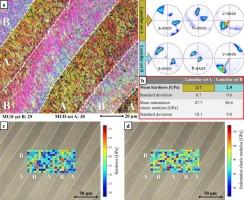
Analyses were conducted using electron backscatter diffraction measurements, laser confocal and backscatter electron imaging, nanoindentation testing and thermogravimetric analysis. We find that the myostracal microstructure is generated mainly through physical determinants, regardless of the bivalve lifestyle and adductor muscle structure. If aragonitic, we show that adjacent shell layers are used as templates for the formation of the myostracal microstructure and highlight how bivalves use the adjacent crystal arrangement to predetermine myostracal microstructure up to inner shell surfaces. Furthermore, this study demonstrates how myostracal layers exceed the hardness of the non-myostracal valves and that of geological aragonite, irrespective of grain size and morphology. Due to the anisotropy of aragonite, we show that aragonite c-axis orientation notably affects the hardness of crystals. The highest hardness is measured when indentation is normal to the shell surface in aragonite c-axes direction.
期刊介绍:
Materials and Design is a multi-disciplinary journal that publishes original research reports, review articles, and express communications. The journal focuses on studying the structure and properties of inorganic and organic materials, advancements in synthesis, processing, characterization, and testing, the design of materials and engineering systems, and their applications in technology. It aims to bring together various aspects of materials science, engineering, physics, and chemistry.
The journal explores themes ranging from materials to design and aims to reveal the connections between natural and artificial materials, as well as experiment and modeling. Manuscripts submitted to Materials and Design should contain elements of discovery and surprise, as they often contribute new insights into the architecture and function of matter.



 京公网安备 11010802042870号
京ICP备2023020795号-1
京公网安备 11010802042870号
京ICP备2023020795号-1

 分享
分享
 求助内容:
求助内容: 应助结果提醒方式:
 扫码关注我们
