{"title":"Quantification and evaluation of strain reduction from small-bubble gas injection in Spallation Neutron Source target vessels","authors":"Hao Jiang, Drew E. Winder, David A. McClintock","doi":"10.1016/j.matdes.2025.113797","DOIUrl":null,"url":null,"abstract":"<div><div>Small-bubble gas injection has been routinely utilized in the operation of Spallation Neutron Source (SNS) mercury targets since 2017 to mitigate cavitation-induced erosion damage to target vessels. Strain measurements of target vessels collected in-situ during initial operation with gas injection were used to study the gas injection effect on the structural response of targets to proton pulses. A significant strain reduction owing to gas injection was found by comparing the strain measurement data during operation with and without gas injection. The research presented here focuses on quantifying strain reductions in SNS targets and evaluating the effect of small-bubble gas injection by comparing different bubbler types and target designs. The strain measurement results show the gas injection significantly reduced strain in SNS target vessels; strain values decreased by 30% to 80% for targets operating with gas injection. Stress and strain responses of SNS targets were simulated to numerically evaluate the gas injection effect. Based on the predicted stresses with and without gas injection, the fatigue lifetimes of SNS jet-flow design target were estimated using fe-safe fatigue analysis software. The simulations show these reductions should improve the fatigue life of target vessels and allow SNS targets to meet their fatigue design goal.</div></div>","PeriodicalId":383,"journal":{"name":"Materials & Design","volume":"253 ","pages":"Article 113797"},"PeriodicalIF":7.9000,"publicationDate":"2025-05-01","publicationTypes":"Journal Article","fieldsOfStudy":null,"isOpenAccess":false,"openAccessPdf":"","citationCount":"0","resultStr":null,"platform":"Semanticscholar","paperid":null,"PeriodicalName":"Materials & Design","FirstCategoryId":"88","ListUrlMain":"https://www.sciencedirect.com/science/article/pii/S0264127525002175","RegionNum":2,"RegionCategory":"材料科学","ArticlePicture":[],"TitleCN":null,"AbstractTextCN":null,"PMCID":null,"EPubDate":"2025/3/11 0:00:00","PubModel":"Epub","JCR":"Q1","JCRName":"MATERIALS SCIENCE, MULTIDISCIPLINARY","Score":null,"Total":0}
引用次数: 0
Abstract
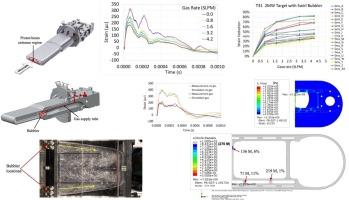
Small-bubble gas injection has been routinely utilized in the operation of Spallation Neutron Source (SNS) mercury targets since 2017 to mitigate cavitation-induced erosion damage to target vessels. Strain measurements of target vessels collected in-situ during initial operation with gas injection were used to study the gas injection effect on the structural response of targets to proton pulses. A significant strain reduction owing to gas injection was found by comparing the strain measurement data during operation with and without gas injection. The research presented here focuses on quantifying strain reductions in SNS targets and evaluating the effect of small-bubble gas injection by comparing different bubbler types and target designs. The strain measurement results show the gas injection significantly reduced strain in SNS target vessels; strain values decreased by 30% to 80% for targets operating with gas injection. Stress and strain responses of SNS targets were simulated to numerically evaluate the gas injection effect. Based on the predicted stresses with and without gas injection, the fatigue lifetimes of SNS jet-flow design target were estimated using fe-safe fatigue analysis software. The simulations show these reductions should improve the fatigue life of target vessels and allow SNS targets to meet their fatigue design goal.
期刊介绍:
Materials and Design is a multi-disciplinary journal that publishes original research reports, review articles, and express communications. The journal focuses on studying the structure and properties of inorganic and organic materials, advancements in synthesis, processing, characterization, and testing, the design of materials and engineering systems, and their applications in technology. It aims to bring together various aspects of materials science, engineering, physics, and chemistry.
The journal explores themes ranging from materials to design and aims to reveal the connections between natural and artificial materials, as well as experiment and modeling. Manuscripts submitted to Materials and Design should contain elements of discovery and surprise, as they often contribute new insights into the architecture and function of matter.



 京公网安备 11010802042870号
京ICP备2023020795号-1
京公网安备 11010802042870号
京ICP备2023020795号-1

 分享
分享
 求助内容:
求助内容: 应助结果提醒方式:
 扫码关注我们
