{"title":"Microbubble synthesis of hybridised bacterial cellulose–gelatin separators for multifunctional supercapacitors†","authors":"Surachai Chaichana, Pawin Iamprasertkun, Montree Sawangphruk, Noelia Rubio and Pichamon Sirisinudomkit","doi":"10.1039/D4SE01684J","DOIUrl":null,"url":null,"abstract":"<p >Separators are known to be a mandatory component due to their crucial function in preventing short circuits between positive and negative electrodes, ensuring the safety and cycle life of energy storage devices. However, in practice, separators are a crucial component that affects cell electrochemical performance, especially rate capability and power density, which have been addressed in only a few research studies. To further investigate this topic, this study introduces durable and eco-friendly separators synthesised by hybridising bacterial cellulose (BC) and gelatin through a facile, cost-effective, desirable and environmentally friendly microbubble process. The as-fabricated symmetric supercapacitor with an as-synthesised separator, prepared under optimal conditions of 2 g per mL BC with 1.5 wt% gelatin and a microbubble rate of 200 CC per min (designated as 2BC1.5GT_R200), reduces cell resistance and optimises ion transport within the cell compared to as-fabricated symmetric supercapacitors using BC, hybridised BC–gelatin under other conditions, conventional cellulose and commercial separators. Additionally, symmetric devices with 2BC1.5GT_R200 separators achieve excellent capacitance retention across a wide range of electrolyte environments, including acidic (1 M H<small><sub>2</sub></small>SO<small><sub>4</sub></small>), basic (1 M KOH), and neutral (1 M NaNO<small><sub>3</sub></small>) solutions, retaining over 91%, 87%, and 82% of their initial capacitance after 10 000 cycles, respectively. These data demonstrate that the microbubble synthesis process combined with gelatin hybridisation can maximise electrochemical performance, maintain high cell efficiency, and enable operation in diverse electrolytes, presenting a promising route for developing innovative separators for energy storage applications.</p>","PeriodicalId":104,"journal":{"name":"Sustainable Energy & Fuels","volume":" 7","pages":" 1745-1754"},"PeriodicalIF":4.1000,"publicationDate":"2025-02-14","publicationTypes":"Journal Article","fieldsOfStudy":null,"isOpenAccess":false,"openAccessPdf":"","citationCount":"0","resultStr":null,"platform":"Semanticscholar","paperid":null,"PeriodicalName":"Sustainable Energy & Fuels","FirstCategoryId":"88","ListUrlMain":"https://pubs.rsc.org/en/content/articlelanding/2025/se/d4se01684j","RegionNum":3,"RegionCategory":"材料科学","ArticlePicture":[],"TitleCN":null,"AbstractTextCN":null,"PMCID":null,"EPubDate":"","PubModel":"","JCR":"Q2","JCRName":"CHEMISTRY, PHYSICAL","Score":null,"Total":0}
引用次数: 0
Abstract
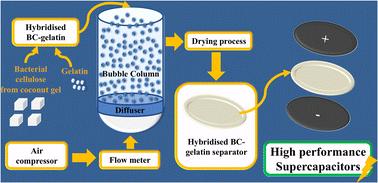
Separators are known to be a mandatory component due to their crucial function in preventing short circuits between positive and negative electrodes, ensuring the safety and cycle life of energy storage devices. However, in practice, separators are a crucial component that affects cell electrochemical performance, especially rate capability and power density, which have been addressed in only a few research studies. To further investigate this topic, this study introduces durable and eco-friendly separators synthesised by hybridising bacterial cellulose (BC) and gelatin through a facile, cost-effective, desirable and environmentally friendly microbubble process. The as-fabricated symmetric supercapacitor with an as-synthesised separator, prepared under optimal conditions of 2 g per mL BC with 1.5 wt% gelatin and a microbubble rate of 200 CC per min (designated as 2BC1.5GT_R200), reduces cell resistance and optimises ion transport within the cell compared to as-fabricated symmetric supercapacitors using BC, hybridised BC–gelatin under other conditions, conventional cellulose and commercial separators. Additionally, symmetric devices with 2BC1.5GT_R200 separators achieve excellent capacitance retention across a wide range of electrolyte environments, including acidic (1 M H2SO4), basic (1 M KOH), and neutral (1 M NaNO3) solutions, retaining over 91%, 87%, and 82% of their initial capacitance after 10 000 cycles, respectively. These data demonstrate that the microbubble synthesis process combined with gelatin hybridisation can maximise electrochemical performance, maintain high cell efficiency, and enable operation in diverse electrolytes, presenting a promising route for developing innovative separators for energy storage applications.
由于隔膜在防止正负极之间短路,确保储能装置的安全性和循环寿命方面具有重要作用,因此被认为是必不可少的部件。然而,在实践中,分离器是影响电池电化学性能的关键部件,特别是速率能力和功率密度,只有少数研究解决了这些问题。为了进一步研究这一主题,本研究通过简单、经济、理想和环保的微泡工艺,将细菌纤维素(BC)和明胶混合合成耐用且环保的分离器。与使用BC、在其他条件下混合BC -明胶、常规纤维素和商用分离器的对称超级电容器相比,在最佳条件下制备的对称超级电容器与合成分离器在最佳条件下制备2 g / mL BC和1.5 wt%明胶和200 CC / min的微泡速率(指定为2BC1.5GT_R200),降低了细胞阻力并优化了细胞内的离子运输。此外,具有2BC1.5GT_R200隔膜的对称器件在广泛的电解质环境中实现了出色的电容保持,包括酸性(1 M H2SO4),碱性(1 M KOH)和中性(1 M NaNO3)溶液,在10,000次循环后分别保持超过91%,87%和82%的初始电容。这些数据表明,微泡合成过程结合明胶杂交可以最大限度地提高电化学性能,保持高电池效率,并能够在多种电解质中运行,为开发用于储能应用的创新分离器提供了一条有前途的途径。
期刊介绍:
Sustainable Energy & Fuels will publish research that contributes to the development of sustainable energy technologies with a particular emphasis on new and next-generation technologies.



 京公网安备 11010802042870号
京ICP备2023020795号-1
京公网安备 11010802042870号
京ICP备2023020795号-1

 分享
分享
 求助内容:
求助内容: 应助结果提醒方式:
 扫码关注我们
