Kang Fu, Kai Sun, Xueyan Li, Haosong Yang, Xingmin He, Shoubao Zhai, Lili Gong and Peng Tan
{"title":"Design of thick electrodes for high-performance lithium-ion batteries: a comprehensive perspective under coupled kinetics and thermodynamics","authors":"Kang Fu, Kai Sun, Xueyan Li, Haosong Yang, Xingmin He, Shoubao Zhai, Lili Gong and Peng Tan","doi":"10.1039/D4SE01825G","DOIUrl":null,"url":null,"abstract":"<p >Further enhancement of the energy density of lithium-ion batteries is a goal pursued in state-of-the-art batteries, and the use of thick electrodes is an effective and direct means. However, thick electrodes often suffer from severe electrochemical performance degradation, which severely hinders their practical application. We comprehensively review the latest progress in the field of thick electrodes to overcome the bottleneck of thick electrode development. First, we systematically analyzed the factors that cause the capacity failure of thick electrodes. The reaction heterogeneity caused by slow kinetics accelerates the deterioration of mechanical stability and interface. Next, we introduce mainstream strategies to enhance the performance of thick electrodes, including multi-scale structural designs from the particle to the electrode level aimed at improving the kinetic performance. However, these studies mainly focus on improving kinetic performance. By analyzing the real electrode reaction processes, we emphasize the critical role of thermodynamics in electrode reactions, suggesting that optimizing the thermodynamic properties can also enhance the performance of thick electrodes. Finally, we propose a development path for thick electrodes under the coupled design of kinetics and thermodynamics. This work offers a more comprehensive perspective to guide electrode design efforts.</p>","PeriodicalId":104,"journal":{"name":"Sustainable Energy & Fuels","volume":" 7","pages":" 1656-1671"},"PeriodicalIF":4.1000,"publicationDate":"2025-02-17","publicationTypes":"Journal Article","fieldsOfStudy":null,"isOpenAccess":false,"openAccessPdf":"","citationCount":"0","resultStr":null,"platform":"Semanticscholar","paperid":null,"PeriodicalName":"Sustainable Energy & Fuels","FirstCategoryId":"88","ListUrlMain":"https://pubs.rsc.org/en/content/articlelanding/2025/se/d4se01825g","RegionNum":3,"RegionCategory":"材料科学","ArticlePicture":[],"TitleCN":null,"AbstractTextCN":null,"PMCID":null,"EPubDate":"","PubModel":"","JCR":"Q2","JCRName":"CHEMISTRY, PHYSICAL","Score":null,"Total":0}
引用次数: 0
Abstract
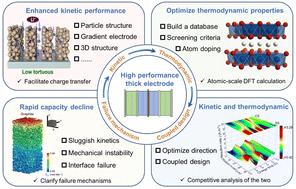
Further enhancement of the energy density of lithium-ion batteries is a goal pursued in state-of-the-art batteries, and the use of thick electrodes is an effective and direct means. However, thick electrodes often suffer from severe electrochemical performance degradation, which severely hinders their practical application. We comprehensively review the latest progress in the field of thick electrodes to overcome the bottleneck of thick electrode development. First, we systematically analyzed the factors that cause the capacity failure of thick electrodes. The reaction heterogeneity caused by slow kinetics accelerates the deterioration of mechanical stability and interface. Next, we introduce mainstream strategies to enhance the performance of thick electrodes, including multi-scale structural designs from the particle to the electrode level aimed at improving the kinetic performance. However, these studies mainly focus on improving kinetic performance. By analyzing the real electrode reaction processes, we emphasize the critical role of thermodynamics in electrode reactions, suggesting that optimizing the thermodynamic properties can also enhance the performance of thick electrodes. Finally, we propose a development path for thick electrodes under the coupled design of kinetics and thermodynamics. This work offers a more comprehensive perspective to guide electrode design efforts.
期刊介绍:
Sustainable Energy & Fuels will publish research that contributes to the development of sustainable energy technologies with a particular emphasis on new and next-generation technologies.




 京公网安备 11010802042870号
京ICP备2023020795号-1
京公网安备 11010802042870号
京ICP备2023020795号-1

 分享
分享
 求助内容:
求助内容: 应助结果提醒方式:
 扫码关注我们
