{"title":"Balancing Risk and Resilience: Which Plant Traits Should Inform Managed Relocation Species Selection?","authors":"Thomas W. M. Nuhfer, Bethany A. Bradley","doi":"10.1111/gcb.70145","DOIUrl":null,"url":null,"abstract":"<div>\n \n <p>Managed relocation is a critical tool for promoting ecological resilience in the face of climate change, and the approach has been proposed for the ecological restoration of plant communities. Given that the relocation of species poses some risk to the recipient ecosystem, plant traits associated with invasiveness have been proposed as a means for assessing risk and selecting candidate species for managed relocation. However, traits associated with invasiveness could also be relevant to successful restoration (and, in turn, for successful managed relocation)—particularly those linked to the establishment of viable populations. Here, we review studies in invasion and restoration ecology that have paired plant functional, ecological, and biogeographic traits with stages of invasion or successful restoration to ask which traits should be used to inform managed relocation species selection. We find substantial overlap between invasiveness traits and restoration traits during population establishment, but divergence during spread and impacts, suggesting that managed relocation species selection should only focus on traits that promote long-distance spread and impact. Instead, the few existing protocols for managed relocation species selection utilize traits that promote establishment. Given that the risk of unintended harm from managed relocation is orders of magnitude smaller than from non-native plant introduction, focusing on traits that promote establishment in risk assessments is likely to exclude those species most able to establish viable populations, causing failure rates in managed relocation. Instead, we recommend that risk assessments for managed relocation candidates focus on traits linked to invasive species spread or impacts and which are not necessary for restoration. Given the substantial ecological threats posed by climate change, a balanced approach to risk assessment that does not severely limit candidate species will best support successful managed relocation as a climate adaptation strategy.</p>\n </div>","PeriodicalId":175,"journal":{"name":"Global Change Biology","volume":"31 3","pages":""},"PeriodicalIF":12.0000,"publicationDate":"2025-03-26","publicationTypes":"Journal Article","fieldsOfStudy":null,"isOpenAccess":false,"openAccessPdf":"","citationCount":"0","resultStr":null,"platform":"Semanticscholar","paperid":null,"PeriodicalName":"Global Change Biology","FirstCategoryId":"93","ListUrlMain":"https://onlinelibrary.wiley.com/doi/10.1111/gcb.70145","RegionNum":1,"RegionCategory":"环境科学与生态学","ArticlePicture":[],"TitleCN":null,"AbstractTextCN":null,"PMCID":null,"EPubDate":"","PubModel":"","JCR":"Q1","JCRName":"BIODIVERSITY CONSERVATION","Score":null,"Total":0}
引用次数: 0
Abstract
Managed relocation is a critical tool for promoting ecological resilience in the face of climate change, and the approach has been proposed for the ecological restoration of plant communities. Given that the relocation of species poses some risk to the recipient ecosystem, plant traits associated with invasiveness have been proposed as a means for assessing risk and selecting candidate species for managed relocation. However, traits associated with invasiveness could also be relevant to successful restoration (and, in turn, for successful managed relocation)—particularly those linked to the establishment of viable populations. Here, we review studies in invasion and restoration ecology that have paired plant functional, ecological, and biogeographic traits with stages of invasion or successful restoration to ask which traits should be used to inform managed relocation species selection. We find substantial overlap between invasiveness traits and restoration traits during population establishment, but divergence during spread and impacts, suggesting that managed relocation species selection should only focus on traits that promote long-distance spread and impact. Instead, the few existing protocols for managed relocation species selection utilize traits that promote establishment. Given that the risk of unintended harm from managed relocation is orders of magnitude smaller than from non-native plant introduction, focusing on traits that promote establishment in risk assessments is likely to exclude those species most able to establish viable populations, causing failure rates in managed relocation. Instead, we recommend that risk assessments for managed relocation candidates focus on traits linked to invasive species spread or impacts and which are not necessary for restoration. Given the substantial ecological threats posed by climate change, a balanced approach to risk assessment that does not severely limit candidate species will best support successful managed relocation as a climate adaptation strategy.
期刊介绍:
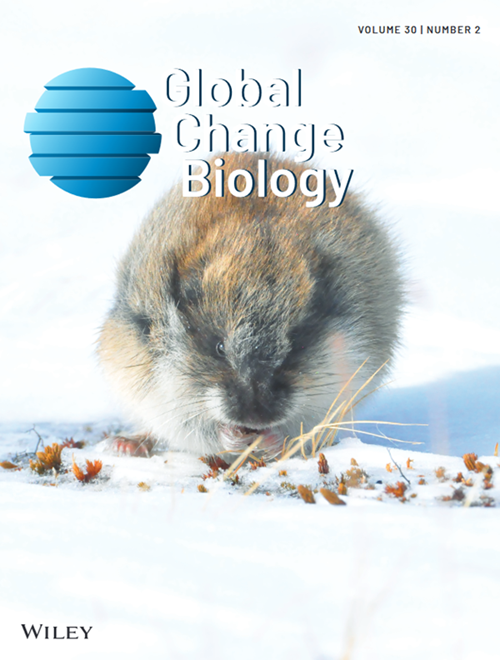
Global Change Biology is an environmental change journal committed to shaping the future and addressing the world's most pressing challenges, including sustainability, climate change, environmental protection, food and water safety, and global health.
Dedicated to fostering a profound understanding of the impacts of global change on biological systems and offering innovative solutions, the journal publishes a diverse range of content, including primary research articles, technical advances, research reviews, reports, opinions, perspectives, commentaries, and letters. Starting with the 2024 volume, Global Change Biology will transition to an online-only format, enhancing accessibility and contributing to the evolution of scholarly communication.




 京公网安备 11010802042870号
京ICP备2023020795号-1
京公网安备 11010802042870号
京ICP备2023020795号-1

 分享
分享
 求助内容:
求助内容: 应助结果提醒方式:
 扫码关注我们
