Mesenchymal Stem Cells and Fibroblasts Contribute to Microvascular Proliferation in Glioblastoma and are Correlated with Immunosuppression and Poor Outcome.
Candice C Poon, Shelley M Herbrich, Yulong Chen, Anwar Hossain, Gregory N Fuller, Sonali Jindal, Sreyashi Basu, Daniel Ledbetter, Marc Macaluso, Lynnette M Phillips, Joy Gumin, Zhong He, Brittany C Parker Kerrigan, Sanjay K Singh, Pratishtha Singh, Mohammed Fayyad Zaman, Derek Ng Tang, Sangeeta Goswami, Frederick F Lang, Padmanee Sharma
{"title":"Mesenchymal Stem Cells and Fibroblasts Contribute to Microvascular Proliferation in Glioblastoma and are Correlated with Immunosuppression and Poor Outcome.","authors":"Candice C Poon, Shelley M Herbrich, Yulong Chen, Anwar Hossain, Gregory N Fuller, Sonali Jindal, Sreyashi Basu, Daniel Ledbetter, Marc Macaluso, Lynnette M Phillips, Joy Gumin, Zhong He, Brittany C Parker Kerrigan, Sanjay K Singh, Pratishtha Singh, Mohammed Fayyad Zaman, Derek Ng Tang, Sangeeta Goswami, Frederick F Lang, Padmanee Sharma","doi":"10.1158/2326-6066.CIR-24-0743","DOIUrl":null,"url":null,"abstract":"<p><p>Microvascular proliferation (MVP) is a disease-defining hallmark of glioblastoma and other World Health Organization grade 4 gliomas. MVP also serves as a poor prognostic marker in various solid tumors. Despite its clinical significance, the mechanisms and biological consequences of MVP are controversial and remain unclear. In this study, we performed single-cell RNA sequencing on paired CD45-CD105+ vascular/perivascular stromal cells (PVSC) and CD45+CD105± immune cells from 16 primary glioma patient samples, both with and without MVP. This analysis revealed the presence of developmentally related mesenchymal stem cells alongside cancer-associated fibroblasts, pericytes, fibromyocytes, and smooth muscle cells within the CD45-CD105+ compartment. RNA velocity analysis identified PDGFRB as a putative driver gene guiding mesenchymal stem cells toward more mature PVSCs in the context of MVP. Signaling network analysis and digital spatial profiling uncovered interactions between PDGFRB+ PVSCs and immunosuppressive myeloid cell subsets enriched in the perivascular niche, suggesting targetable receptor-ligand interactions. Additionally, a gene signature of MVP-associated PVSCs from gliomas predicted worse prognosis in multiple other solid tumors. This study provides a transcriptomic cell atlas of PVSCs and immune cells in glioma, helping to refine the biological model of MVP which has traditionally focused on endothelial cells.</p>","PeriodicalId":9474,"journal":{"name":"Cancer immunology research","volume":" ","pages":"804-820"},"PeriodicalIF":8.2000,"publicationDate":"2025-06-04","publicationTypes":"Journal Article","fieldsOfStudy":null,"isOpenAccess":false,"openAccessPdf":"https://www.ncbi.nlm.nih.gov/pmc/articles/PMC12175251/pdf/","citationCount":"0","resultStr":null,"platform":"Semanticscholar","paperid":null,"PeriodicalName":"Cancer immunology research","FirstCategoryId":"3","ListUrlMain":"https://doi.org/10.1158/2326-6066.CIR-24-0743","RegionNum":1,"RegionCategory":"医学","ArticlePicture":[],"TitleCN":null,"AbstractTextCN":null,"PMCID":null,"EPubDate":"","PubModel":"","JCR":"Q1","JCRName":"IMMUNOLOGY","Score":null,"Total":0}
引用次数: 0
Abstract
Microvascular proliferation (MVP) is a disease-defining hallmark of glioblastoma and other World Health Organization grade 4 gliomas. MVP also serves as a poor prognostic marker in various solid tumors. Despite its clinical significance, the mechanisms and biological consequences of MVP are controversial and remain unclear. In this study, we performed single-cell RNA sequencing on paired CD45-CD105+ vascular/perivascular stromal cells (PVSC) and CD45+CD105± immune cells from 16 primary glioma patient samples, both with and without MVP. This analysis revealed the presence of developmentally related mesenchymal stem cells alongside cancer-associated fibroblasts, pericytes, fibromyocytes, and smooth muscle cells within the CD45-CD105+ compartment. RNA velocity analysis identified PDGFRB as a putative driver gene guiding mesenchymal stem cells toward more mature PVSCs in the context of MVP. Signaling network analysis and digital spatial profiling uncovered interactions between PDGFRB+ PVSCs and immunosuppressive myeloid cell subsets enriched in the perivascular niche, suggesting targetable receptor-ligand interactions. Additionally, a gene signature of MVP-associated PVSCs from gliomas predicted worse prognosis in multiple other solid tumors. This study provides a transcriptomic cell atlas of PVSCs and immune cells in glioma, helping to refine the biological model of MVP which has traditionally focused on endothelial cells.
期刊介绍:
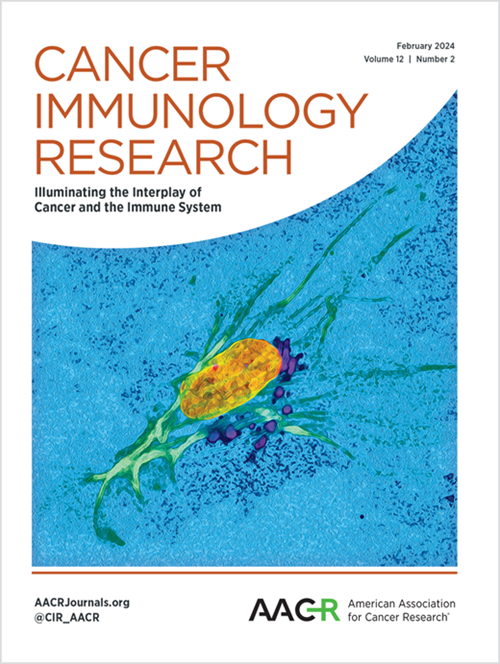
Cancer Immunology Research publishes exceptional original articles showcasing significant breakthroughs across the spectrum of cancer immunology. From fundamental inquiries into host-tumor interactions to developmental therapeutics, early translational studies, and comprehensive analyses of late-stage clinical trials, the journal provides a comprehensive view of the discipline. In addition to original research, the journal features reviews and opinion pieces of broad significance, fostering cross-disciplinary collaboration within the cancer research community. Serving as a premier resource for immunology knowledge in cancer research, the journal drives deeper insights into the host-tumor relationship, potent cancer treatments, and enhanced clinical outcomes.
Key areas of interest include endogenous antitumor immunity, tumor-promoting inflammation, cancer antigens, vaccines, antibodies, cellular therapy, cytokines, immune regulation, immune suppression, immunomodulatory effects of cancer treatment, emerging technologies, and insightful clinical investigations with immunological implications.



 京公网安备 11010802042870号
京ICP备2023020795号-1
京公网安备 11010802042870号
京ICP备2023020795号-1

 分享
分享
 求助内容:
求助内容: 应助结果提醒方式:
 扫码关注我们
